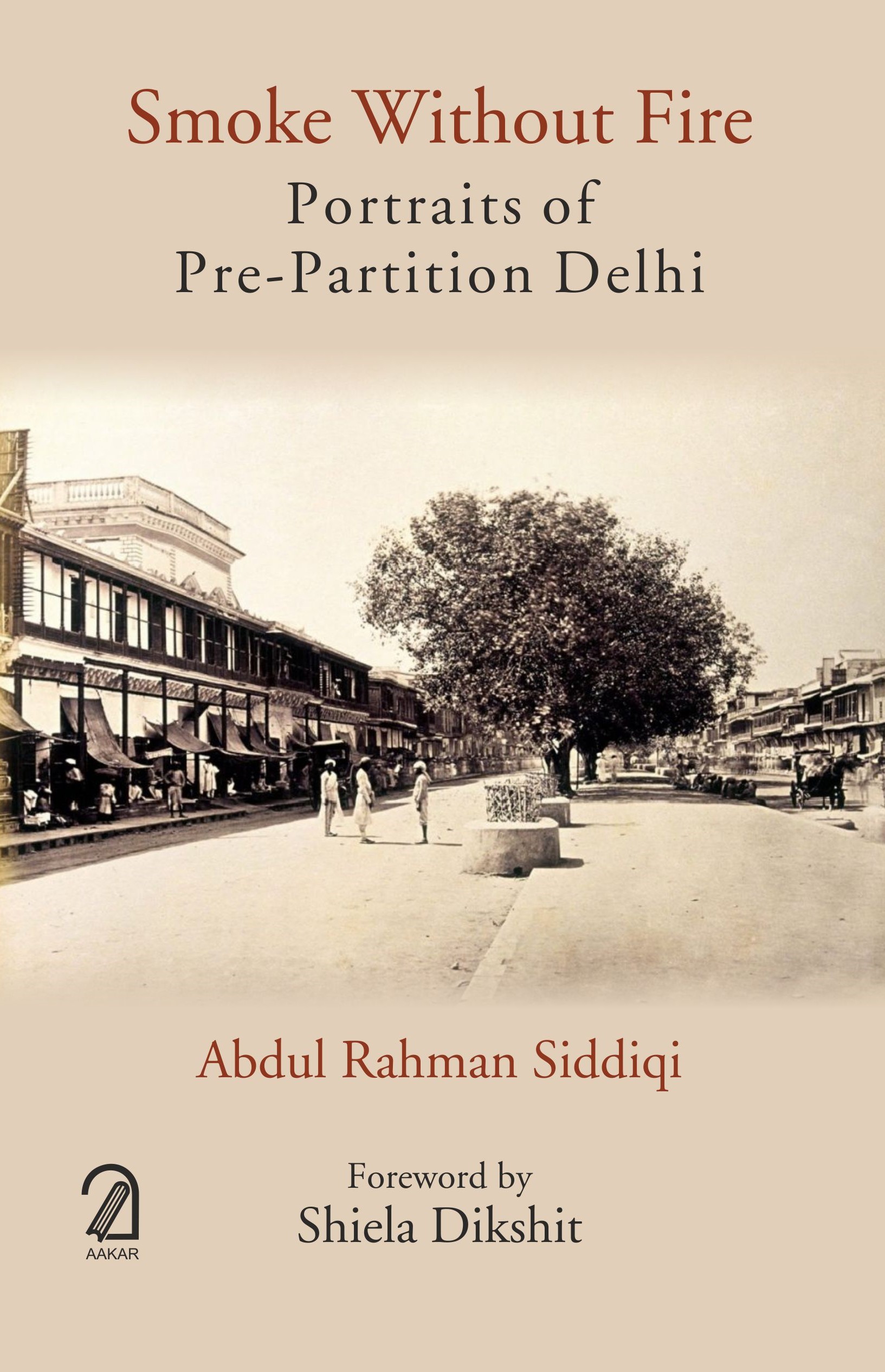
SMOKE WITHOUT FIRE: Portraits of Pre-Partition Delhi
The book could have been appropriately sub-titled as ‘Life in Pre-Partition Delhi (Dilli) Laid Bare’. It is, the first, and easily the last one of its kind by one of the vanishing breed of vintage Dilliwallas, born, bred and educated over there, before emigrating to Pakistan. Old Dilli of the author’s childhood, breathed the very air of the life and times of Ghadar — the (Revolt or the Mutiny) of 1857. Until the early 30s there was hardly any electricity, running water, pucca paved streets and public transport except for tongas and dolies for women traveling from one mohallah, one house, one street to another. The book covers the intriguing canvas of life as seen by the author as a child and a youngman. It also tells the story of an old family through its cycles of birth, marriage and death. The author, pries deep into the back alleys of the ancient city and portrays the youthful and adult delinquencies seen in their nook and crannies. Vignettes of the city’s red light districts add the raw edge of realism rarely met elsewhere. The book is the third of the author’s Partition Quartet. The other two being, Tuqseme-i- Hind Aur Bahadur Shah Zafar ki Wapsi (Partition and the Return of Bahadur Shah Zafar -Urdu) and Partition and the making of Mohajir Mindset (Oxford). The fourth and the last of the quartet Partition: An Emperor’s Nightmare is under publication. The book is refreshingly free from the kind of morbid nostalgia associated with such personal narratives. Abdul Rahman (A.R.) Siddiqi is a vintage, authentic Dilliwalla. He belongs to the generation of the City poised on the verge of extinction. Born, raised and educated in the city he was 23 (b. 06 September, 1924) at the time of Partition. Siddiqi had been through a richly-varied cycle of experiences as a journalist (Dawn, Delhi as a junior sub-editor in mid 1947) and in Pakistan as the Special Representative of the Civil-Military Gazette, Lahore, assigned to the NWFP and Rawalpindi (1947-1950). In 1950 he joined the Pakistan army and retired in 1973 as the Chief of the Inter-Services Public Relations, Directorate in the rank of Brigadier. He had been through the 1965 and 1971 wars acting as the principal military spokesman in 1971. After his retirement, he launched the Monthly Defence Journal, first of its kind ever or since in Pakistan. He owned, published and edited the Journal until 1997. He had been and remains regular columnist and news commentator for the print and electronic media. He lives in Karachi with his family, dedicated to reading, writing and movies. Review “Abdul Rahman Siddiqi belongs to the rare, and now practically invisible, Dilliwallas who were born and brought up in Delhi. He belongs to the Dilli Punjabi Saudagran community which migrated to Delhi from Panipat during the reign of Shah Jahan, to settle as a trading community. This book celebrates the people, the food and the history and culture of the city before India’s Partition. It also highlights the seamier side of the city such as its red light districts or the communal divide at the time of Partition. For this breed of Dilliwallas, Delhi was not just a city but a friend, a confidante with whom they played youthful pranks or shared their secrets. The people of this city had witnessed the worst of times during the revolt of 1857, and now, along with the rest of the country, were dreaming of Independence-an idea that would have appeared impossible to previous generations. Smoke Without Fire covers the author’s life in the city from 1924 to 1947. He takes us into parts of the city which till date remain largely hidden and unexplored. The book intertwines political turmoil in the city with the everyday life of a typical Old Delhi family. The family and the city are extensions of each other. What the city goes through, the family too must suffer. The book is also a document of how the two fight their lone battles and don’t seem to give up.” – The Book Review, Volume 36, No. 3, March 2012 “…Lo! From heart, or it comes from soul Where does this smoke like thing come from…Thus bemoaned the greatest Urdu poet of the eighteenth century, Mir Taqi Mir, the drifting of the age old tranquility of Delhi towards an upheaval which eventually culminated, much after the poet’s death, in the final collapse of the Mughal empire, and the massacre that occurred amidst the annexation of Delhi by East India Company. The fire that engulfed the city in 1857 must have taken a couple of years to extinguish, but the smoke continued to rise decades afterwards. The book under review speaks about the Delhi of the earlier decades of the 20th century, when the smoke had still not cleared. The author does not only see the smoke hovering around, he also feels it in his heart and soul…” – Pakistan Perspectives, Vol.20, No.1, January-June 2015
Specifications
- Author
- Abdul Rahman Siddiqi
- Format
- Paper Back
- Language
- English
AI Readiness
Good foundation, but some important product data is still missing.