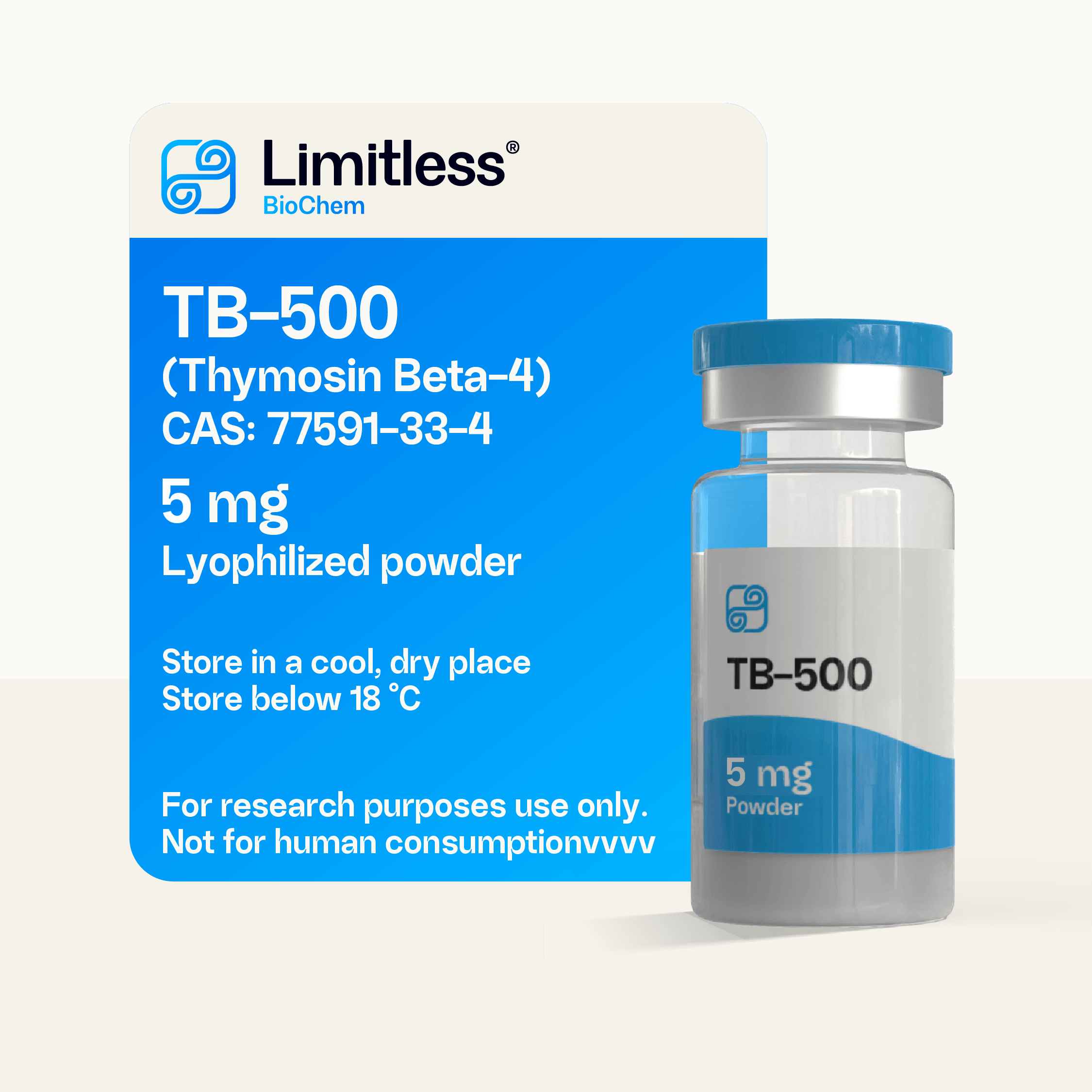
TB-500 5 mg
TB-500 5 mg (Thymosin Beta-4) research-grade lyophilized peptide powder in a glass vial. Studied in experimental models of tissue repair and regeneration, angiogenesis, inflammatory signaling and cell migration. Research Use Only: All products are intended exclusively for laboratory and scientific research. Not for human or veterinary use. Purity High purity (third-party tested) Form Lyophilized peptide powder Content 5 mg TB-500 (Thymosin Beta-4) per vial Packaging Glass vial with sterile closure Storage Store lyophilized at −20 °C (desiccated, protected from light) Molecular Formula C212H350N56O78S Molecular Weight ≈ 4963.5 g·mol⁻¹ Peptide Length 43-amino-acid peptide (Thymosin Beta-4) CAS Number 77591-33-4 Research Overview TB-500 is a research peptide corresponding to thymosin beta-4, an actin-binding protein involved in cell migration and cytoskeletal organization. In experimental systems it is used to explore mechanisms of tissue repair, angiogenesis and modulation of inflammatory signaling pathways. Primary Research Areas Tissue repair & regeneration: models of soft-tissue, cardiac and dermal recovery [1,3,4]. Angiogenesis & vascular support: studies on new blood-vessel formation and microcirculation [2]. Inflammatory signaling & cytoprotection: experimental work on pro-inflammatory mediators and tissue protection [1,6]. Cell migration & actin dynamics: research into actin-dependent cell motility and cytoskeletal organization [1,2]. Recovery after a head injury: rats given a controlled cortical impact got whole thymosin beta-4 starting six hours after the blow. Compared with saline they used their limbs better, learned the water maze faster and lost fewer hippocampal cells. Eight rats per group, injected, and the full 43-amino-acid peptide, not the fragment usually sold under this name [5]. Myelin repair and movement: mice with experimental autoimmune encephalomyelitis, the multiple-sclerosis model, got whole thymosin beta-4 at 6 mg/kg every three days for five doses. They recovered neurological function better, had fewer inflammatory patches (3.6 versus 5.0 per slide) and roughly twice as many myelin-making cells. It was 21 mice, injected, and the whole peptide, not the fragment [6]. Tumour biology: in human brain-tumour tissue, thymosin beta-4 levels rose with how malignant the glioma was, and switching the gene off reduced glioma migration and invasion and made tumour-bearing mice live longer. None of this tests whether giving the peptide affects tumour growth, and it was not studied in the presence of an untreated tumour [7,8]. Wounds that heal badly: full-thickness skin wounds in diabetic db/db mice and in 26-month-old mice both closed faster with thymosin beta-4, with more wound contraction and more collagen laid down. It was mice, applied to the wound, and the seven-amino-acid fragment LKKTETQ worked about as well as the whole peptide in the aged animals [3]. The fragment versus the whole peptide: whole thymosin beta-4 and its seven-amino-acid actin-binding fragment behaved almost identically at around 50 nanomolar in human endothelial migration and chick aortic sprouting tests. So for vessel growth this vial’s whole 43-amino-acid protein and the short fragment sold as TB-500 are close to interchangeable. It was cells and explants, not animals or people [2]. References Bock-Marquette I, Saxena A, White MD, et al. Thymosin beta4 activates integrin-linked kinase and promotes cardiac cell migration, survival and cardiac repair. Nature. 2004;432(7016):466-72. PMID 15565145. doi:10.1038/nature03000 Philp D, Huff T, Gho YS, et al. The actin binding site on thymosin beta4 promotes angiogenesis. FASEB J. 2003;17(14):2103-5. PMID 14500546. doi:10.1096/fj.03-0121fje Philp D, Badamchian M, Scheremeta B, et al. Thymosin beta 4 and a synthetic peptide containing its actin-binding domain promote dermal wound repair in db/db diabetic mice and in aged mice. Wound Repair Regen. 2003;11(1):19-24. PMID 12581423. doi:10.1046/j.1524-475x.2003.11105.x Guarnera G, DeRosa A, Camerini R. The effect of thymosin treatment of venous ulcers. Ann N Y Acad Sci. 2010;1194:207-12. PMID 20536470. doi:10.1111/j.1749-6632.2010.05490.x Xiong Y, Zhang Y, Mahmood A, et al. Neuroprotective and neurorestorative effects of thymosin β4 treatment initiated 6 hours after traumatic brain injury in rats. J Neurosurg. 2012;116(5):1081-92. PMID 22324420. doi:10.3171/2012.1.JNS111729 Zhang J, Zhang ZG, Morris D, et al. Neurological functional recovery after thymosin beta4 treatment in mice with experimental auto encephalomyelitis. Neuroscience. 2009;164(4):1887-93. PMID 19782721. doi:10.1016/j.neuroscience.2009.09.054 Wirsching HG, Krishnan S, Florea AM, et al. Thymosin β 4 gene silencing decreases stemness and invasiveness in glioblastoma. Brain. 2014;137(Pt 2):433-48. PMID 24355709. doi:10.1093/brain/awt333 Lee JW, Ryu YK, Ji YH, et al. Hypoxia/reoxygenation-experienced cancer cell migration and metastasis are regulated by Rap1- and Rac1-GTPase activation via the expression of thymosin beta-4. Oncotarget. 2015;6(12):9820-33. PMID 25888632. doi:10.18632/oncotarget.3218
How AI sees this product
The more complete this product's details, the more confidently AI assistants can understand and recommend it.