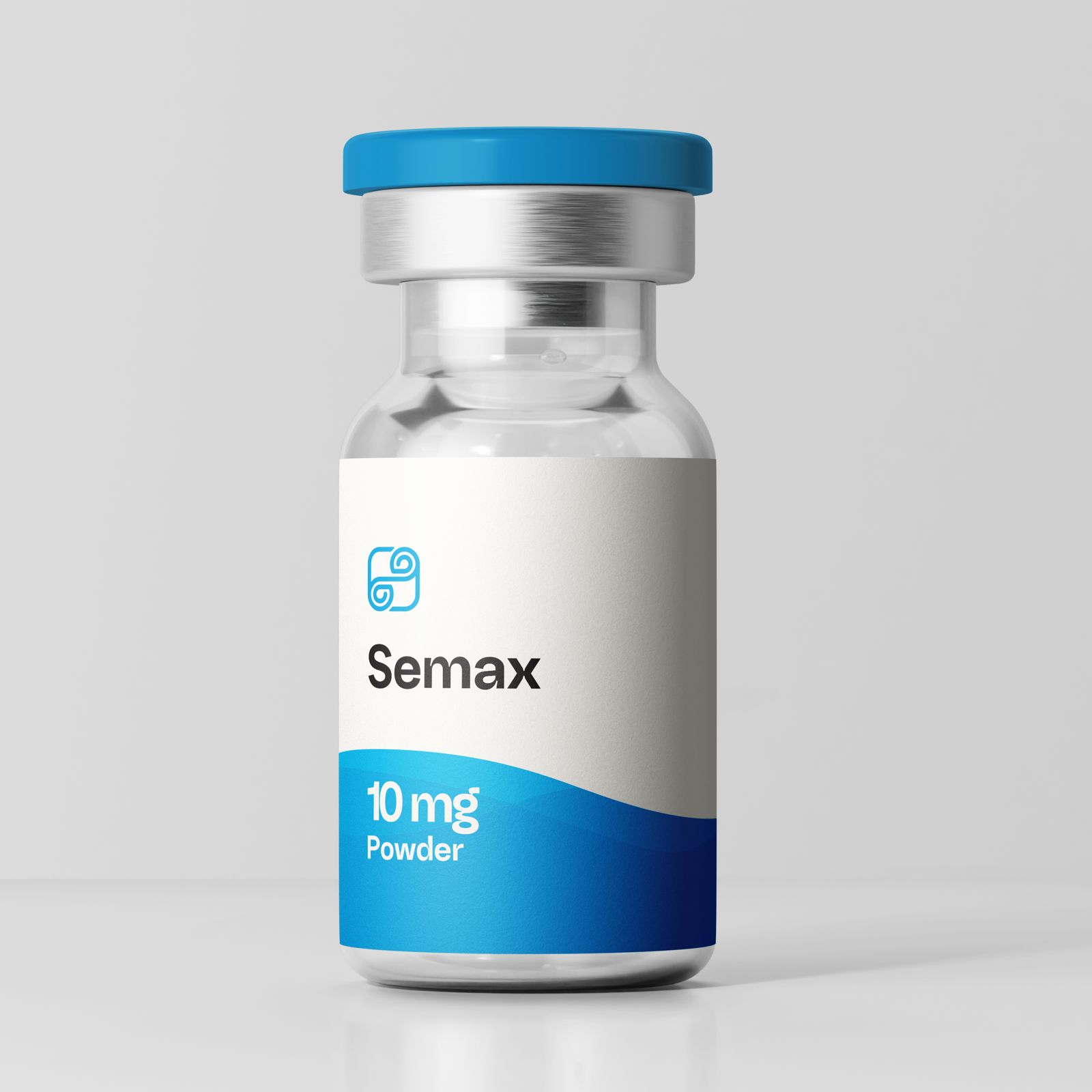
Semax 10 mg (preorder)
Semax 10 mg research-grade lyophilized peptide powder in a glass vial. Studied in neuroprotection, BDNF and neurotrophic signalling, cognitive function and stress-response research models. Research Use Only: All products are intended exclusively for laboratory and scientific research. Not for human or veterinary use. Purity High purity; third-party tested (COA/HPLC) Form Lyophilized powder Content 10 mg Semax per vial Packaging Glass vial with sterile closure Storage Store lyophilized at 2–8 °C (desiccated, protect from light) Molecular Formula C37H51N9O10S Molecular Weight ~813.9 g·mol⁻¹ Sequence Met-Glu-His-Phe-Pro-Gly-Pro (ACTH(4–10) analog with PGP tail) CAS Number 80714-61-0 Research Overview Semax is a synthetic heptapeptide (Met-Glu-His-Phe-Pro-Gly-Pro), an analog of the ACTH(4–10) fragment extended with a Pro-Gly-Pro tail for improved stability. It is widely used in experimental models investigating neuroprotection, neuroplasticity, cognitive performance and central stress-response pathways. Primary Research Areas Neuroprotection & neurorestoration: models of ischemia, brain injury and neuronal survival, focusing on adaptive responses in central nervous system tissue [2]. BDNF & neurotrophic signalling: regulation of brain-derived neurotrophic factor (BDNF) and related pathways linked to synaptic plasticity and learning [1]. Cognition & attention: behavioural and electrophysiological models exploring memory, focus, information processing and higher-order cognitive tasks [1,2]. Stress & monoaminergic systems: experimental work on dopaminergic and serotonergic signalling and central responses to acute and chronic stressors [3]. Brain protection when blood flow drops: in rats with an experimental stroke, Semax reduced the size of the damaged area and the animals did better in a memory test; gene studies in a similar model show that more than half of the genes it changes in the injured brain belong to the immune system. This is why it is studied during and after ischemic events [2,4]. Pain: Semax lowered pain sensitivity in several rat and mouse tests. In mice with a spinal cord injury it improved the recovery of movement, and the authors traced the effect to the μ-opioid receptor, the receptor that morphine-type painkillers act on. Of interest for pain and for recovery after nerve damage [5,6]. Blood clotting under stress: in rats, stress pushes blood toward clotting and Semax pushed it back, with less clot formation and less platelet clumping. Two implications for further work: a possible effect when stress raises clotting, and an overlap with anticoagulant and antiplatelet drugs that has not been tested [7]. Mood and resilience to chronic stress: in rats kept under unpredictable stress, Semax reversed or reduced the loss of interest in sweet water (the standard measure of anhedonia), the slower weight gain, the enlargement of the adrenal glands and the drop in hippocampal BDNF. This points to stress resilience rather than acute stimulation [3]. Memory loss with aging: in mice bred to develop Alzheimer-type changes, Semax improved memory tests and reduced the number of amyloid deposits in cortex and hippocampus. Early animal work, but it is the reason the peptide is looked at in age-related memory decline [8]. References Dolotov OV, Karpenko EA, Inozemtseva LS, et al. Semax, an analog of ACTH(4-10) with cognitive effects, regulates BDNF and trkB expression in the rat hippocampus. Brain Res. 2006;1117(1):54-60. PMID 16996037. doi:10.1016/j.brainres.2006.07.108 Romanova GA, Silachev DN, Shakova FM, et al. Neuroprotective and antiamnesic effects of Semax during experimental ischemic infarction of the cerebral cortex. Bull Exp Biol Med. 2006;142(6):663-6. PMID 17603664. doi:10.1007/s10517-006-0445-0 Inozemtseva LS, Yatsenko KA, Glazova NY, et al. Antidepressant-like and antistress effects of the ACTH(4-10) synthetic analogs Semax and Melanotan II on male rats in a model of chronic unpredictable stress. Eur J Pharmacol. 2024;984:177068. PMID 39442746. doi:10.1016/j.ejphar.2024.177068 Medvedeva EV, Dmitrieva VG, Povarova OV, et al. The peptide semax affects the expression of genes related to the immune and vascular systems in rat brain focal ischemia: genome-wide transcriptional analysis. BMC Genomics. 2014;15:228. PMID 24661604. doi:10.1186/1471-2164-15-228 Ivanova DM, Levitskaya NG, Andreeva LA, et al. Comparative study of analgesic potency of ACTH4-10 fragment and its analog semax. Bull Exp Biol Med. 2007;143(1):5-8. PMID 18018999. doi:10.1007/s10517-007-0002-5 Liu R, Chen Y, Huang H, et al. Semax peptide targets the μ opioid receptor gene Oprm1 to promote deubiquitination and functional recovery after spinal cord injury in female mice. Br J Pharmacol. 2025;182(22):5489-5516. PMID 40692165. doi:10.1111/bph.70122 Grigorjeva ME, Lyapina LA. Anticoagulation and antiplatelet effects of semax under conditions of acute and chronic immobilization stress. Bull Exp Biol Med. 2010;149(1):44-6. PMID 21113455. doi:10.1007/s10517-010-0871-x Radchenko AI, Kuzubova EV, Apostol AA, et al. The Potential of the Peptide Drug Semax and Its Derivative for Correcting Pathological Impairments in the Animal Model of Alzheimer’s Disease. Acta Naturae. 2025;17(4):110-120. PMID 41479572. doi:10.32607/actanaturae.27808
How AI sees this product
The more complete this product's details, the more confidently AI assistants can understand and recommend it.