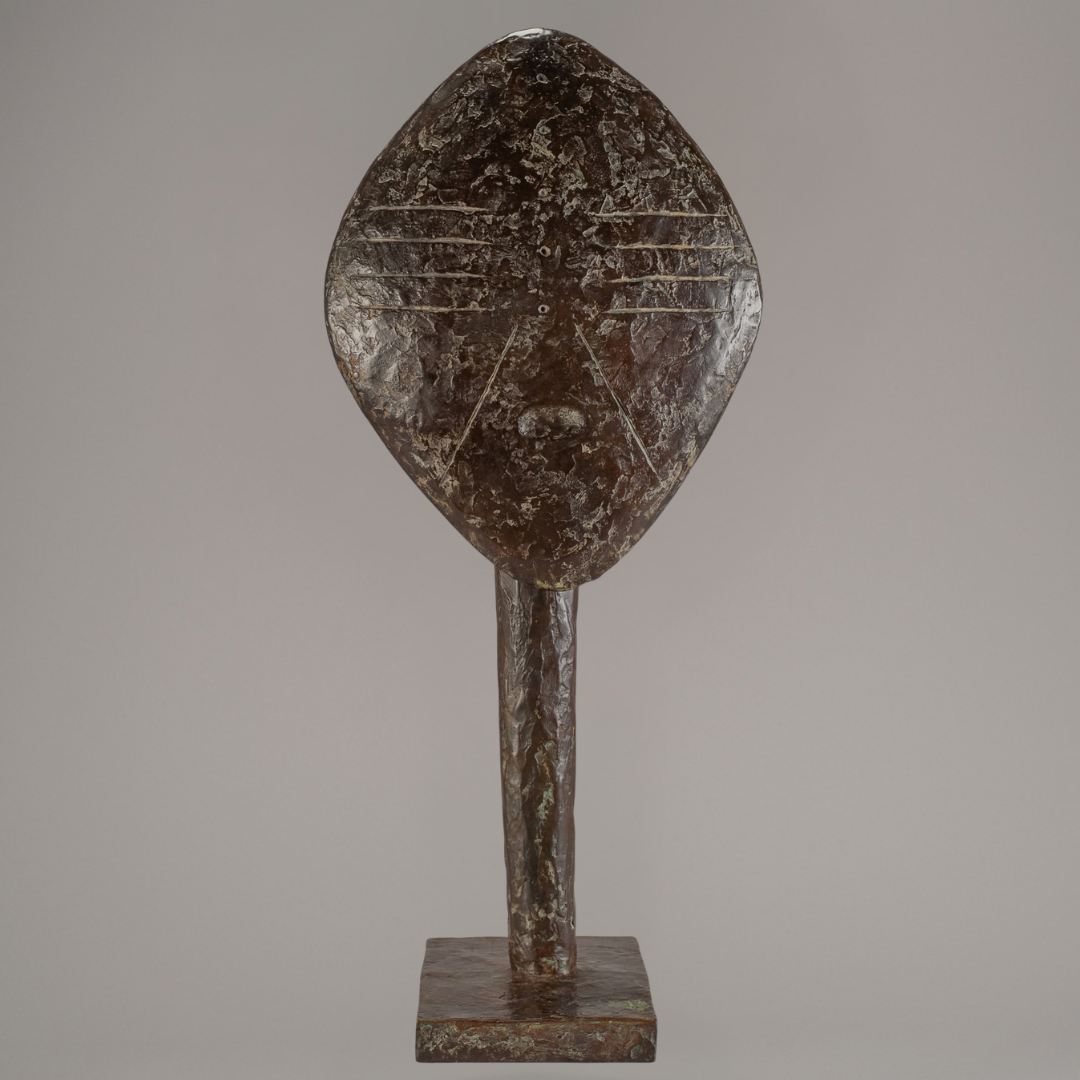
Mask
Inscribed with the artist’s stamp, numbered 1/6 and dated 88 Bronze Height: 26″ (66 cm) Conceived and cast in 1988 Edition of six ABOUT THE ARTWORK Born in Dundee, William Turnbull left school at the age of fifteen during the Depression and worked as a labourer in a shipyard while attending evening art classes. This early exposure to industrial materials and large-scale construction would later inform his sensitivity to structure and form. In 1941, he joined the RAF and served as a pilot in Canada, India and Ceylon, later turning down the opportunity of a commercial flying career in order to pursue art. In 1946, he enrolled at the Slade School of Fine Art in London, where he discovered his vocation as a sculptor and formed a close friendship with Eduardo Paolozzi. In 1948, before completing his studies, Turnbull moved to Paris, where he lived until 1950. There, he became acquainted with Alberto Giacometti and encountered first-hand the work of Brancusi, while also travelling extensively. By 1950, he had exhibited at Galerie Maeght, and soon after his return to the UK, he exhibited with Paolozzi at the Hanover Gallery in London. William Turnbull, Ancestral Figure, 1989, Yorkshire Sculpture Park. During the 1950s, he emerged as a key figure in British art. Turnbull’s international reputation was established with his inclusion in New Aspects of British Sculpture, held in the British Pavilion at the Venice Biennale in 1952, where he exhibited alongside Robert Adams, Reg Butler, Lynn Chadwick, Geoffrey Clarke, Bernard Meadows, Eduardo Paolozzi, and Kenneth Armitage, helping to usher in a new wave of British sculpture. He was a founding member of the Independent Group at the ICA in London, where he held a solo exhibition in 1957, and participated in the radical exhibition This Is Tomorrow at the Whitechapel Gallery in 1956, a seminal moment that signalled a transition from post-war art. During this period, he developed his celebrated Idol sculptures—works of striking, primal presence, shaped by his study of ancient and non-Western art forms. Turnbull’s work is represented in numerous museum collections including Tate Britain, London, the Getty Museum, Los Angeles and the Museum of Modern Art, New York. A major retrospective at Tate in 1973 marked an important point in his career, and in 1984, he and Kim Lim were in a joint exhibition at the National Museum of Art Gallery, Singapore. An exhibition at the Serpentine Gallery in London in 1995 brought renewed public attention to his work, and in 2005, William Turnbull: Retrospective 1946–2003 was held at the Yorkshire Sculpture Park. William Turnbull, Large Horse, 1990, Yorkshire Sculpture Park. Over the course of his career, Turnbull also worked with materials such as steel, Perspex and fibreglass. At the end of the 1970s, he returned to bronze, which remained his preferred material. While Turnbull’s figures of the 1950s often conveyed a more primitive strength and rougher texture, his later bronzes developed a smoother elegance and greater formal clarity. Mask, conceived in 1988, belongs to the renewed group of Idols and Masks that Turnbull developed during this period. In this work, he reduced the human form to a simplified shape, allowing the head to be suggested with remarkably little descriptive detail. Drawing on Cycladic sculpture, African masks and a wider fascination with archaeological objects and prehistoric tools, Turnbull transformed these influences into a distinctly modern sculptural language. Turnbull’s sculpture from these years is characterised by textured surfaces and incised markings which animate the form and reinforce its archetypal presence. In Mask, the broad ovoid head and worked bronze surface create a powerful human presence while maintaining a tension between figuration and abstraction. As an example of Turnbull’s mature style, Mask encapsulates many of the ideas that shaped his career. It stands as a quintessential work by one of the leading figures of modern British sculpture, distilling ideas Turnbull had explored since the 1950s into a concise and highly characteristic expression of his later practice.
How AI sees this product
The more complete this product's details, the more confidently AI assistants can understand and recommend it.