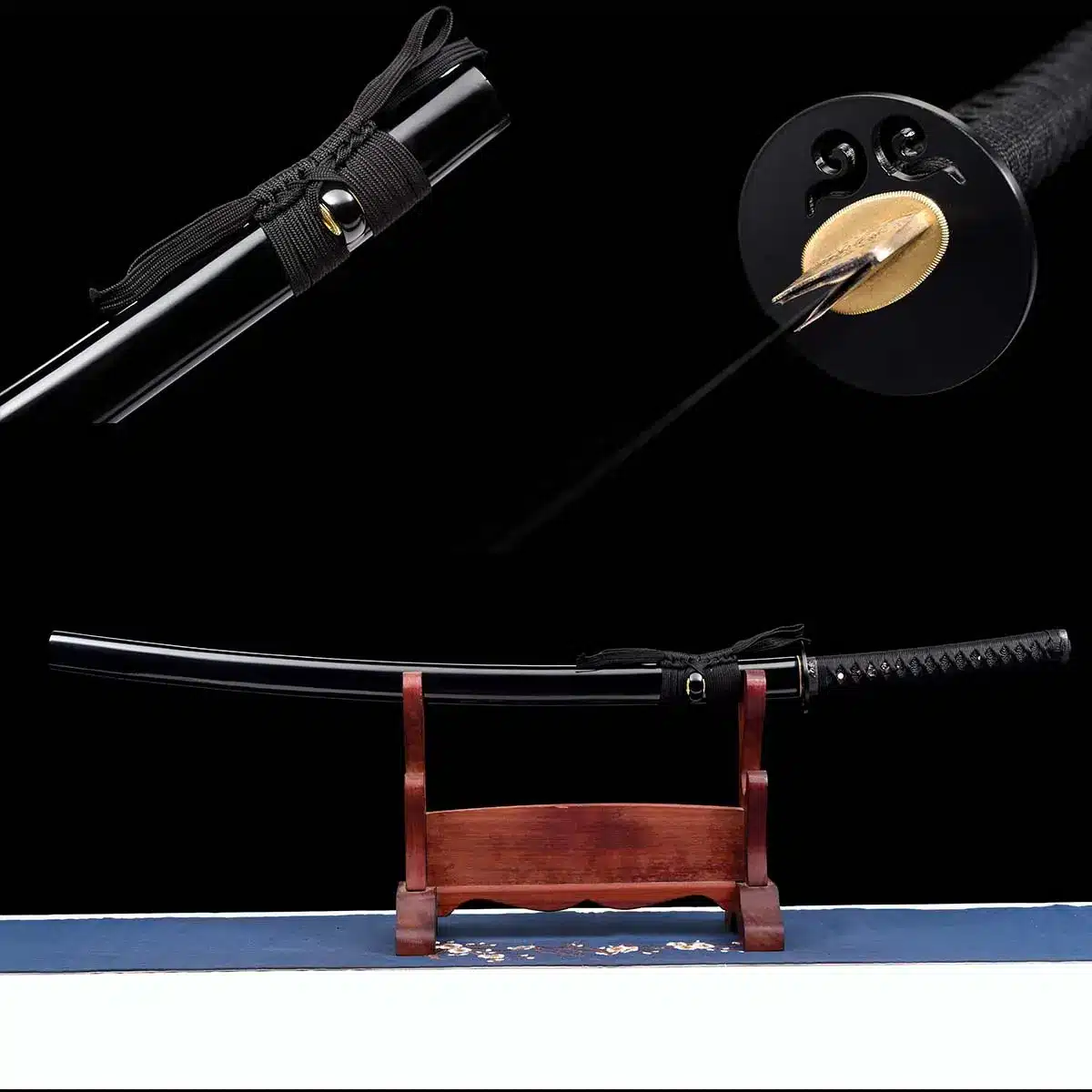
Tool Steel Katana Mirror Polish Black Warrior Full Tang
.desc-collapse { position: relative; } .desc-collapse-body { overflow: hidden; transition: max-height 0.45s ease; } .desc-collapse-body.collapsed { max-height: 110px; } .desc-collapse-body.collapsed::after { content: “”; position: absolute; bottom: 0; left: 0; right: 0; height: 60px; background: linear-gradient(to bottom, rgba(255,255,255,0), rgba(255,255,255,0.97) 70%); pointer-events: none; } .desc-toggle-wrap { text-align: center; } .desc-toggle-btn { display: inline-block; padding: 10px 28px; background: #1a1a1a; border: none; border-radius: 40px; font-size: 13px; font-weight: 600; color: #fff; cursor: pointer; font-family: inherit; letter-spacing: 0.5px; transition: background 0.2s, transform 0.15s; box-shadow: 0 2px 8px rgba(0,0,0,0.15); } .desc-toggle-btn:hover { background: #c0392b; transform: translateY(-1px); } .desc-toggle-btn .arrow { display: inline-block; transition: transform 0.25s ease; font-size: 10px; margin-left: 5px; vertical-align: middle; } .desc-toggle-btn.open .arrow { transform: rotate(180deg); } A tool steel katana with a mirror-polished blade and an all-black mounting. The blade reaches HRC 62–66 — harder than most katana steels on the market. The finish is a full mirror polish on both faces, ground to 3000 grit and buffed to a reflective surface that catches light like liquid metal. The rest of the sword is black: black lacquer saya, black ito, matte black tsuba. One copper habaki as the only contrast point. the blade — tool steel, mirror finish Tool steel is a different category from the carbon steels most katana use. The composition includes tungsten and other alloying elements that increase wear resistance and allow the steel to hold a harder edge for longer. At HRC 62–66, this blade is harder than 1095 (59–62 HRC), harder than 9260 (56–58 HRC), and at the upper end of what a functional katana edge should reach. The mirror polish is done in multiple stages. The blade is ground through progressive grits — 400, 800, 1500, 3000 — then finished with a leather wheel and aluminum oxide polishing compound. The result is a surface that reflects a clear image. Not a satin finish. Not a high polish. A mirror. In direct light, the blade surface shows the room around it. The steel is hand-forged. The forging process refines the grain structure and distributes carbides evenly through the steel. This matters more at high hardness levels — a poorly forged tool steel blade is brittle in ways that a well-forged one isn’t. The heat treatment is done after forging: quench, then temper to bring the hardness into the 62–66 HRC range while preserving enough toughness in the spine to resist bending. bo-hi — the blood groove The bo-hi runs the length of the blade, cut into the spine face. It reduces blade weight by roughly 8–12% without removing material from the edge geometry. The weight reduction changes the balance point slightly toward the handle, which makes the sword feel quicker in the hand than the raw weight suggests. On a mirror-polished blade, the bo-hi creates a visual effect that’s worth noting. The groove catches light differently from the flat faces — in warm light, it reads as a deep shadow line running the length of the blade, dividing the mirror surface into two distinct planes. The contrast is sharp. It’s one of the more visually striking features of this particular sword. tsuba — matte black zinc alloy The tsuba is a round zinc alloy casting with a matte black surface finish. Round profile, standard katana proportions. The surface is sandblasted to a uniform matte texture — no shine, no gloss. Two hitsu-ana (side openings) are present on both faces, as is traditional. The matte black finish on the tsuba is a deliberate contrast to the mirror blade. The blade reflects everything. The tsuba absorbs light. The transition between the two is one of the more interesting visual moments on this sword. habaki — copper, engraved The habaki is solid copper with a relief-engraved scrollwork pattern on the face. Copper habaki are less common than brass or alloy versions — the material is softer, which means it seats more precisely against the blade geometry and creates a tighter fit in the saya. The engraving is traditional karakusa (scrolling vine) pattern, cast and finished by hand. The copper color against the all-black mounting is the one deliberate contrast point in this sword’s design. Everything else is black or mirror silver. The habaki is warm gold. It’s a small detail that reads clearly against both the blade and the tsuba. tsuka — black ray skin, black ito The handle core is wood, wrapped in black ray skin (samegawa) with a textured diamond-cut surface. The ray skin provides grip and a base layer for the ito wrapping. Over the ray skin, black cotton ito is wrapped in the traditional diamond (hishi) pattern. The wrapping is tight and even — the diamonds are uniform in size and the ito tension is consistent across the full handle length. Handle length is 26.5 cm / 10.4 in. Two menuki are set under the ito at the standard positions — cast metal with a traditional beast pattern, copper-toned against the black ito. The kashira (pommel cap) is cast metal with a matching beast motif inset, providing a visual echo of the menuki at the handle end. The mekugi (bamboo pin) secures the tang through the handle. The connection is solid — no movement, no play between blade and handle. saya — high-gloss black lacquer The saya is hardwood with multiple coats of high-gloss black lacquer. The lacquer surface is smooth and even — no bubbles, no brush marks. In direct light, the saya surface has a gloss level that approaches the mirror finish of the blade. The two surfaces — blade and saya — reflect light at similar intensities, which gives the sword a visual coherence when sheathed. The koiguchi (saya mouth) is fitted with a metal collar that mates precisely with the copper habaki. The fit is snug — the sword locks in with a clean click and draws smoothly without resistance. The sageo (cord) is black braided cord, attached at the kurigata with a traditional cross-knot. It can be used for obi carry or left as a decorative element. dimensions Overall length (sheathed): approx. 104 cm / 40.9 in Blade length: 71 cm / 27.95 in Handle length: 26.5 cm / 10.4 in Blade width: 3.1 cm / 1.22 in Edge hardness: HRC 62–66 Blade material: Tool steel Tang structure: Full tang Weight: approx. 1.1 kg / 2.43 lbs Mekugi: Bamboo × 2 options Available sharpened or unsharpened. Sharpened for cutting practice. Unsharpened for display or jurisdictions with edged weapon restrictions. The blade geometry and finish are identical either way. Show More ▼ function toggleDesc(btn) { var wrap = btn.parentElement; var body = wrap.previousElementSibling; var isOpen = !body.classList.contains(‘collapsed’); if (isOpen) { body.style.maxHeight = ‘110px’; body.classList.add(‘collapsed’); btn.classList.remove(‘open’); btn.innerHTML = ‘Show More ▼‘; } else { body.style.maxHeight = body.scrollHeight + ‘px’; body.classList.remove(‘collapsed’); btn.classList.add(‘open’); btn.innerHTML = ‘Show Less ▲‘; } }
Specifications
- HAND SHARPENING
- Hand Sharpened, Unsharpened
AI Readiness
Good foundation, but some important product data is still missing.