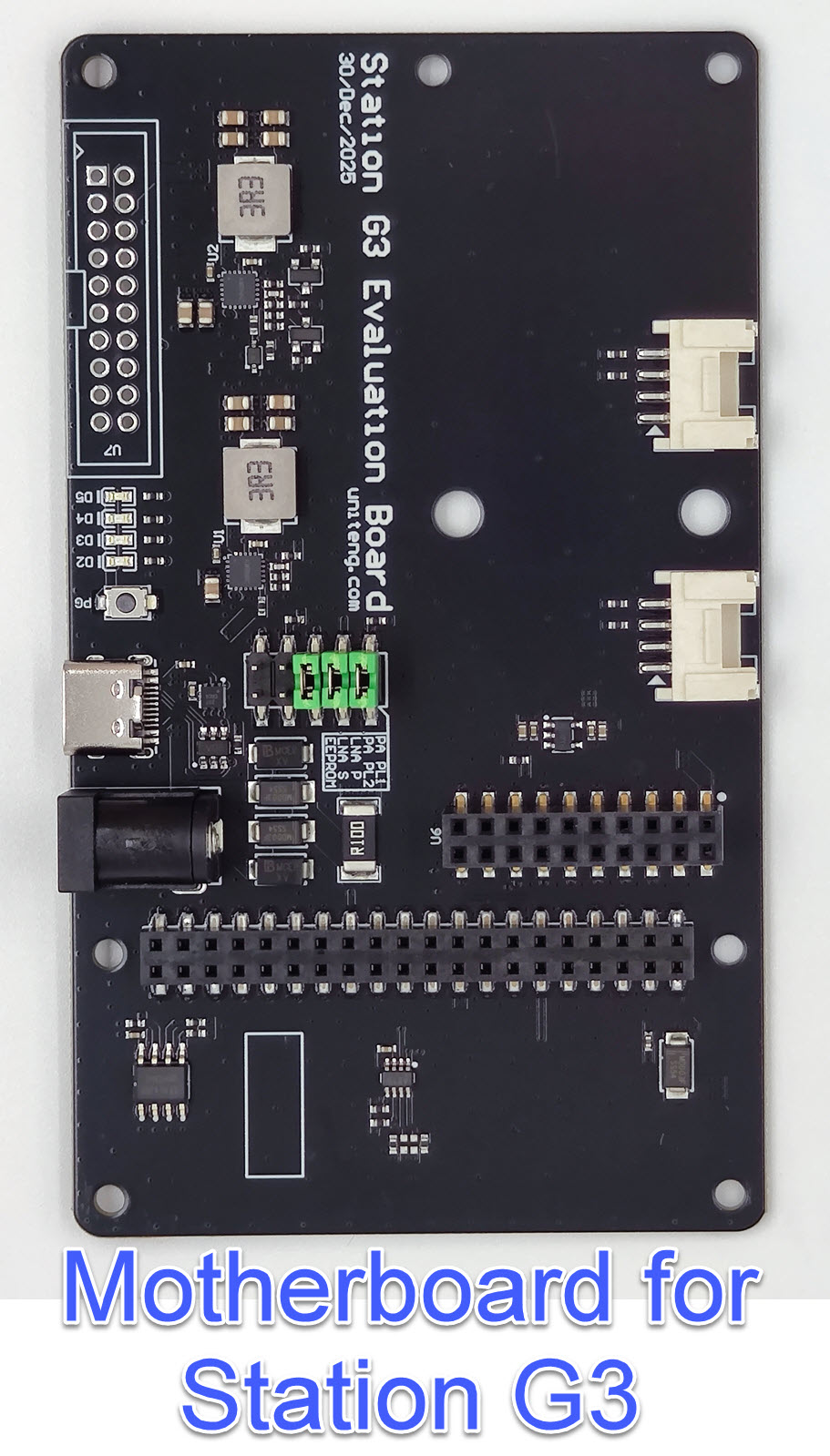
Motherboard for Station G3
Overview The Motherboard for Station G3 is the core baseboard of the modular Station G3 ecosystem. It serves as the central platform that connects RF daughterboards and MCU daughterboards via standardized interfaces, allowing users to configure and upgrade each component independently . We believe this decoupled architecture will help extend the lifecycle of RF designs and make it easier for more engineers to integrate Station G3 into their custom projects Please note that this product is not a turnkey solution; it is sold as an independent module. To assemble a fully functional Mesh node, you must pair the motherboard with both an RF daughterboard and an MCU daughterboard. Compatible Daughterboards To build a complete Mesh node using the Motherboard for Station G3, you will need to select compatible daughterboards from the following options : RF Daughterboard BQ35LORA900V1M: Supports the 850 MHz–930 MHz frequency band, featuring an up to 35 dBm PA for transmit and LNA design with dynamic gain control and impedance matching for receive . MCU Daughterboard The motherboard’s MCU socket is fully compatible with the standard Raspberry Pi 40-pin GPIO header definition . You can choose from: Official: BQESP32V1M – Built using an ESP32 S3 (Flash: 16MB, PSRAM: 8MB) and a 1.3-inch OLED screen . Third-Party: Raspberry Pi Zero 2W – Experienced users can use the Raspberry Pi Zero 2W with Header as an MCU daughterboard to build their own Linux Mesh nodes . Key Features True Modular Architecture The Motherboard serves as the central platform, connecting various RF daughterboards and MCU daughterboards via standardized interfaces. Users can flexibly swap or upgrade components based on specific application requirements without redesigning the entire system, greatly improving development efficiency and hardware scalability . Fast-Transient DC-DC Power Technology The motherboard employs the same Fast-Transient DC-DC for LoRa Power Amplifier technology as the Station G2, providing excellent power support to ensure the correct transmission and reception of LoRa packets . Flexible Hardware Configuration Jumpers The hardware configuration of the Motherboard for Station G3 is set via 5 jumpers located on the board (PA PL1, PA PL2, LNA P, LNA S, EEPROM). By default, the 2.54mm jumpers are not installed for both LNA S and EEPROM . Users can fine-tune RF performance based on their application scenario: Power Amplifier Operating Mode Configuration (PA PL1 & PA PL2): By combining these settings, users can switch between 4 power levels (Power Level 1-4), flexibly balancing transmit power and overall system power consumption . LNA Operating Mode Configuration (LNA P): Supports enabling or disabling the external Low Noise Amplifier (LNA). In complex electromagnetic environments with high ambient noise floors, disabling the LNA can help improve the Signal-to-Noise Ratio (SNR) and optimize RX dynamic range . Power & Safety Specifications Dual Power Input The Motherboard for Station G3 supports two power input methods: USB Type-C PD: Supports 15VDC power supply via PD protocol . DC5521 Socket: Supports 9VDC–19VDC external power input, featuring a built-in reverse polarity protection diode to ensure connection safety . High Power & Voltage Protection Max High Power Adaptation: When configured for the highest transmit power (Power Level 4), it is recommended to use a power adapter with a minimum rated output of 25W @ 10 VDC . Overvoltage Protection: Regardless of the power supply method used, the maximum peak input voltage to the Motherboard for Station G3 must not exceed 19V. Exceeding this limit may cause permanent damage to the device.
How AI sees this product
The more complete this product's details, the more confidently AI assistants can understand and recommend it.