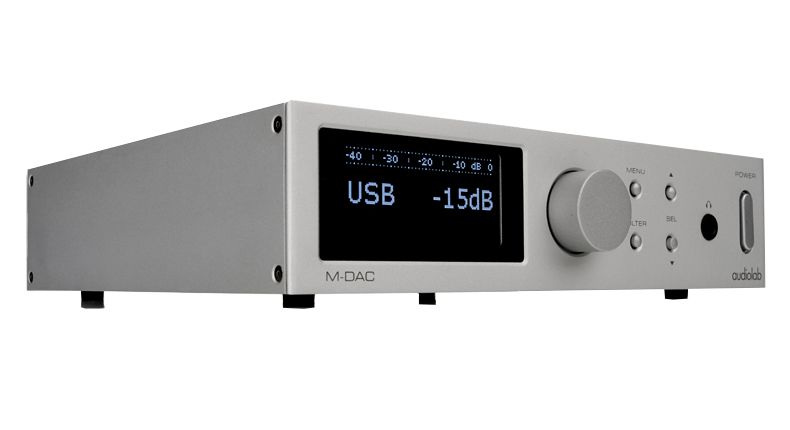
Audiolab M-Dac D/A Converter
Audiolab M-DAC Review The Audiolab M-DAC, launched in late 2011/early 2012, quickly became one of the most acclaimed and award-winning DACs of its era. Designed by John Westlake and built around the highly regarded ESS Sabre32 9018 chip, it offered exceptional performance, flexibility, and build quality at a mid-range price (originally around £600 / $800–900). It won multiple “Product of the Year” awards and remains a strong performer on the used market today. Design and Build The M-DAC is a compact, half-width aluminium chassis finished in black or silver. It features a clear OLED display that shows input, sample rate, volume level, and other information, along with a large volume control and simple front-panel buttons. The unit feels solid and more expensive than its price suggests. Connectivity is comprehensive for its time: Digital inputs: 2 × coaxial, 2 × optical (Toslink), 1 × USB (asynchronous) Digital outputs: 1 × coaxial, 1 × optical Analogue outputs: Balanced XLR and unbalanced RCA (fixed or variable) Headphone output: 6.3 mm jack on the front panel It can operate as a pure DAC or as a digital preamplifier thanks to the variable analogue output. Multiple user-selectable digital filters allow fine-tuning of the sound. The original version supported up to 24-bit/192 kHz via S/PDIF and 24-bit/96 kHz via USB (later firmware and the M-DAC+ improved on this). Key Specifications DAC chip: ESS Sabre32 9018 (32-bit) Supported formats: Up to 24-bit/192 kHz (coaxial/optical); USB typically 24-bit/96 kHz on the original model Frequency response: 20 Hz – 20 kHz (±0.2 dB) THD: <0.002 % (RCA), even lower on XLR Dynamic range: >115 dB (RCA), >120–122 dB (XLR) Output level: 2.25 V RMS (RCA), 4.5 V RMS (XLR) Dimensions: Approx. 250 × 59 × 252 mm Features: Multiple digital filters, Class A analogue output stage, headphone amplifier, remote control Sound Quality The M-DAC is widely praised for its engaging, musical, and highly resolving performance. It combines precision with energy and avoids the clinical or sterile character sometimes associated with early Sabre-based designs. Timing and dynamics: Excellent. The M-DAC has a propulsive, rhythmic quality that makes music feel lively and involving. Transients are sharp and impactful without becoming aggressive. Detail and resolution: High levels of insight and clarity. It retrieves fine detail and texture effectively while maintaining a natural sense of flow. Soundstage: Wide, well-organised, and three-dimensional, with good depth and precise imaging. Tonal balance: Generally neutral to slightly forward, with clean, extended treble, a clear and present midrange, and controlled, articulate bass. It is not overly warm, but neither is it bright or fatiguing when properly matched. Headphone performance: The built-in headphone stage is capable and enjoyable, making the unit useful as a desktop DAC/headphone amp. Reviewers frequently noted that it punched well above its price, often competing with more expensive DACs in musicality and overall enjoyment. It works well with a wide range of sources and systems, from desktop setups to full hi-fi systems. Pros Highly musical, dynamic, and engaging sound Excellent resolution and timing Flexible connectivity and filter options Can function as a digital preamp Solid build and clear display Outstanding value (especially used) Strong headphone output Cons Original USB implementation limited to 24/96 (improved in the later M-DAC+) No native DSD support on the first version External power supply (some prefer an upgraded linear PSU) Slightly forward character may not suit all systems or tastes Verdict The Audiolab M-DAC is a landmark product that helped popularise high-performance DACs at accessible prices. It delivers a combination of technical ability, musical engagement, and practical features that still holds up well more than a decade later. While the later M-DAC+ added higher sampling rates, DSD support, and an internal power supply, the original M-DAC remains an excellent choice for listeners seeking a detailed, lively, and involving digital source. On the used market it continues to offer exceptional performance for the money and is highly recommended for anyone building or upgrading a digital front end.
How AI sees this product
The more complete this product's details, the more confidently AI assistants can understand and recommend it.