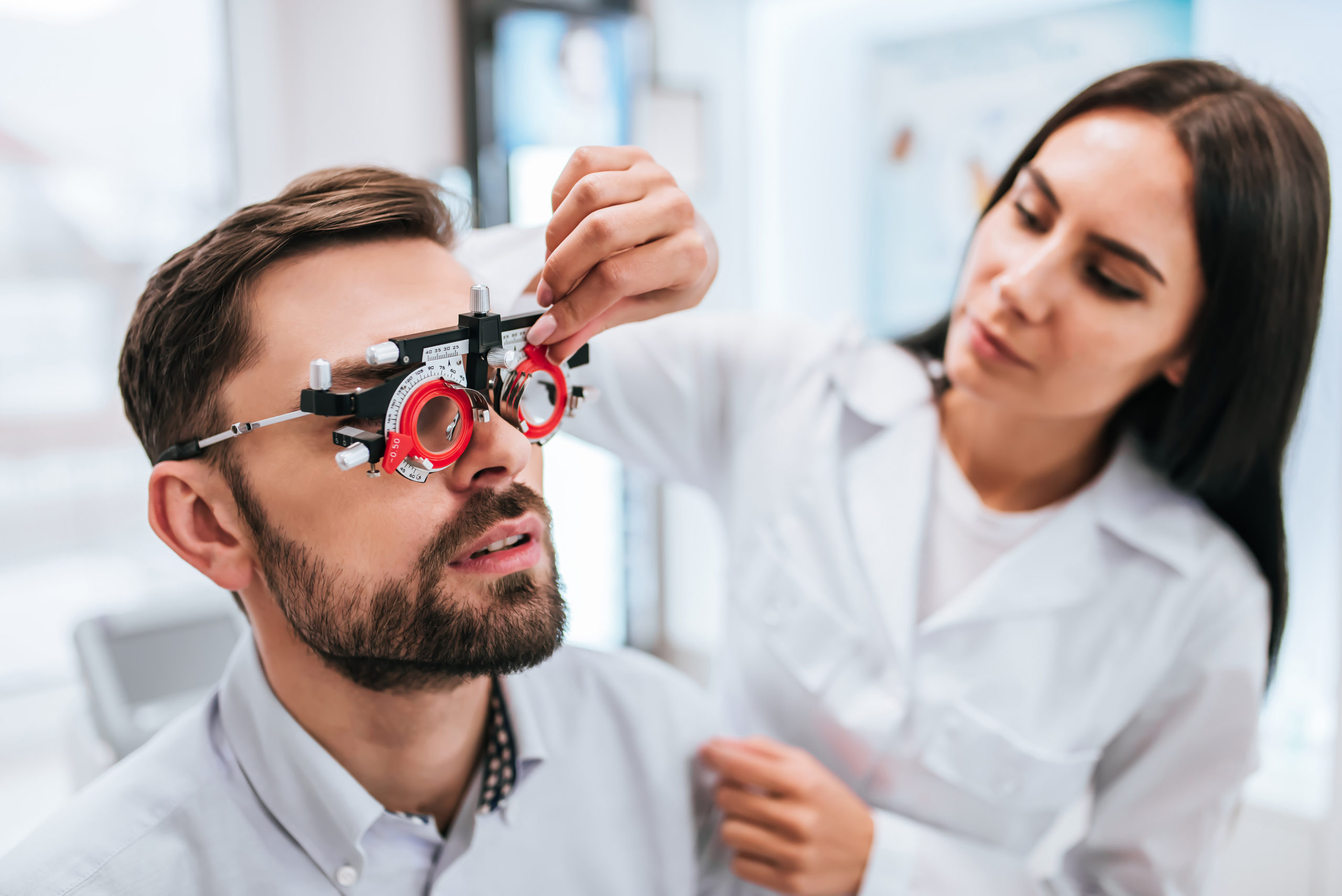
Training Program Bachelor’s Degree in Optometry and Optics
5 YEAR RESIDENTIAL MEDICAL TRAINING PROGRAM DISTRIBUTION OF TIME BY SUBJECT FIRST YEAR SUBJECT: INTRODUCTION TO HEALTH TECHNOLOGY List of topics By topic and forms of educational organization Conference Seminar Workshop Practical class Assessment TOTAL Topic 1 1 2 2 2 2 9 Topic 2 1 4 – 8 1 14 Topic 3 2 – 2 4 1 9 TOTAL 4 6 4 14 4 32 SUBJECT: PHYSICAL PREPARATION AND SPORT I Topic C S CP E Total hours I 2 17 1 20 II 9 3 12 Totals 2 26 4 32 SUBJECT: MORPHOPHYSIOLOGY I No. TOPIC Total hours Morphology overview Somatic systems 7 Circulatory systems 6 Nervous systems 20 Visceral systems 5 Total 42 SUBJECT: REFRACTION I No. Topics Classes Sem. CP Total I Subjective methods for ocular refractive examination 20 4 6 30 II Spherical refractive error 20 4 6 30 III Convergence accommodation 4 2 2 8 IV Objective methods for ocular refractive examination 22 4 6 32 Total 66 14 20 100 Subject: IT and research I Topic Title Setup Sem. CP CTP EV Total I Introduction to information manipulation 5 10 1 16 II Aspects related to the processing of information 2 4 6 III Health data search and recovery 2 6 8 Total 2 7 20 1 30 SUBJECT: OPTICAL TECHNOLOGY I No. Topics CT (h) CP (h) Total I Technological and ophthalmic optics 4 – 4 II Optical systems 2 – 2 III Ophthalmic lenses 6 – 6 IV Transpositions or conversions 6 2 8 V Lensometer 6 2 8 VI Manufacture of frames 6 – 6 VII Optical technological process 12 2 14 TOTAL 42 6 48 SUBJECT: GEOMETRIC OPTICS No. Topics CT (h) CP (h) Total (h) Geometric optics I Introduction to geometric optics. Nature of light 4 – 4 II Reflection of light. Flat and spherical mirrors 4 2 6 III Refraction of light. Prisms 4 2 6 IV Thin and thick lenses. Aberrations 4 2 6 V Cylindrical lenses 4 – 4 VI The eye as an optical system 4 2 6 Assessment – 2 2 Total 24 10 34 SUBJECT: BIOSTATISTICS FOR HEALTH RESEARCH Topic Title Setup Sem. CP CTP EV. Total I Introduction to the methodology of descriptive research and statistics 2 7 6 1 16 II Elements of demography and health statistics 4 6 10 TOTAL 2 11 12 1 26 SUBJECT: ENGLISH I Unit 1-3 – 2 hrs each Total: 6 hrs Unit 4 – 3 hrs Total: 3 hrs Units 5-8 – 4 hrs each Total: 16 hrs PIS (weeks 7 or 8) Total: 3 hrs Consolidation/Review Total: 2 hrs Total 30 hrs Contents: Language Name, alphabet, greetings, age, colors, nationalities, weather & seasons Cardinal numbers from 1-100 Possessive adjectives (singular), possessives of names Indefinite & definite articles Verb BE (affirmative, negative & interrogative sentences) Wh-questions Demonstrative adjectives (singular & plural) Prepositions of place Imperatives Adverbs right & left Simple present / Auxiliaries do-does Ø Have got – has got Position of adjectives Ø There is/are Countable & uncountable nouns; some/any Conjunctions and, but, so Present continuous (affirmative & negative) Functions Introducing oneself & others Spelling names, words Saying phone numbers. Asking for and telling the time. Finding out the owner of an item Asking & giving locations & directions Asking & giving information about food & drink, likes & dislikes, families & oneself Describing eating habits, leisure & routine activities, different homes, clothes, the weather 3. Main topics Family & home Food & drink Free time Clothes School & daily life SUBJECT: ENGLISH II Units 9-12 4 hrs each Total: 16 hrs (Changes 1 simple past tense) Total: 4 hrs Consolidation/Review Total: 2 hrs PIS (between units 11 & 12) Total: 3 hrs Project check extra class Total: 1 hr TOTAL 26 hrs CONTENTS Language Present continuous (interrogative) Can for ability // be good at// know how to May for permission Ordinal numbers 1-100. Dates Imperatives for advice Future with going to & with will Time expressions: Prepositions in, on, at Past tense (most common verbs e.g. work, go, study and the like) Recycling of all structures studied so far Functions Asking about & describing current activities Asking for & giving information about abilities & talents Saying dates, asking about birthdays. Describing future plans Talking about illness and health problems Making appointments Giving advice Main Topics Daily activities Games & spots Celebrations The body & health problems Past events SUBJECT: OPTICAL TECHNOLOGY II OPTICAL TECHNOLOGY II CURRICULUM No. Topics CT CP TOTAL I Technological process in the workshop 14 2 16 II Ophthalmic prisms 14 2 16 III Special lenses 12 2 14 TOTAL 40 6 46 SUBJECT: REFRACTION II No. Topics Classes Seminars Practical classes Total I Cylindrical or astigmatic refractive errors 30 2 6 38 II Presbyopia. Relationship between cylindrical and astigmatic refractive errors 4 2 4 10 III Methods for ocular refractive examination 34 6 14 54 Total 68 10 24 102 SUBJECT: APPLIED MATHEMATICS Topics Classes Total Applied Mathematics 60 60 With a total of 60 hours, it provides the necessary tools to establish the necessary logical thought in order to analyze and understand the processes that occur in the visual organ from a physical approach. SUBJECT: PHYSICAL PREPARATION AND SPORT II Topics C S CP CT-P E Total hours I 2 13 2 1 18 II 1 8 2 3 14 Totals 3 21 4 4 32 SUBJECT: BIOLOGICAL AGENTS List of topics Organizational structure of the tuition Conferences Seminars Assessment Total Amino acids 2 2 4 Proteins 4 2 6 Enzymes 4 2 6 Cellular respiration 4 2 6 Carbohydrate metabolism 4 2 6 Amino acid metabolism 2 2 4 Biological membranes 4 2 6 Vision biochemistry 6 2 8 Total 30 16 2 48 SUBJECT: EYE EXAMINATION No. Topics Classes Sem. CP ET Total 1 Anatomy and physiology of the visual system 6 2 – – 8 2 Ophthalmological Clinical History 2 – 2 4 3 Eye examination 4 – 4 32 40 Assessment 2 Total: 10 6 6 32 54 SECOND YEAR SUBJECT: REFRACTION III No. Topics Classes Sem. CP Total 1 Anisometropia 6 2 2 10 2 Aphakia 6 2 2 10 3 Subjective methods for ocular refractive examination 14 2 2 18 Total: 26 6 6 38 SUBJECT: PHYSICAL OPTICS No. Topic C T (h) C P (h) Total I Photometry 4 2 6 II Interaction of light with isotropic media 8 2 10 III Light propagation in anisotropic media 8 2 10 IV Interference and light diffraction 8 2 10 TOTAL 28 8 36 SUBJECT: ENGLISH II Consolidation/Review Total: 14 hrs TCC (2 or 3 days before the end of the term) Total: 1hr Project Check Extra class Total: 1 hr TOTAL 16 hrs CONTENTS Text types: letters, ads, forms, reading passages and e-mails Language: Recycling of communicative functions and structures previously taught (simple present, present continuous, future with going to & will, demonstrative & possessive adjectives, some past tense) Past simple (regular & irregular verbs) Past of BE (plus there was/were) Modals (according to the texts) Present Perfect SUBJECT: VISUAL FIELD I No. Topics Classes CP Total I Visual Field. Generalities 14 2 16 II Methods of study and exploration of the visual field 10 2 12 Total 24 4 28 SUBJECT: PHILOSOPHY AND HEALTH I Topic 1. THE CONCEPTION OF THE WORLD, OF MAN AND SOCIETY Knowledge system The world and man. Region, object and fundamental problem of Philosophy. The material and the ideal. Society and the dialectical method applied to society. Essence of the materialistic conception of history. Social economic training (SET). The social structure. Classes and class struggles. The political structure of society. Social policy and health policy. Humanism and human rights. Man and his culture. Political culture Ideology and freedom. Battle of ideas. Man and diseases. The biological and the social. Determinants of the health-disease process. Biologicism and sociology. Models of thought. By topic and forms of educational organization Philosophy, health, and health technology I ———— 26 h———— 20 HOURS CONFERENCE AND 16 HOURS OF SEMINAR: SUBJECT: REFRACTION IV No. Topic Classes Sem CP Total 1 Static refraction 4 2 2 8 2 Post-cycloplegic test 4 2 1 7 3 Dynamic refraction 4 2 1 7 4 Diagnostic tests for vehicle drivers 4 2 2 8 Total: 16 8 6 30 SUBJECT: PHYSIOLOGICAL OPTICS No. Topic C T (h) C P (h) Total I The human eye 4 – 4 II The retinal image 6 2 8 III Optical compensations 6 2 8 IV Vision physiology and psychophysics 8 2 10 TOTAL 24 6 30 SUBJECT: VISUAL FIELD II No. Topic Theory classes CP Total III Pathological visual field in general 20 2 22 Total 20 2 22 SUBJECT: ENGLISH IV Consolidation/Review Total: 14 hrs TCC (2 or 3 days before the end of the term) Total: 1hr Project Check Extraclass Total: 1 hr TOTAL 16 hrs CONTENTS Text type: magazine articles & reading passages Language: Recycling of studied communicative functions and linguistic notions. Past continuous vs. past simple Passive voice (simple present and past). The set phrase be born Modals (according to texts) Some of Conditional type 1 SUBJECT SCIENTIFIC RESEARCH METHODOLOGY Topic Title Setup Sem. CP CTP EV Total I Research methodology 1 4 5 II Statistical inference 2 2 6 1 11 TOTAL 2 3 10 1 16 SUBJECT: PHILOSOPHY AND HEALTH II Topic 2. The human activity Knowledge system Human activity as an object-subject relationship. Gnoseological principles of Marxist-Leninist Theory. Scientific method. Cognitive activity. The S-O relationship and sensory and rational knowledge. Common knowledge and scientific knowledge. Science and technical scientific revolution. The so-called neutrality of science. Its current use and dilemmas. Impact on health. Valuative activity and spiritual production. The formation of values. Its role in the continuity of socialism. The social consciousness and its forms. Moral conscience. The Professional ethics of the health technologist and the ethics of communication. Legal awareness and law. The fair use of science and technology and its results. Religious conscience. Religion, belief and science in the field of health. HOURS Philosophy, health, and health technology II ——— 30 h————20 h conference, and 10 h seminar. THIRD YEAR SUBJECT: INSTRUMENTAL OPTICS L No. Topic CT Sem. Total I Basic notions of geometric optics 6 2 8 II Photometry basics 6 2 8 III The eye as a receiver of the information provided by optical instruments 6 2 8 IIV General optic, geometric and photometric general characteristics of optical instruments 6 2 8 Total 24 8 32 SUBJECT: ORTHOPTICS I No. Topics Setup Sem. Total 1 Binocular vision 2 – 2 2 Motor system 6 2 8 3 Sensory system 6 2 8 4 Diagnostic methods of binocular vision 10 2 12 Total 24 6 30 SUBJECT: INSTRUMENTAL OPTICS II No. Topic CT Sem. Total I Optical instruments 6 1 7 II Optical aids for low vision 6 1 7 III Optometric instruments 6 2 8 Total 18 4 22 SUBJECT: ORTHOPTICS II No. Topics CT Seminars CP Total 1 Stereoscopic vision 6 1 2 9 2 Diagnostic methods of binocular vision 14 5 6 25 Total 20 6 8 34 SUBJECT: PSYCHOLOGY OF REHABILITATION CURRICULUM TOPIC I 2 Conf. 1 Pract. Class 1 Semi. Total 6 hours TOPIC II 1 Conf. 1 Pract. Class 1 Semi. Total 6 hours TOPIC III 2 Conf. 1 Pract. Class 1 Semi. Total 6 hours TOPIC IV 1 Conf. 1 Pract. Class 1 Semi. Total 6 hours TOPIC V 1 Conf. 1 Pract. Class ———— Total 4 hours TOTAL HOURS: 28 hours Topic I Explore the activities of people’s daily lives and the influences that family and community may have on their health or illness. Identify prolonged stressful living conditions that may be related to the illness. Explore the affective life of the person, their strongest and most frequent emotions, and their predominant moods to relate them to the origin and evolution of their illness and responsibility for treatment. Assess the image of the illness, its causes, diagnosis, treatment and its danger, which people develop according to their personality traits. Topic II To assess the influences of the way of life of the community and the family in the genesis, evolution and treatment of the illness and to demonstrate its use. Detect and assess household hygiene, family human relationships, work, study, recreation and physical activity, and their influence on health and the illness. To detect situations that generate sustained stress or traumatic situations in the activities of the community and the individual actions that could relate to the health and evolution of illnesses. Topic III To outline positive and negative characteristics of communication in professional relationships with healthy and sick people. Explain extraverbal manifestations of the patient in professional communication relationships with people, which are useful to the nurse and which he/she must be able to control when addressing the patient. Build empathetic responses when the situation requires it. Explain how to deal with difficult patients. Topic IV Argue the need to create a sense and motivation for the information provided to protect health and deal with the illness. Assess community and family action in relation to poor or good health education. Explain the benefits of receiving support from the family, health institution, and community regarding health education. Choose and implement techniques for health education. Topic V To argue the defense of human rights in harmony with society, personality and his/her psychic balance, during the work of the health professional. To confront with professional rationality and ethics the false promises encouraged by new technologies and medicines. Define the possibilities of technology and inform the patient and his family, to help them know the cost-benefit ratio and make better decisions. To argue the psychological aspects of ethical characteristics of the professional interaction with the patient, family and work team. SUBJECT: VISUAL SYSTEM SEMIOLOGY CURRICULUM No. Topics Classes Sem. CP Total 1 Functional organization of the visual system. 16 6 4 26 2 Ocular semiology. 14 4 2 20 Total 30 10 6 46 SUBJECT: FUNDAMENTALS OF HEALTH PSYCHOLOGY Topic C S CP E TH I – Introduction to psychology 4 1 1 6 II – Psychology and health 2 1 1 4 III – Educational communication in health 4 2 2 8 IV – Age and its relation with the health-disease process 3 1 2 6 V – Psychological reactions during the health-illness process 4 1 1 6 Course project 2 2 Total 17 6 7 2 32 SUBJECT: CUBAN HISTORY WORKSHOPS No. Titles CE Total Introduction to the course 2 2 1 Nationality is the purest form of patriotism 4 4 2 Only those who obey their nation are constructive for their country 6 6 3 The fight in the present to improve the future 4 4 4 History will absolve me 4 4 5 The world only respects those who have founded and battled 6 6 6 Internationalism, the most beautiful flower of the Revolution 4 4 Presentation of research projects 4 4 Total 34 SUBJECT: DISSERTATION PREPARATION Subjects C DG CTP CP TI E T 1. Introduction and general points 2 2 2 6 2. Effects of disasters on health 4 2 6 3. Health sector organization 2 2 2 2 2 10 4. Operation of field hospitals. Technical profiles activity. 2 2 2 2 2 10 5. Mass handling of corpses 2 2 2 6 Final assessment 2 2 Total 8 10 8 6 6 2 40 FOURTH YEAR SUBJECT: LOW VISION No. Topic Classes Seminars Total 1 Characteristics of patients with low vision 4 – 4 2 Optometric examinations Low vision specials. Diagnosis and treatment 4 1 5 3 Visual training in patients with low vision 4 1 5 Total 12 2 14 SUBJECT: CONTACTOLOGY CURRICULUM No. Topic Classes Sem. CP Total 1 General information on the contact lens 4 – – 4 2 The cornea and its relationship with the contact lens 4 – 2 6 3 Physiology of the cornea and its relationship with the contact lens 8 1 2 11 4 Procedures for selection and prescription of rigid contact lenses and permeable gas 12 1 2 15 5 Hydrophilic contact lenses 6 1 3 10 Total 34 3 9 46 SUBJECT: PUBLIC HEALTH LIST OF TOPICS TOPIC PUBLIC HEALTH FUNDAMENTALS TOPIC II HEALTH RESEARCH TOPIC III STATE OF HEALTH OF THE POPULATION. ANALYSIS OF THE HEALTH SITUATION OF THE COMMUNITY. COMPONENTS AND DETERMINANTS OF THE HEALTH STATUS OF THE POPULATION: ENVIRONMENTAL MODE, CONDITIONS AND LIFESTYLE. BIOGENETIC ORGANIZATION OF HEALTH SERVICES TOPIC IV DISEASES AND OTHER HEALTH DAMAGES TOPIC V HEALTH INTERVENTIONS TOPIC VI HEALTH SURVEILLANCE By topic and forms of educational organization: Relationship of topics ORGANIZATIONAL STRUCTURE OF THE TUITION TOTAL Setup Sem. CP E. in T. Evaluation I 2 – – – – 2 II 1 1 – – – 2 III 4 4 4 – – 12 IV 2 2 2 – – 6 V 2 – 2 – – 4 VI 2 2 – – – 4 Total 13 9 8 – 2 32 SUBJECT: ETHICS AND BIOETHICS CURRICULUM Topic No. 1 – Ethics and morals. Theory and practice. Topic No. 2 – Ethics and Bioethics. Convergences and divergences. Topic No. 3 – National and international codes of ethics. Deontology Topic No. 4 – Professional morality. BY TOPIC AND FORMS OF EDUCATIONAL ORGANIZATION: Topic Class-meetings Seminars Total 1. Ethics and moral. Theory and practice. 2 h 2 h 4 h 2. Ethics and bioethics. Convergences and divergences. 2 h 2 h 4 h 3. National and international codes of ethics. Deontology 2 h 2 h 4 h 4. Professional morale 2 h 2 h 4 h TOTAL 8 h 8 h 16 h SUBJECT: BINOCULAR VISION No. Topic CE CP Sem. Total 1 Binocular vision alterations. 12 2 2 16 2 Diagnostic methods of binocular vision. 14 2 2 18 3 Orthotopic and pleoptic treatments. 14 2 2 18 Total: 40 6 6 52 SUBJECT: REFRACTIVE SURGERY No. Topics CT Sem. CP Audio visual Total I Refractive surgery 4 – – 4 II Refractive surgery techniques. Description 6 1 – 7 III Refractive surgery techniques: according to the type and amount of ametropia. 14 1 4 19 Total 24 2 4 30 SUBJECT: PSYCHOPHYSICAL VISION METHODS TOPIC I 2 Conf. 2 Pract. Class 1 Semi. Total: 8 hours TOPIC II 2 Conf. 1 Pract. Class 1 Semi. Total: 8 hours TOPIC III 2 Conf. 3 Pract. Class 2 Semi. Total: 12 hours TOTAL 6 6 4 TOTAL 28 hours CONTENTS Topic I Manage psychomotor processes and higher psychic functions related to the development and alterations of vision. Explore the activities of higher psychic functions and psychomotor activities that guide him/her in the development and alterations of vision and reading/writing. To assess the role of neuropsychological alterations and their influence on vision and reading/writing problems. Topic II Identify and differentiate the neuropsychological components in the work of the visual analyzer. To assess the influences and role of the cerebral cortex in the activity of the visual analyzer and its impact on vision. Identify and assess alterations in spatial relationships and body, and their possible influence on vision problems. Topic III To explore and assess the presence of visual agnosia and its possible relationship with visual and reading/writing problems. To identify cerebral hemispherical dominance through ocular and manual dominance in people with vision and reading/writing problems. To assess the possible influence of poor lateralization of psychomotor functions in vision and reading/writing problems. SUBJECT: PEDAGOGY Topics Class-meeting Seminar Practicum Extra-class work Total I. The education process 1 – – – 1 II. The teaching-educational process 1 – – 1 III. Process components teaching – educational 5 2 2 (4 hours) 9 IV. The evaluation of learning 2 1 (4 hours) 3 V. Organizational documents of the teaching-educational process 2 2 Total: 11 2 3 (8 hours) 16 SUBJECT: PRACTICAL HEALTH RESEARCH Topic Title CTP Sem. T CP EV Total I Qualitative research techniques in health. 4 2 6 II Practical research in the profession. 6 20 26 Totals 4 6 20 2 32 FIFTH YEAR SUBJECT: PRE-PROFESSIONAL PRACTICE ROTATION: VISUAL FIELD Professional cycle Objective: Perform central and peripheral visual field examinations in children and adults; taking into account the different ametropias, the visual acuity achieved and the methodology to be followed in each examination. Knowledge system Skills History or interview. Clinical history. 1. Establish a good relationship with the patient. Call the patient by his/her first name and last name and greet the patient. Ask how she/he is feeling. Know the need for which the examination is requested (medical order). Review the ophthalmological medical history, to know: a) Last refraction. b) Update of visual acuity. c) Last visual field examination. d) State of the ocular media and fundus. e) Presumptive diagnosis. Lighting, levels or domains. 2. Prepare lighting conditions of the room, to achieve patient adaptation depending on the examination to be performed: Photopic level Mesopic level Scotopic level Confrontation method. Equipment to be used. Equipment characteristics. Stimuli to be used. Examination technique, taking into account the type of examination to be carried out (perimetry: peripheral visual field and campimetry: central visual field). 3. Develop the visual field examination technique. Explain to the patient what the exam consists of. Perform the confrontation method. Position the patient in front of the equipment, with his/her eyes at the level of the fixing point. Explain to the patient what the exam consists of. Demonstrate examination with stimuli (large 20 mm). Place optical correction far on tangent screen or autoplot and close on perimeter attachment, as appropriate. Occlude the unexamined eye and begin with the best-vision eye. Position the patient on the chinrest. Start the examination by: PERIMETER: a) Correctly position the patient approximately at 33 cm. b) Place the graphic on the equipment. c) Determine the patient’s threshold. d) Explore the blind spot and mark limits. e) Explore the peripheral visual field, obtaining two isopteras and marking limits. f) Explore with colored stimuli (optic nerve and pathway with green and retina with blue) and mark limits. g) Remove the patient from the chinrest. h) Remove occlusion from the unexamined eye. i) Join the vision points to determine the isopters on the graph. j) Occlude the other eye. k) Perform the same steps of the technique from a) to i) in this eye. l) Remove occlusion. m) Join the vision points to determine the isopters on the graph and complete it, taking into account the observations it should reflect. n) Guide the patient to see his ophthalmologist. TANGENT SCREEN: a) Correctly position the patient within 1 to 2 meters, depending on the size of the screen. b) Select the stimulus to be used. c) Explore the blind spot and mark limits. d) Explore the periphery and mark limits. e) Explore with colored stimuli (optic nerve and pathway with green and retina with blue) and mark limits. f) Remove the patient from the chinrest. g) Remove occlusion from the unexamined eye. h) Transcribe the results to the graph. i) Occlude the other eye. j) Perform the same steps of the technique from a) to f). k) Remove occlusion. l) Complete information on the graph, taking into account the observations it should reflect. m) Guide the patient to see his ophthalmologist. ROTATION: EYE EXAMINATION Professional cycle Objective: Differentiate normal eye fundus from pathological eye fundus. Knowledge system Skills Fundus Perform fundus. ROTATION: CONTACT LENSES Professional cycle Objective: To interpret the refractive defects of the human eye and to predict, by means of specialized techniques, such as biomicroscopy, retinoscopy, keratometry, the contact lens, both rigid, and permeable gas lens, hydrophilic, which must be prescribed to achieve the visual rehabilitation of the individual. Knowledge system Skills Prior examinations for the prescription of contact lenses Perform biomicroscopy, tear study, keratometry, refractometry, horizontal diameter of visible iris, topography, lens calculation and prescription. Adaptation of contact lenses Perform geometrical, physical and optical adaptation.
How AI sees this product
The more complete this product's details, the more confidently AI assistants can understand and recommend it.