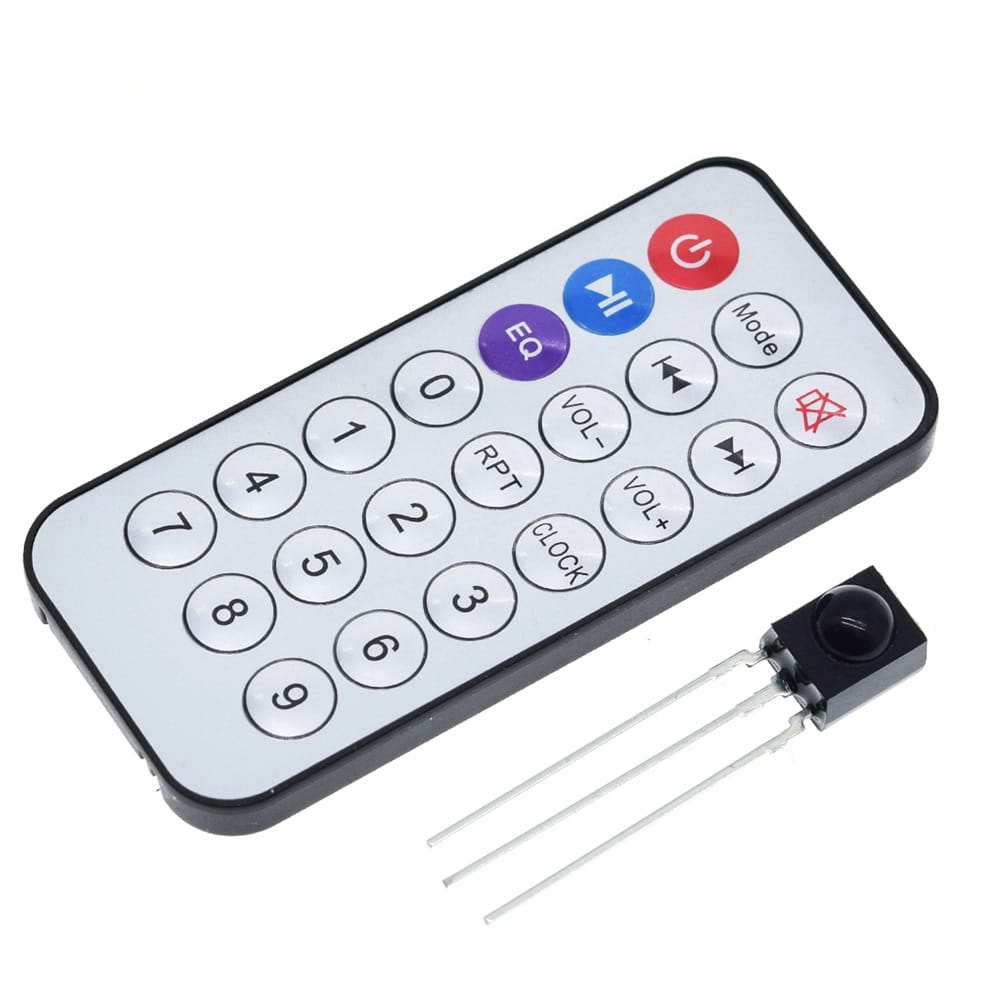
Wireless Remote Control Module (TSOP4838 – 38kHz)
The TSOP4838 is a miniaturized Infrared (IR) receiver module engineered specifically for Pulse Code Modulation (PCM) remote control systems. Operating at a standard carrier frequency of 38 kHz, it integrates a PIN photodiode and a preamplifier into a single package. This enables it to receive, demodulate, and filter signals from common consumer electronic remotes. Core Technical Specifications: Carrier Frequency: 38 kHz Operating Voltage: 2.5 V to 5.5 V DC Supply Current: 0.5 mA to 0.9 mA (very low power requirements) Transmission Distance: Up to 45 meters (148 feet) under ideal conditions Peak Sensitivity Wavelength: 950 nm Directivity Angle: 45 degrees Package Form Factor: DIP-3 (through-hole component) Pin Configuration (DIP-3 Package): Looking at the front of the sensor (the side with the bulbous detector lens), the pins from left to right are typically arranged as follows: OUT (Pin 1): Demodulated data output. Connects directly to a microcontroller digital input pin. GND (Pin 2): Ground connection (0V). Vs (Pin 3): Power supply pin. Key Performance Strengths: Noise Suppression: Built-in automatic gain control (AGC) suppresses spurious pulses caused by energy-saving lamps like Compact Fluorescents (CFLs). EMI Shielding: Internal metal shielding protects the data string from electromagnetic interference. Ambient Light Resistance: Package features an epoxy daylight filter to ensure sunlight or room lighting does not disrupt signal reception. Burst Detection Design: Optimized exclusively for receiving brief bursts of data separated by gaps (like remote buttons) rather than handling continuous 38 kHz data streams. Common Applications: Interfacing with microcontrollers such as Arduino and Raspberry Pi boards. DIY home automation, smart lighting switches, and robotics. Replacement parts for consumer entertainment systems like televisions, stereos, and media players.
AI Readiness
Good foundation, but some important product data is still missing.