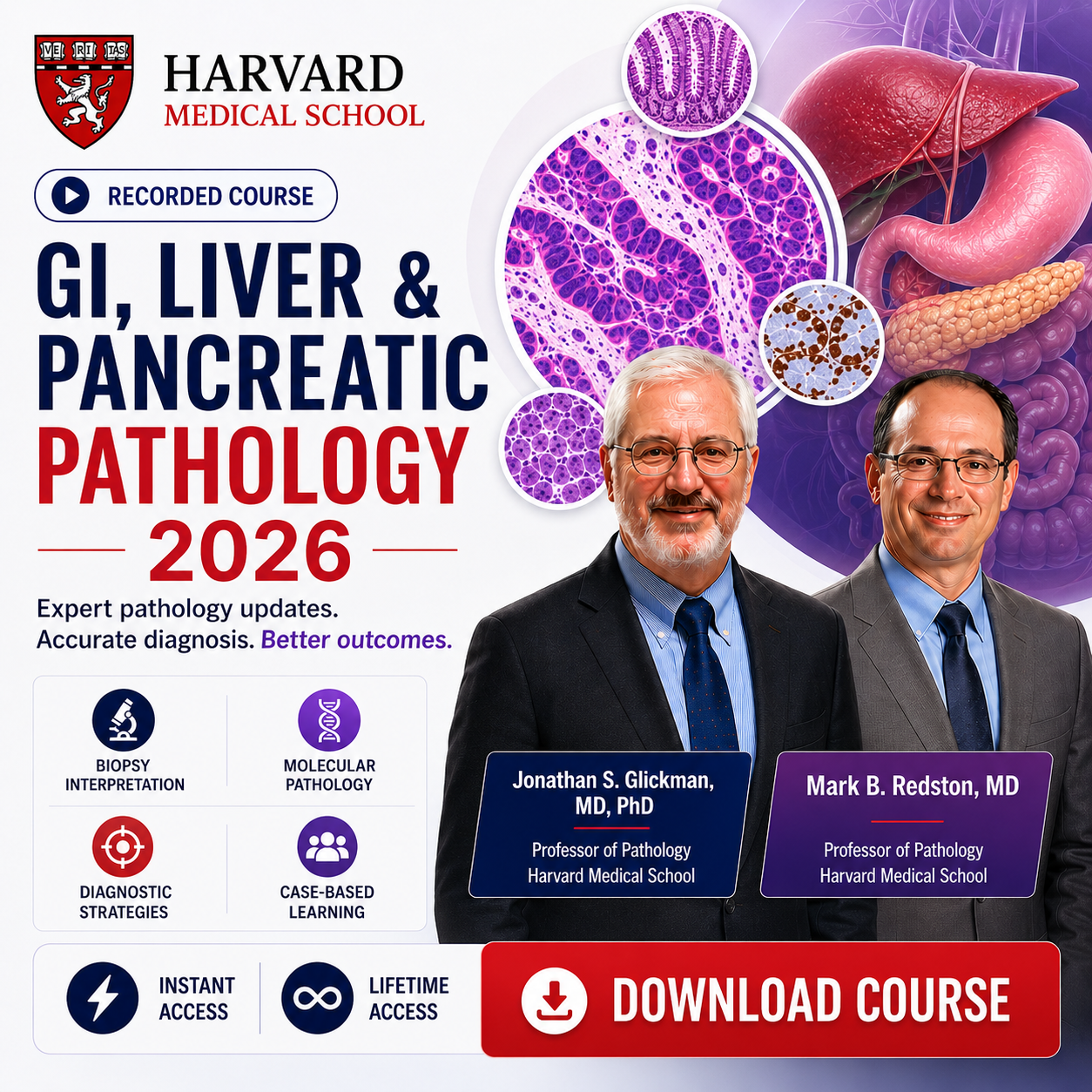
Harvard Gastrointestinal, Liver, and Pancreatic Pathology 2026
.mc-course{ max-width:1100px; margin:40px auto; font-family:Arial,sans-serif; color:#222; line-height:1.7; } .mc-hero{ background:linear-gradient(135deg,#8b0018,#e52b35); color:white; padding:40px; border-radius:16px; } .mc-badge{ display:inline-block; border:1px solid #fff; border-radius:30px; padding:6px 14px; font-size:12px; margin-bottom:15px; } .mc-hero h1{ font-size:34px; margin:0 0 15px; color:white; } .mc-stats{ display:grid; grid-template-columns:repeat(4,1fr); gap:15px; margin-top:25px; } .mc-stat{ background:rgba(255,255,255,.15); padding:15px; border-radius:12px; text-align:center; } .mc-stat strong{ font-size:28px; display:block; } .mc-section{ margin:35px 0; } .mc-section h2{ color:#9b001b; border-bottom:2px solid #d33; padding-bottom:8px; } .mc-box{ background:#fff4f4; border-left:5px solid #b00020; padding:18px; border-radius:10px; margin:18px 0; } .mc-card{ border:1px solid #e8b8bd; border-radius:12px; margin:15px 0; overflow:hidden; } .mc-card h3{ background:#9b001b; color:white; margin:0; padding:14px; } .mc-card ul{ margin:0; padding:18px 25px; } .mc-grid{ display:grid; grid-template-columns:repeat(4,1fr); gap:15px; } .mc-info{ background:#fff4f4; padding:18px; border-radius:12px; } .mc-cta{ background:#b00020; border-radius:14px; font-size:26px; font-weight:bold; margin-top:30px; overflow:hidden; text-align:center; } .mc-cta a{ display:block; width:100%; padding:22px; color:white !important; text-decoration:none !important; box-sizing:border-box; transition:background .2s ease, transform .2s ease; } .mc-cta a:hover{ background:#8b0018; color:white !important; } @media(max-width:768px){ .mc-stats, .mc-grid{ grid-template-columns:1fr; } .mc-hero{ padding:28px; } .mc-hero h1{ font-size:26px; } } HARVARD • 2026 EDITION Harvard Gastrointestinal, Liver, and Pancreatic Pathology 2026 Expert-guided updates in gastrointestinal, liver, and pancreatic pathology with practical diagnostic strategies, biopsy interpretation, molecular testing, and challenging case-based learning. 2026 Edition GI Pathology Liver Pathology Pancreas Pathology Course Details: Harvard Gastrointestinal, Liver, and Pancreatic Pathology 2026 — recorded medical course package focused on diagnostic pathology, molecular testing, and practical specimen interpretation. About This Course This course provides a comprehensive update in gastrointestinal, liver, gallbladder, and pancreatic pathology, with emphasis on new entities, recent advances, practical diagnostic strategies, and systematic interpretation of specimens. Topics include Barrett’s esophagus and associated neoplasia, colitis biopsy diagnosis, IBD controversies, colon cancer staging, GIST, GI lymphomas, molecular diagnostics, pancreaticobiliary tumors, acute hepatitis, autoimmune hepatitis, cholestatic disorders, and hepatocellular carcinoma. Why Choose This Course Key Highlights Focused review of gastrointestinal, pancreatic, and liver pathology Practical diagnostic strategies for everyday pathology practice Updates on neoplastic and non-neoplastic diseases Biopsy interpretation and ancillary testing approaches Case-based learning for pathologists, fellows, and trainees Topics Covered GI Pathology Barrett’s esophagus, colitis, IBD, colon cancer staging, GIST, and GI lymphomas. Liver Pathology Acute hepatitis, autoimmune hepatitis, cholestatic disorders, and hepatocellular carcinoma. Pancreatic Pathology Pancreaticobiliary tumors, cytology, tumor classification, and diagnostic pitfalls. Molecular Testing Molecular diagnostics, ancillary techniques, and modern diagnostic workflows. Complete Curriculum Gastrointestinal Pathology Barrett’s Esophagus and Associated Neoplasia Biopsy Diagnosis of Colitis Inflammatory Bowel Disease Controversies Colon Cancer Staging Gastrointestinal Stromal Tumors GI Lymphomas Liver Pathology Acute Hepatitis Autoimmune Hepatitis Cholestatic Disorders Hepatocellular Carcinoma Practical Diagnostic Approaches in Liver Biopsies Pancreatic & Biliary Pathology Pancreaticobiliary Tumors Pancreatic Cytology and Diagnostic Workup Challenging Pancreas Cases Biliary Tract Neoplasia Algorithmic Approaches to Diagnosis Molecular Diagnostics & Ancillary Techniques Molecular Testing in GI Pathology Use of Ancillary Techniques Diagnostic Pitfalls and Pattern Recognition Case-Based Interpretation Updates in Modern Classification Systems Who Should Take This Course Pathologists, pathology fellows, pathology residents, academic and community practice pathologists, gastroenterologists, hepatologists, pancreatic disease specialists, and clinicians involved in the management of gastrointestinal, liver, gallbladder, and pancreatic disorders. Delivery & Access Recorded Course Study at your own pace. Pathology Updates GI, liver, and pancreatic pathology. Practical Cases Diagnostic strategies and specimen interpretation. Support contact@medicourses.online DOWNLOAD COURSE “`
AI Readiness
Good foundation, but some important product data is still missing.