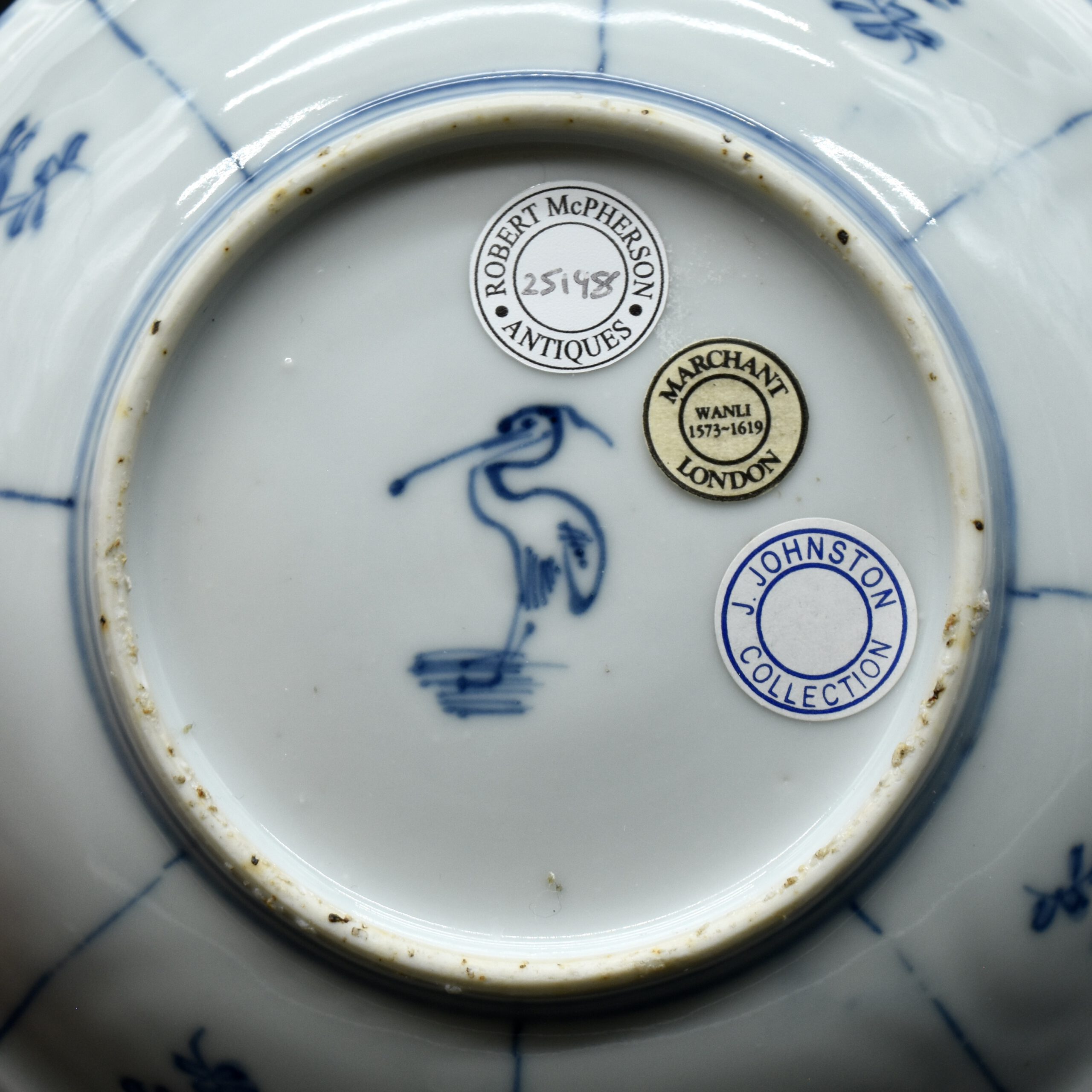
A Very Rare Egret Marked Small Ming Kraak Ware Saucer Shaped Dish c.1590s.
A Very Rare, Perhaps Unrecorded, Egret Marked Ming Saucer Shaped Kraak Ware Dish, Jingdezhen, Perhaps Guanyinge or Shibaqiao Kilns, Wanli Period c.1590s. This small Kraak porcelain or Kraak porselain, dish comes from a Swedish Collection, it then went to the renowned London dealers S. Marchant & Son, who commented that “It is most unusual to find a small saucer dish with an egret mark, no others appear to be recorded” on their invoice, see Provenance. This small Kraak ware dish comes from the Jack Johnson Collection. Dishes with egret marks are rare and have always been very desirable, the reason for this mark is less than straightforward. It is certainly associated with high quality Ming Kraak ware. In the past is has been suggested that the mark was is in fact a stork, the bird that symbolises Den Hague (The Hague). Rather wishful thinking, from a time when people saw Chinese porcelain from a rather biased Western perspective. I can imagine that story would have gone down rather well with some Dutch dealers in the past. The design is of a goose standing at the edge of a piece of flat land surrounded by flowering lotus growing from a pond or lakes edge. The lightly moulded border has eight panels, which are not circular but tear drop shaped or best described as pyriform, meaning pear shaped. It is only recently that pieces excavated with the egret mark have been found in Jingdezhen, at two different kilns, Guanyinge or Shibaqiao. Of course, it is possible that they were made at other Jingdezhen kilns as well. This rare mark is associated with high quality Ming Kraak ware. In the past is has been suggested that the mark was in fact a stork, the bird that symbolises Den Haag (The Hague). I was wishful thinking, from a time when people saw Chinese porcelain from a rather biased Western perspective. The only excavated example of an egret marked porcelain is a fragment that provides evidence of a Portuguese connection as it was excavated at Macao, at the CD-1 Pak Van site (see References). Macau was an important Portuguese colony on the Pearl River from 1557. From the 1640s Macau’s economy declined after Japan halted trade, as well as revolts against Spain and Portuguese. I assume the present example was more likely to have been shipped by the Portuguese to Europe, rather than by the Dutch as the V.O.C. wasn’t formed until 1602. However the Dutch were trading in the late 16th century, and kraak porcelain was imported into the Netherlands. In the 46 years I have been dealing, this is the second egret marked piece I have had. That piece was purchased by Tom Lurie about 25 years ago at the Olympia Antique and Art Fair, London, I am pretty sure it is illustrated in the catalogue of his collection. For more information about Kraak porcelain below our Photograph Gallery also see Kraak Ware Porcelain I have relied extensively on a really well written and produced book for the background history of this Kraak ware dish. Teresa Canepa has done so much research, and the illustrations are excellent. If you don’t have this book, you really should consider buying it : Jingdezhen to the World: The Lurie Collection of Chinese Export Porcelain from the Late Ming Dynasty (Teresa Canepa, published by Ad Ilissvm 2019. ISBN 978-1-912168-09-5). See Reference. SOLD See Below For More Photographs and Information
AI Readiness
Good foundation, but some important product data is still missing.