Explain Your Evidence: Elaboration Revision Mini-Lessons for Opinion and Informational Writing, 4th-5th Grade
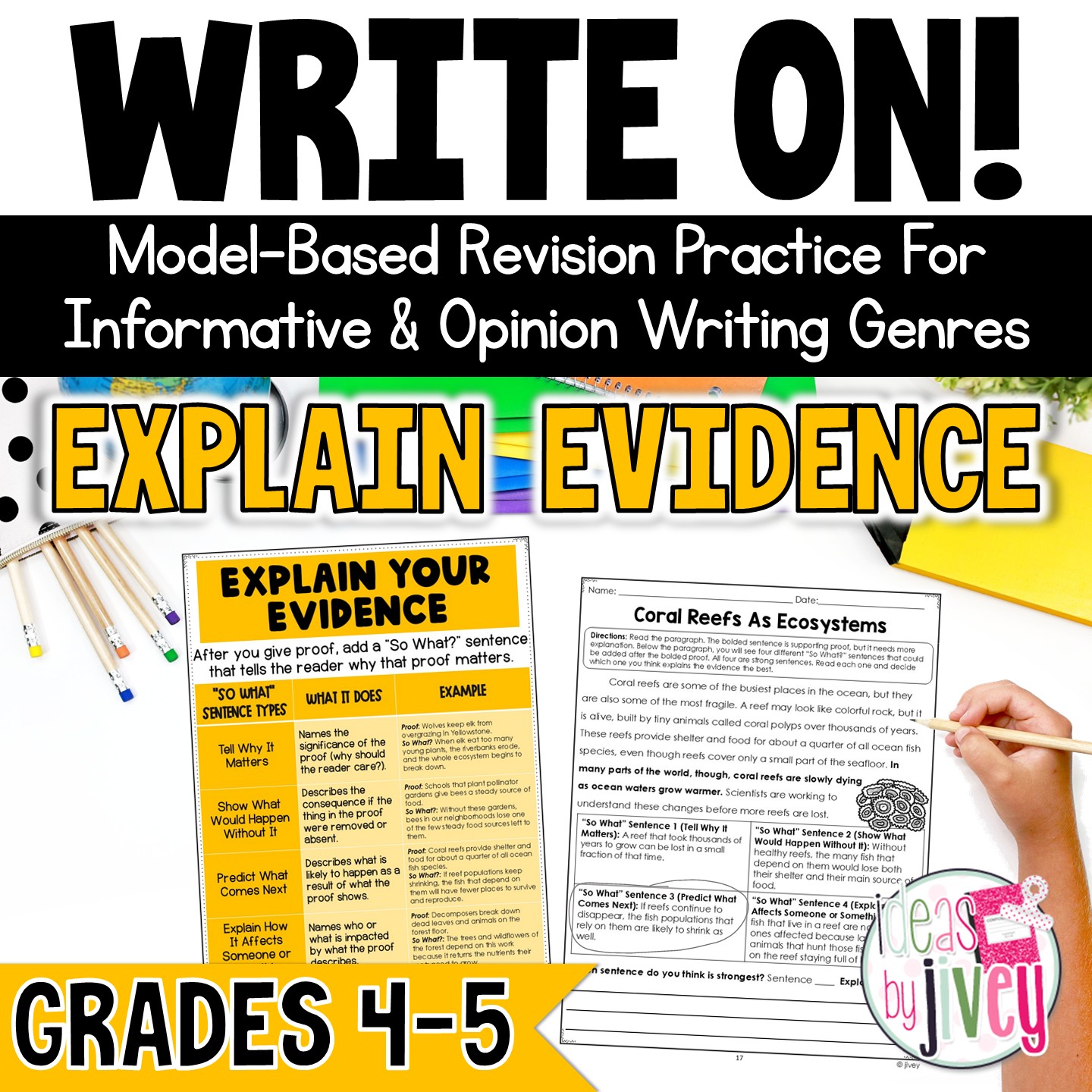
A fact on its own doesn’t make an argument, but many 4th and 5th graders drop one into a paragraph and move on as if it does. This Explain Your Evidence unit is a set of revision mini-lessons that teaches 4th- and 5th-graders to explain their evidence in opinion and informational writing. Students learn four named types of explanations (tell why it matters, show what would happen without it, predict what comes next, and explain how it affects someone or something) and practice adding a “So What?” sentence that tells the reader why each piece of proof matters. This print-and-teach resource is designed to fit inside your existing writing lessons. It teaches one revision move, explaining evidence with a “So What?” sentence, so you can teach it as a short sequence and then use it whenever students revise their own drafts. All passages focus on ecosystems and food webs, so your writing block builds science content knowledge at the same time! How the lessons work In each genre, students begin with an exploration lesson. They study two versions of the same passage, one where the proof stands alone and one with “So What?” sentences, and name what the explanations add. Then three activities move from most supported to most independent: Activity 1, Choose So What Sentence to Support Proof: Students read a passage with four pre-written “So What?” sentences, one of each type, and explain which one they would choose and why. All four are strong, so the goal is building a rationale, not finding one right answer. Activity 2, Label So What Sentences and Add to Writing: Students label four explanations by type, then decide where each one best fits in a passage. Activity 3, Revise With Strong Explanations: Students write their own “So What?” sentences to explain the proof in a passage, with no options provided. Samples are included for every activity in both genres. The sample explanations model specific craft reasoning, so students can see what a strong explanation looks like. What’s included Teacher guide Explaining Your Evidence strategy poster, in black-and-white and color Before You Publish checklist Revision rubric Exploration lessons for opinion and informational writing Three application activities for each genre Samples for all activities in both genres Why teach revision with models Telling students to “make it better” doesn’t give them anything to act on. A named strategy paired with side-by-side models of weak and strong writing does. Students see the difference, name the technique, and practice it across three activities, so the skill has a chance to carry into their own writing. Part of the Write On! series This resource uses the same exploration and application framework as my Write On! Grammar Integration resources. Grammar builds sentence-level skills and revision builds craft-level moves, so the two series work well in the same writing block. You don’t need the grammar resources to use this one. It’s also one of eight strategies in the Write On! Revision Mini-Lessons Bundle, 4th-5th Grade. FAQ What is a So What? sentence in writing? A “So What?” sentence comes right after a piece of proof and tells the reader why it matters. This resource teaches four ways to write one: tell why it matters, show what would happen without it, predict what comes next, and explain how it affects someone or something. How does this resource teach students to explain their evidence? Students first compare a passage where the proof stands alone with the same passage after “So What?” sentences are added, and name what changed. They then learn the four types and move through three activities, from choosing between pre-written sentences to labeling and placing them to writing their own. Is this a full writing unit? No. It teaches one specific revision move (explaining evidence) and is designed to be used inside your existing opinion and informational writing lessons. Do I need the Write On! Grammar resources to use this? No. The two series are designed to work together, but each one stands on its own. Please remember, this purchase is for the use of one teacher. It is not intended to be shared. Please use the ‘additional license’ purchase if more than one teacher will be using it. Thank you! Copyright © Ideas By Jivey, LLC All rights reserved by author, Jessica Ivey. Permission to copy for single classroom use only. Electronic distribution limited to single classroom use only. Not for public display.
How AI sees this product
The more complete this product's details, the more confidently AI assistants can understand and recommend it.