Meshtastic Mesh Device Nano G2 Ultra
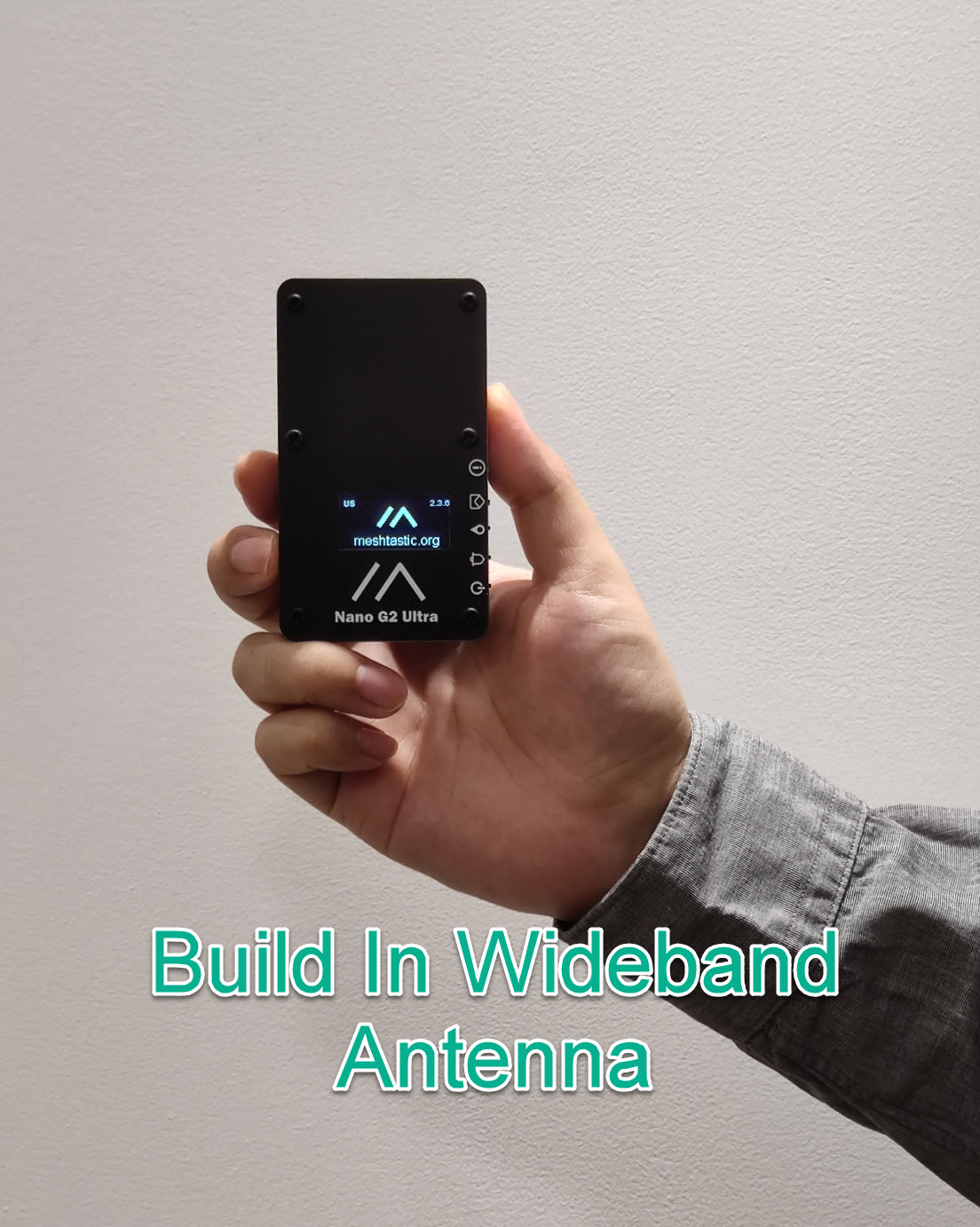
More stock is expected to arrive at the warehouse on August 25, 2025. [Click Here for An Overview and Comparison Table of our Products for Meshtastic ] The Core Advantage of Nano Series The Nano series’ Lora antenna offers superior performance in various environments, including near the human body, due to its special design that minimize signal degradation and maintain efficient communication. In contrast, most other antennas currently available experience significant performance degradation when placed near the human body, as evidenced by a marked shift in resonant frequency and a substantial increase in VSWR, making them less suitable for wearable wireless devices. More Technical Information Meshtastic Frequency Bands Supported by Nano G2 Ultra US (902.0Mhz to 928.0Mhz), EU_868 (869.4Mhz to 869.65Mhz), JP (920.8Mhz to 927.8Mhz), ANZ (915.0Mhz to 928.0Mhz), RU (868.7Mhz to 869.2Mhz), KR (920.0Mhz to 923.0Mhz), TW (920.0Mhz to 925.0Mhz), IN (865.0Mhz to 867.0Mhz), NZ_865 (864.0Mhz to 868.0Mhz), TH (920.0Mhz to 925.0Mhz), UA_868 (868.0Mhz to 868.6Mhz). About Meshtastic: https://meshtastic.org/docs/about Meshtastic Youtube Channel: https://www.youtube.com/meshtastic Overview The Nano Series devices are engineered to be a portable and durable solution for outdoor adventures such as hiking, piloting, skiing and more. They are designed to strike a balance between RF performance, size, ruggedness, and power efficiency, providing users with a reliable solution in various outdoor environments. The primary design goal of the Meshtastic Mesh Device Nano G2 Ultra is to reduce power consumption and improve battery life (Battery is NOT Included, Battery Information) by using the low power MCU NRF52840 and optimizing the power relatived designs. The typical battery life is optimized to be about 5 days. Nano G2 Ultra and Nano G1 Explorer have exactly the same Lora front-end circuit design and internal wideband Lora antenna, which supports frequencies from 815 Mhz to 940 Mhz. The wideband antenna, combined with an optimized wideband Lora RF frontend circuit, enables the Nano G2 Ultra to work with the majority of regions’ LoRa frequency bands around the world without the need for antenna changes. The design of the Nano G2 Ultra also takes into account the potential effect of the human body on its antenna performance, ensuring optimal RF performance even when carried in a pocket. Power Consumption and Features Comparison of Nano G2 Ultra and Nano G1 Explorer Editions Nano G2 Ultra Nano G1 Explorer Core Research Areas Low Power Design Human Body Near Antenna (HBN) Wideband High Radiation Efficiency Planar Antenna and RF Front-end Design Photo Product Status ACTIVE ACTIVE Current Hardware Version 22 Sep 2023 06 Mar 2023 Lora RF Max Output Power Up to 22 dBm Up to 22 dBm LoRa Transceiver SX1262 SX1262 Lora Operation Frequency Wideband from 815 Mhz to 940 Mhz Wideband from 815 Mhz to 940 Mhz MCU NRF52840 ESP32 WIFI – YES Bluetooth v5.4 v4.2 Satellite Navigation GPS, BDS GPS, BDS Real-Time Clock (RTC) NXP PCF8563 – USB Connector Type C Type C Screen 1.3 Inch OLED Screen 1.3 Inch OLED Screen Battery Optional 3.7V 603450 JST 1.25mm Rechargeable Li-Polymer Battery (Battery is NOT Included, Battery Information) Optional 3.7V 603450 JST 1.25mm Rechargeable Li-Polymer Battery (Battery is NOT Included, Battery Information) Power Input Socket USB Type C, JST 1.25mm Connector for Rechargeable Li-Polymer Battery USB Type C, JST 1.25mm Connector for Rechargeable Li-Polymer Battery LoRa Antenna Build In Wideband PCB Antenna Build In Wideband PCB Antenna Accessories Build In 10 Pin FPC Connector (0.5mm Pitch, 1x I2C, 6x GPIO, VCC3V3 and GND) Optional I2C Extension Board (1x GROVE I2C Socket and 1x SparkFun QWIIC I2C Socket for Sensors and Keyboard) – Typical Average Power Consumption 14.24 mA @ 4.3V (Lora TX Power = 22 dBm, GPS OFF, Screen OFF, Two Nodes in Network) 70.50 mA @ 4.3V (Lora TX Power = 22 dBm, GPS Low Power Mode, Screen OFF, Two Nodes in Network) Typical Scenarios Hiking, Pilot, Skiing, Work with the majority of regions’ LoRa frequency bands around the world without the need for Antenna changes. The typical battery life is optimized to be about 5 days (For Hardware Version 22 Sep 2023 or Later). Hiking, Pilot, Skiing, Work with the majority of regions’ LoRa frequency bands around the world without the need for Antenna changes. The typical battery life is optimized to be about 16 Hours. In general, Nano G2 Ultra is not designed to replace Nano G1 Explorer, Nano G2 Ultra focuses on low power, and Nano G1 Explorer supports WIFI. Typical RF Performance Item Description Lora Operation Frequency 815 Mhz to 940 Mhz Lora Max RF Output Power 22 dBm VSWR of Lora PCB Antenna < =1.5 @ 915 MHz and 868Mhz Gain of Lora PCB Antenna 2.0 dBi, Omni-directional Impedance Bandwidth of Lora PCB Antenna 815 Mhz to 940 Mhz for VSWR < = 2 Polarization of Lora PCB Antenna Linear High-Precision Frequency Reference for Lora 32MHz TCXO (+-1.5 ppm) Positioning And Navigation Module Build-in GPS Module, LNA and Omni-directional Antenna. GPS and BDS are supported VSWR of GPS PCB Antenna < =2 @ 1575.42 MHz, GPS L1 Band Impedance Bandwidth of GPS PCB Antenna 1474 Mhz to 1590 Mhz for VSWR <= 2 Electrical Characteristics Item Description Note MAX Charging Current 485 mA Typical Charging Time 3 Hours From 0% to 100%, 3.7V 1200mAh 603450 JST 1.25 Rechargeable Li-Polymer Battery Typical Battery Life 5 Days 1200mAh Li-Polymer Battery, Two Nodes in Network, Channel Options: Long Rang Fast, GPS set to OFF The Latest Firmware Meshtastic Mesh Device Nano G2 Ultra had been supported by the official meshtastic repository on Github from firmware version 2.x.xx.xx. Thus, the latest firmware could be downloaded from the meshtastic project’s releases page: https://github.com/meshtastic/Meshtastic-device/releases Firmware file: firmware-nano-g2-ultra-2.x.x.xxx.uf2 The Fimware could be updated by Drag & Drop. Mechanical Design Accessories Optional I2C Extension Board [Installation Instructions] The I2C Extension Board has two I2C sockets, which are used to connect GROVE, Adafruit STEMMA QT and SparkFun QWIIC devices. These two I2C sockets are based on the 10 Pin FPC Connector of Nano G2 Ultra. Meshtastic supported I2C devices (Keyboard and Sensors are NOT Included) Telemetry Module Supported sensors connected to the I2C bus of the device will be automatically detected at startup. Environment Telemetry and Air Quality must be enabled for them to be instrumented and their readings sent over the mesh. Sensor I2C Address Data Points BMP280 0x76, 0x77 Temperature and barometric pressure BME280 0x76, 0x77 Temperature, barometric pressure and humidity BME680 0x76, 0x77 Temperature, barometric pressure, humidity and air resistance MCP9808 0x18 Temperature INA260 0x40, 0x41 Current and Voltage INA219 0x40, 0x41 Current and Voltage LPS22 0x5D, 0x5c Barometric pressure SHTC3 0x70 Temperature and humidity SHT31 0x44 Temperature and humidity PMSA003I 0x12 Concentration units by size and particle counts by size More Information: https://meshtastic.org/docs/settings/moduleconfig/telemetry Canned Message Module Canned Message Module, I2C Extension Board and M5Stack CardKB can turn Nano G2 Ultra into a stand-alone device, which can send and receive messages without a mobile phone. M5Stack CardKB The CardKB is fully supported in freetext mode and select mode. Use UP/DOWN/ENTER to select a predefined message and send it. For a freetext message, just type it in and press ENTER to send it. If you don’t want to broadcast your freetext message, you can use the CardKB to send it to a specific node. Just press TAB and select the target node with the LEFT/RIGHT keys. The message will be sent to the node with the matching name and node number. The target node will be remembered for your next message. More Information: https://meshtastic.org/docs/settings/moduleconfig/canned-message#cardkb APP Screenshots Additional Information Firmware Android APP iOS APP Meshtastic Home Page
Specifications
- Region
- Wideband 815Mhz to 940Mhz, EU868MHz
How AI sees this product
The more complete this product's details, the more confidently AI assistants can understand and recommend it.