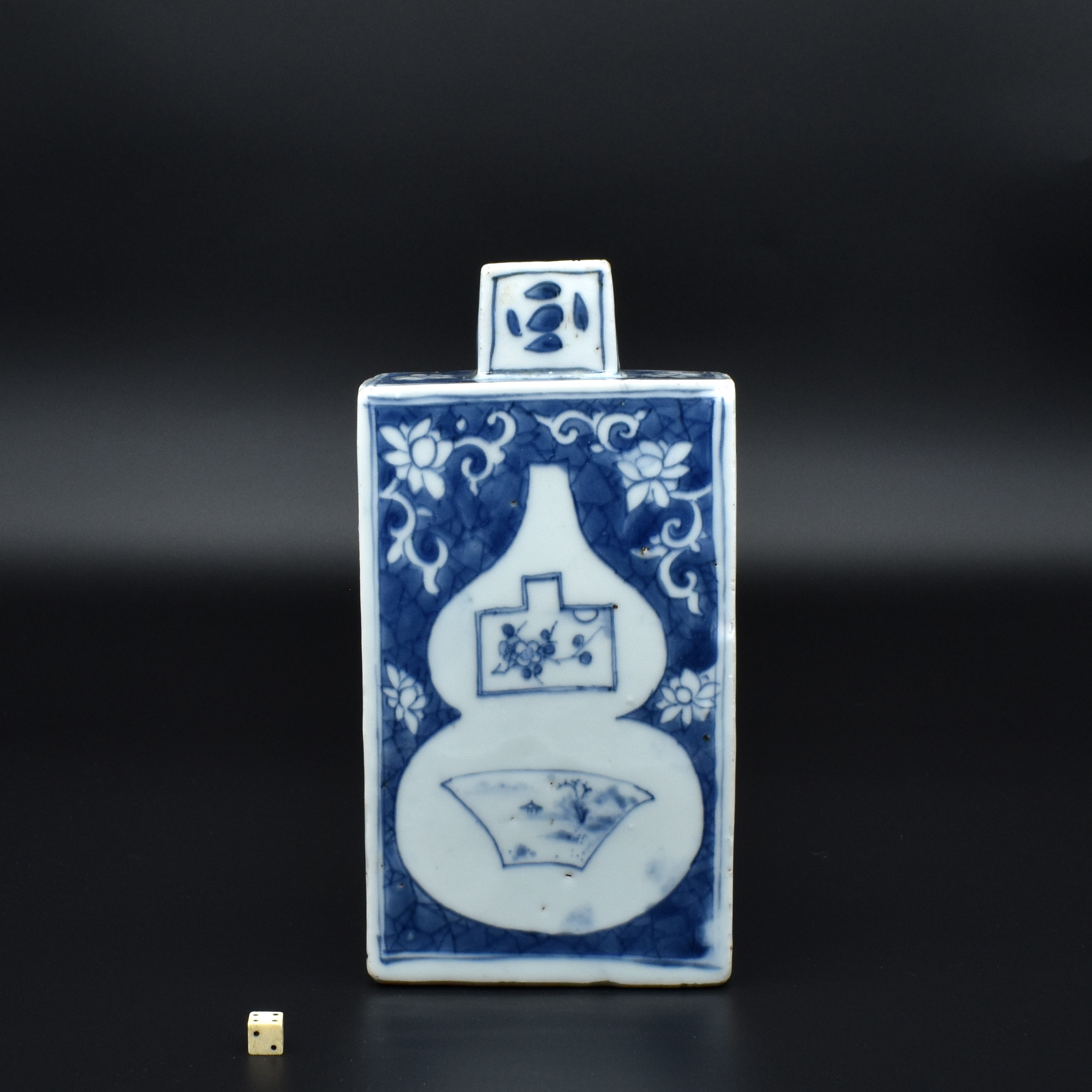
An Unusual Chongzhen Blue and White Export Porcelain Canister c.1640.
An Unusual Transitional Blue and White Export Porcelain Canister, Jingdezhen Kilns, Late Ming Dynasty, Chongzhen Period (1628-1644). This heavily potted rectangular canister has blue ground panels framed within blue lines. The main panels and side panels have a deep cobalt blue ground which is painted to resemble cracked ice, symbolic of the arrival of Spring. Flowering lotus and a double gourd are left in the white, with a lotus flower either side on the flat top. One side has a painting of flowering cherry in the moonlight, below is a painted fan with a winters landscape. The gourd panel on the other side is decorated with what are sometimes referred to as floating flowers. Including flowering prunus, fruiting pomegranate and bamboo sprigs. This early Chinese export porcelain canister is not based on a Chinese form, it is likely to have been based on a Western original, perhaps Dutch. The Dutch sent out wooden models to be made in porcelain at Jingdezhen, this could be one such example. It seems that at this period the decoration was mostly left to what the Chinese artists wanted to paint. Rectangular and square forms don’t come naturally to ceramics, unlike the more natural clay forms thrown by a potter on a wheel. The present example likely derives its form from a metal original. Sheets of metal can easily be soldered together to create this form, they have strong resilient edges. Ceramics with sharp edges are more tricky to construct because the clay often dries unevenly and the sharp damp edges especially vulnerable. The Chinese potter who made this canister has had to repair a corner by adding a small piece of clay before it was fired (see photographs and condition). The sharp edges are also a cause for problems after firing, they are easy to chip. Porcelain with sharp edges made during the Kangxi period (1662-1722) were more likely to have small glaze frits to the edges than pieces from the Chongzhen period. Technology is often two steps forward, one step back. The present example has decoration that appears on other Chongzhen pieces, see ‘Information’ below the Photograph Gallery. There are a pair of very Transitional porcelain canisters with covers at Burghley House. They are recorded in the 1690 Devonshire Schedule, an inventory recording an enormous bequest from Elizabeth, Countess of Devonshire (1619-1689), to her daughter Anne, Countess of Exeter (1649-1703). Under the heading ‘Large plain China’ are listed: ‘A pair of blue and white flatt square Bottles with hollow fflatt cover to them.’ For a link to this pair of canisters see ‘Information’ below the Photograph Gallery. SOLD
How AI sees this product
The more complete this product's details, the more confidently AI assistants can understand and recommend it.