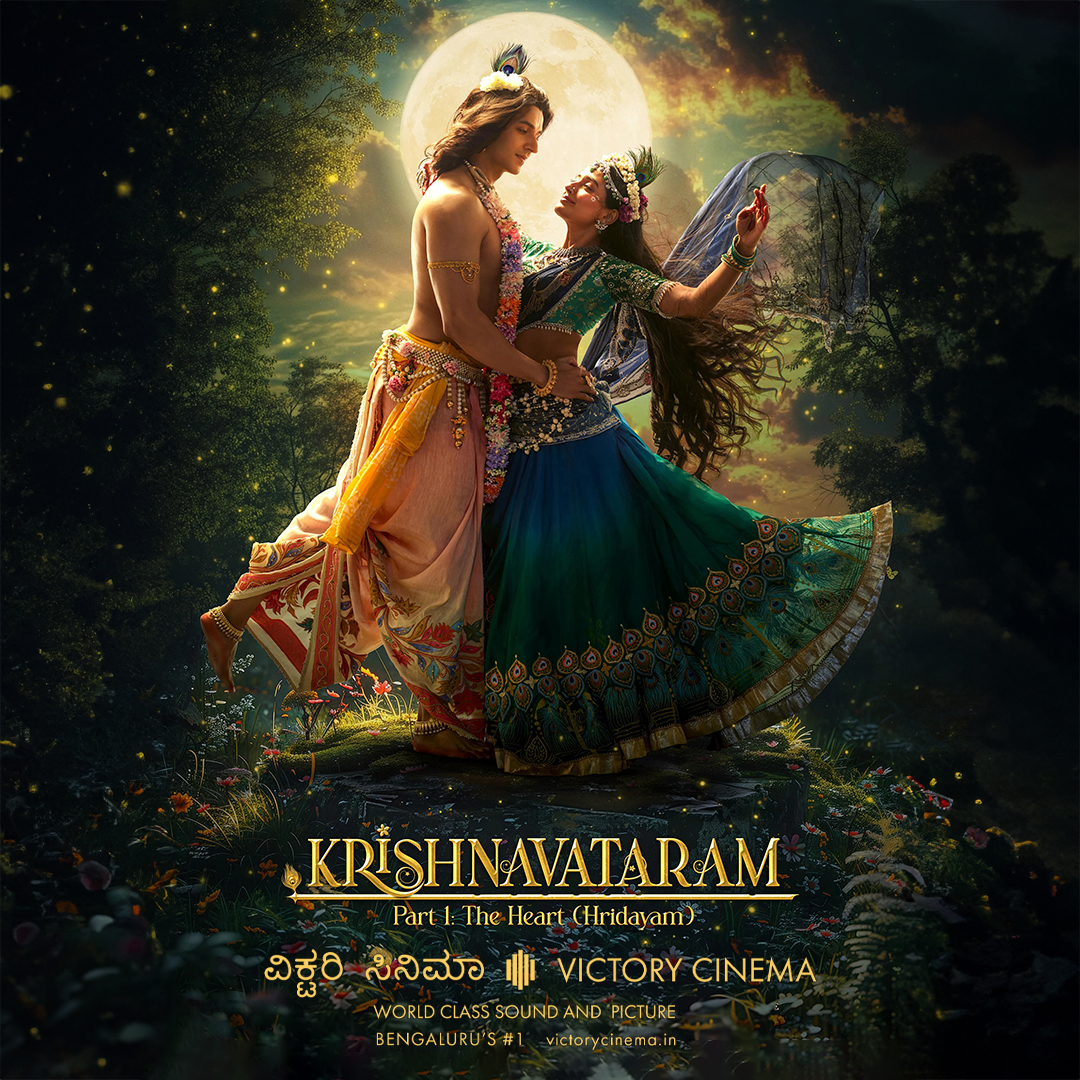
Krishnavataram Part 1: The Heart (Hindi with English Subtitles)
Krishnavataram Part 1: The Heart (Hindi with English Subtitles) The Divine, Made Human There are stories that belong to every Indian childhood — told by grandparents before bedtime, painted on temple walls, sung in courtyards and classrooms. The story of Lord Krishna is perhaps the most enduring of them all: a tale of love in all its forms, of duty and devotion, of mischief and majesty, of a life that touched every person it met and left them transformed. Krishnavataram Part 1: The Heart, directed by Hardik Gajjar and now showing at Victory Cinema in Hindi with English subtitles, attempts something bold and rare — to bring this story to the cinema screen not as a spectacle of invincibility, but as a deeply emotional, deeply human journey. It is the opening chapter of a planned trilogy, and it announces itself with both sincerity and scale. The Story: Three Loves, One Life The film opens with a quietly extraordinary choice. We see Lord Krishna — Dwarikadhish, the king of Dwarka — in his final moments on earth, struck by an arrow shot by a hunter named Jara. Most stories treat the death of a god as catastrophe. Krishnavataram treats it as the calm completion of a life lived with absolute fullness. Before departing, Krishna asks the hunter for his flute — so he may play it one last time, honouring a promise made to Radha, his eternal beloved. It is a beginning that immediately establishes the film’s emotional register: sacred, intimate, and quietly devastating. The narrative is framed through a contemporary lens. A young, sceptical man visits the Jagannath Temple in Puri, challenging a priest with questions of logic, science, and reason. Why believe? What is God? In response, the priest begins to tell Krishna’s story — and the film unfolds as that telling. It is an elegant structural choice that anchors an ancient myth in the questions of a modern mind. The heart of the film lies in Dwarka, and in three relationships that together trace the full geography of love. With Radha, Krishna shares something beyond the physical — a love so pure it cannot be possessed, only remembered and grieved. With Rukmini, the avatar of Lakshmi and his foremost queen, he shares devotion, duty, and a partnership of divine equals. With Satyabhama — the daughter of Satrajit, fierce and passionate, who encounters Krishna and falls deeply in love — he shares the most turbulent and earthly of connections: marked by ego, longing, and the painful complexity of truly human emotion. The film is told significantly from Satyabhama’s point of view, and this is one of its most distinctive and courageous decisions. In choosing to give primacy to the most emotionally volatile of Krishna’s consorts, director Hardik Gajjar finds a way into the story that is both unconventional and deeply relatable. Satyabhama is not the serene divine beloved — she is flawed, jealous, and achingly real. Through her eyes, the audience encounters a Krishna who must navigate the full difficulty of love — not just as a cosmic force, but as a person. The Creative Team Hardik Gajjar directs and co-writes alongside Prakash Kapadia and Raam Mori, the latter of whom also authored the 2025 book Satyabhama — one of the source texts for the film alongside the ancient Brahma Vaivarta Purana. The producers are Sajan Raj Kurup and Shobha Sant under their banner Creativeland Studios Entertainment, in association with Athasrikatha Motion Pictures. The visual language of the film is crafted by cinematographer Ayananka Bose, who brings to the screen the elaborate sets of Dwarka, its temple spaces, and the mythological landscapes surrounding them with a palette that reviewers have noted as one of the film’s most consistent strengths. The music is composed by Prasad Sashte, combining devotional melody with orchestral sweep to create an atmosphere that is both intimate and expansive — designed to move the audience emotionally as much as spiritually. The Cast Siddharth Gupta takes on one of Indian cinema’s most daunting challenges: bringing Lord Krishna to life on screen for a contemporary audience that has grown up with countless versions of this figure across television, art, and literature. His performance has drawn praise for its restraint and warmth — for its focus on Krishna’s humanity rather than his omnipotence. It is a portrayal of a god who listens, who loves, who carries the weight of all his promises. Sanskruti Jayana as Satyabhama delivers what several reviewers have identified as the emotional core of the film — a performance of intensity and vulnerability that anchors the story’s most dramatically rich arc. Sushmitha Bhat as Radha and Nivaashiyni Krishnan as Rukmini bring their respective characters’ contrasting natures to life with quiet power. The supporting cast includes Jackie Shroff, Akshara Shivakumar as Draupadi, Amanjot Singh as Balram, and a wide ensemble drawn from across Indian film and television. What the Critics Are Saying Krishnavataram Part 1: The Heart has been received with genuine warmth by critics who came to it with open eyes. India TV News awarded it 3.5 out of 5 stars, calling it a brave attempt to humanise the divine — a film about ego, jealousy, and the messy reality of relationships, wrapped in a spiritual context — and praising it as a film that makes audiences care about the person behind the peacock feather. Bollywood Hungama described it as a sincere, visually rich, and emotionally resonant devotional saga, noting the strong emotional core and the grandeur of its production design, while pointing to a slow first half and uneven moments as areas where the film could have been tighter. All Tenvow recommended it particularly as a theatre experience — citing the emotional depth and spiritual resonance as qualities that stay with the viewer well after the credits roll, and identifying it as completely suitable for family audiences. Critics across publications consistently praised Ayananka Bose’s cinematography, the production design, Prasad Sashte’s score, and the lead performances. A Film Built for the Big Screen Krishnavataram Part 1: The Heart is, by every measure, a film designed for theatrical viewing. Its canvas is the sweep of Dwarka, the golden chambers of a divine household, the luminous expanse of myth made tangible. Its emotional peaks — the flute played at the end of a god’s life, the rage of a queen who loves without limits, the silence of a love too large for words — are experiences that reward the undivided attention only a cinema can provide. This is a film to be seen with the full scale of a proper screen and the company of an audience that shares, in whatever measure, in the cultural memory it carries. Book Directly at victorycinema.in — No Booking Fees Krishnavataram Part 1: The Heart is showing at Victory Cinema in Hindi with English subtitles. Book your tickets directly at victorycinema.in — Victory Cinema’s own website — with no convenience fee, no surcharge, and no hidden charges of any kind. All 505 seats are the same class, the same comfort, and the same price. What you see is what you pay. Victory Cinema is the highest-rated cinema on Google Reviews in Bengaluru — and across all of Karnataka — among both single screens and multiplexes. Experience devotional cinema the way it was meant to be experienced: on a great screen, with a great audience.
AI Readiness
Good foundation, but some important product data is still missing.