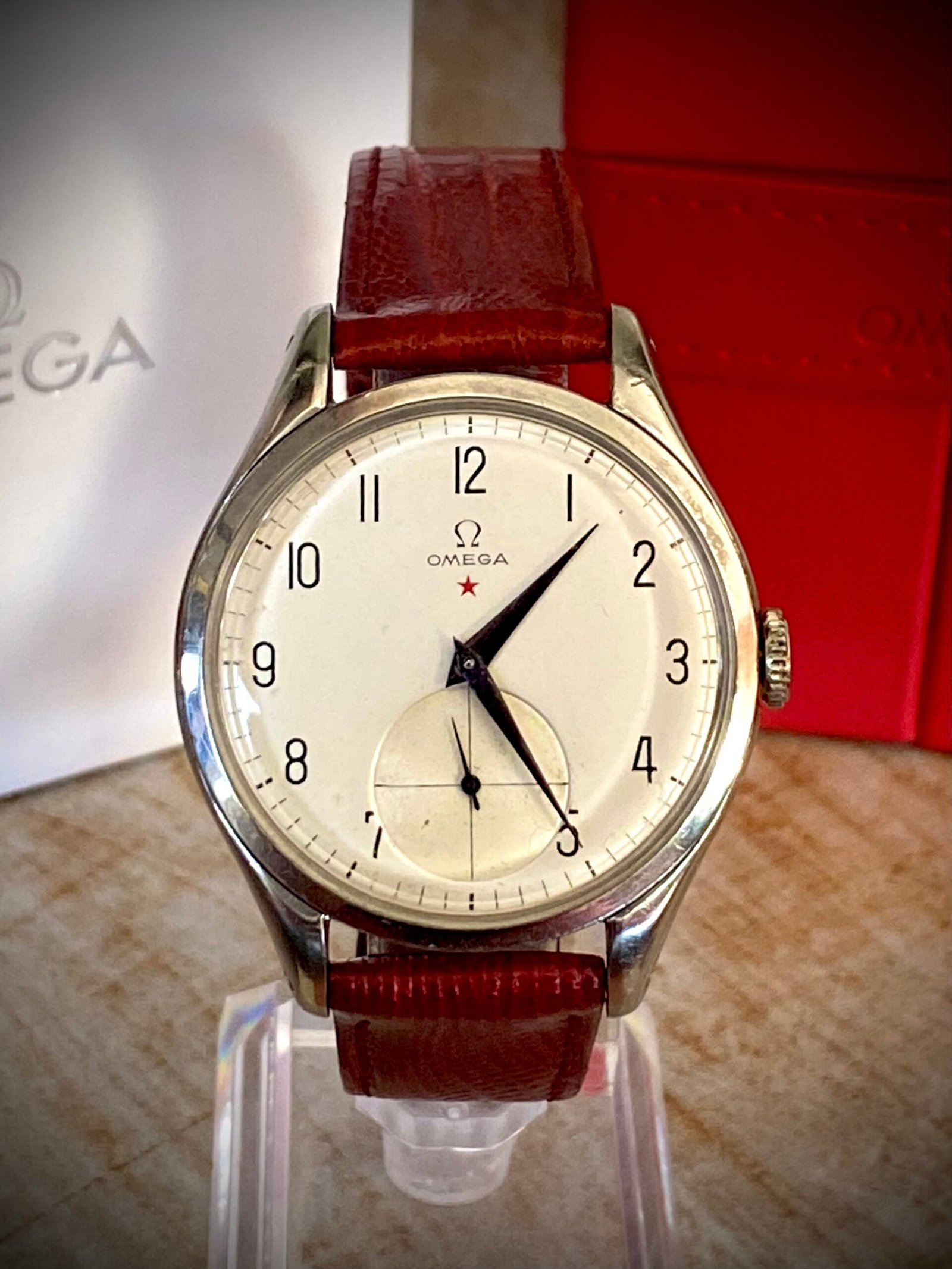
OMEGA PRE-GENEVE CASE «JUMBO» YEAR 1950
History of Omega Watches The history of Omega is a fascinating tale of constant innovation, limitless precision, and a unique connection with humanity’s most pivotal moments. From its humble beginnings as a family workshop in Switzerland to becoming a global giant in watchmaking, Omega has left an indelible mark on history, whether on the wrists of astronauts on the Moon, on secret agents on the big screen, or on the tracks of the Olympic Games. Origins and Foundation Omega’s story began in 1848, when a 23-year-old watchmaker named Louis Brandt opened a pocket watch assembly workshop in La Chaux-de-Fonds, Switzerland. In its early days, Brandt purchased components from local craftsmen and assembled them with meticulous precision. Following his death in 1879, his sons Louis-Paul and César took over the business. Tired of the inconsistent quality of suppliers, they made a bold move: in 1880, they relocated the company to Biel/Bienne and began manufacturing their own movements, thus controlling the entire production process. The Birth of the Name Omega The major turning point came in 1894 with the creation of the revolutionary 19-line caliber. This movement was not only extremely precise, but it also introduced a system of interchangeable parts that allowed for easy repair by any watchmaker in the world. The success was so overwhelming that the Brandt brothers decided to name their creation after the last letter of the Greek alphabet: Omega, symbolizing perfection, «the ultimate achievement». In 1903, the company officially became Omega Watch Co., adopting the name of its star product. Consolidation and Challenges of the 20th Century In the early decades of the 20th century, Omega solidified its reputation for precision. In 1917, the British Royal Flying Corps designated it as the official supplier, and during the Second World War, it became the primary provider of watches for the Allied forces, demonstrating its reliability under extreme conditions. The post-war economic difficulties led Omega to merge with Tissot, forming the SSIH group (Société Suisse pour l’Industrie Horlogère) in 1930. In 1932, the brand achieved another milestone by being named the official timekeeper of the Los Angeles Olympic Games, a role it maintains to this day, forever linking it to the precise measurement of time in elite sports. The Golden Era: Birth of Icons The second half of the 20th century witnessed the birth of the most iconic models from the brand. In 1948, to celebrate its centennial, Omega launched the Seamaster, based on designs developed for the British navy during the war. Conceived as a timepiece for «the city, the sea, and the field,» it combined elegance and water resistance, laying the foundation for one of the longest-running collections in history. In 1952, the Constellation line appeared, created to commemorate the numerous precision awards the brand had won at chronometer observatories. In 1955, Omega introduced the Ladymatic, the first automatic watch for women. But it was in 1957 when Omega unveiled the legendary professional trilogy: the Seamaster 300 (professional diving), the Railmaster (anti-magnetic for scientists), and the timepiece that would become the most famous in history, the Speedmaster (racing chronograph). The Conquest of Space and the «Moonwatch» The destiny of the Speedmaster changed forever when NASA, in 1965, subjected it to rigorous testing alongside other chronographs. The Speedmaster was the only one to pass all the tests, certified for all manned missions. Since then, it has accompanied astronauts on the Gemini and Apollo programs. The pinnacle moment came on July 21, 1969, when Buzz Aldrin stepped onto the lunar surface with his Speedmaster Professional on the wrist, forever earning the nickname «Moonwatch.» During the fateful Apollo 13 mission, the Speedmaster was crucial for timing the engine ignition that allowed the crew’s safe return, a feat for which NASA awarded Omega the prestigious «Snoopy» prize. The Quartz Crisis and Revival The 1970s brought about the quartz revolution and a profound crisis that shook the entire Swiss watchmaking industry. The SSIH group was on the brink of bankruptcy, but in 1983, entrepreneur Nicolas Hayek led the merger with ASUAG to create SMH, which later became the Swatch Group, safeguarding Omega’s future. The brand made a strong comeback, focusing on its heritage and new marketing strategies. In 1995, a Seamaster appeared on Pierce Brosnan‘s wrist in the James Bond film «GoldenEye», starting a partnership that continues to this day and has made the Seamaster Diver 300M the official watch of agent 007. Technical Innovation and the New Millennium In 1999, Omega introduced a technical revolution with British watchmaker George Daniels: the Co-Axial Escapement. This innovative system drastically reduced friction, improving precision and extending maintenance intervals. In 2002, the Seamaster Aqua Terra was born, a bridge between sportiness and elegance, and in 2005, the robust Seamaster Planet Ocean. Starting in 2007, Omega began developing its own in-house movements, reaching a new level of technical independence. In 2015, the brand took a step further with the Master Chronometer certification, the industry’s most demanding, supervised by METAS (Swiss Federal Institute of Metrology), ensuring exceptional performance, including magnetic resistance of up to 15,000 gauss. Collections Today Today, Omega’s catalog is structured into four main families, each with its own personality and legacy. The Speedmaster collection remains the core of sports and chronographs, with the Moonwatch as its ultimate expression. The Seamaster collection is the vast universe of diving watches, ranging from the elegant Aqua Terra to the ultra-technological Planet Ocean and the extreme Ultra Deep, capable of descending to 6,000 meters depth. The Constellation collection offers designs of luxury, both for sports and formal wear, with its iconic integrated bracelet. Finally, the De Ville collection gathers the most elegant and classic timepieces from the brand, suited for formal occasions. Legacy and Conclusion Omega’s history is a living testament to how vision, innovation, and perseverance can build an indelible legacy. From its origins in a workshop in La Chaux-de-Fonds to becoming a global icon that has touched the Moon, explored oceanic depths, and accompanied sports and movie heroes, Omega has repeatedly shown that its name is synonymous with precision, adventure, and excellence. Its ability to honor its rich history while looking to the future with cutting-edge technology cements it as one of the foundational pillars of the global watchmaking industry. TEMPPUS. All rights reserved.
Specifications
- Brand
- Omega
- Model
- Pre Genéve
- Gender
- Man
AI Readiness
Good foundation, but some important product data is still missing.