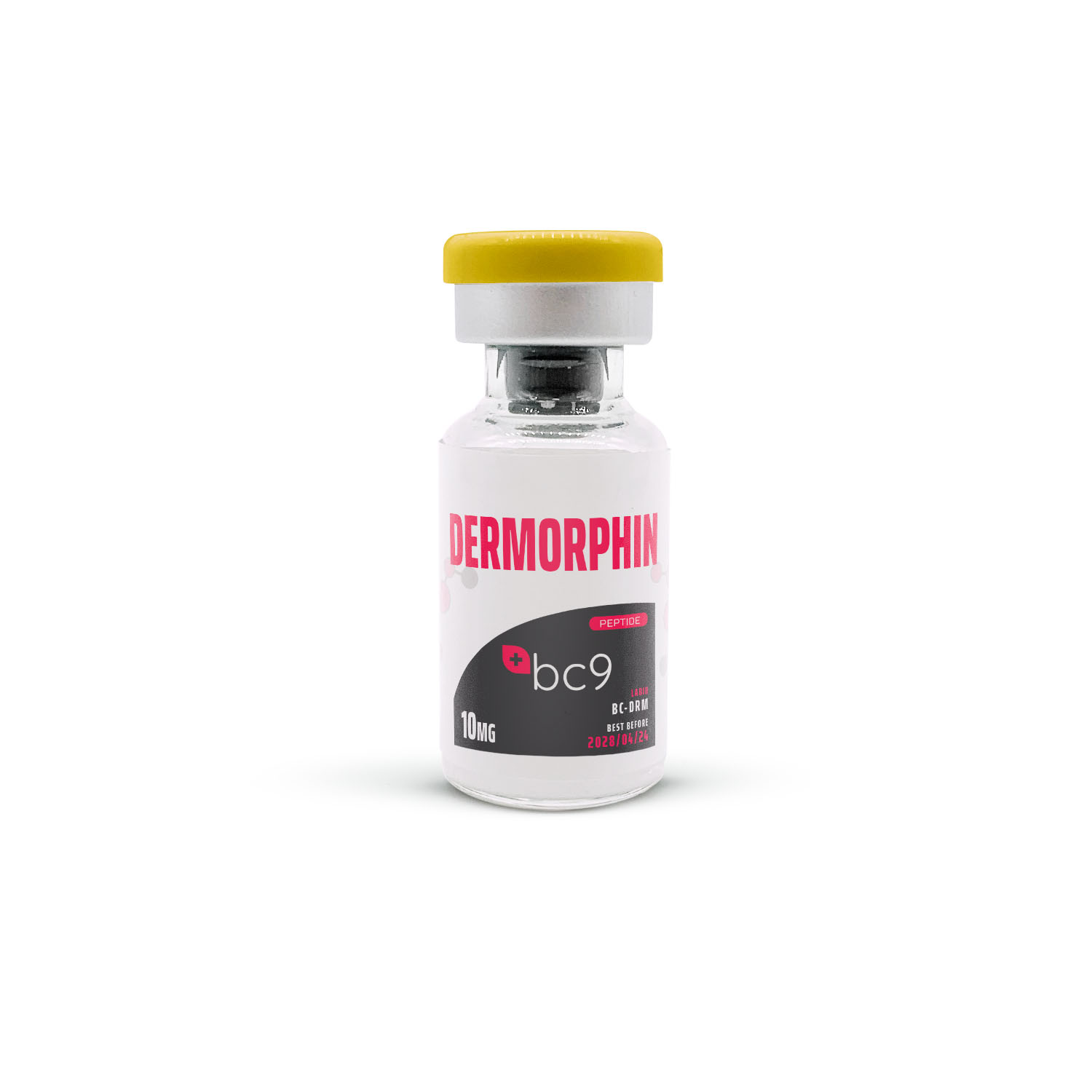
Dermorphin
Disclaimer: This compound is provided strictly for laboratory and scientific research purposes only. It is not approved by the U.S. Food and Drug Administration (FDA) for human or veterinary use, including ingestion, injection, or any form of administration. Chemical Properties of the Compound Property Details CAS Number 77614-16-5 Molar Mass 802.9 g/mol Chemical Formula C₄₀H₅₀N₈O₁₀ IUPAC Name (2S)-2-[[(2R)-2-[[(2S)-2-[[(2S)-2-[[(2S)-2-[[(2R)-2-amino-3-(4-hydroxyphenyl)propanoyl]amino]propanoyl]amino]-3-phenylpropanoyl]amino]acetyl]amino]-3-(4-hydroxyphenyl)propanoyl]amino]-1-oxo-3-hydroxypropan-1-yl]pyrrolidine-2-carboxamide Synonyms Tyr-D-Ala-Phe-Gly-Tyr-Pro-Ser-NH₂; Demorphin Peptide Class Naturally derived heptapeptide; amphibian opioid peptide Physical Form Lyophilized white powder Solubility Soluble in water and aqueous buffers Stability / Shelf Life Stable for up to 24 months when stored lyophilized under appropriate conditions Storage Instructions Store lyophilized at −20°C, protected from light and moisture. Following reconstitution, store at 2–8°C and use within 30 days. Avoid repeated freeze-thaw cycles. Purity Percentage ≥98% PubChem CID 5485199 Vial Format 10mg lyophilized peptide per vial Overview Dermorphin (Tyr-D-Ala-Phe-Gly-Tyr-Pro-Ser-NH₂) is a naturally occurring heptapeptide. It was originally isolated from the skin secretions of the South American frog Phyllomedusa sauvagei. It is classified as an opioid peptide and is of considerable scientific interest due to its high selectivity for mu-opioid receptors (MOR), as well as its unique structural feature. That feature is the presence of a D-alanine residue in its native sequence, an unusual characteristic among naturally occurring peptides. In preclinical rodent antinociceptive assays, Dermorphin demonstrates 30–40 times the analgesic potency of morphine, with greater than 1,000-fold selectivity for mu-opioid receptors over delta- and kappa-opioid receptor subtypes. Regulatory agencies, including the U.S. Food and Drug Administration (FDA), have not approved Dermorphin for human or veterinary use, including ingestion, injection, or any form of administration. It is not a dietary supplement or consumer product. Availability is restricted to qualified researchers and licensed laboratory institutions. Clinical research initiatives involving this compound require guidance from the relevant Institutional Review Board (IRB), and preclinical animal studies must comply with IACUC directives under the Animal Welfare Act (AWA). Working Mechanism of Dermorphin In preclinical models, Dermorphin has been investigated for its high-affinity interaction with mu-opioid receptors (MOR), specifically as a selective agonist of the morphine (mu) receptor subtype. Radioligand binding studies in rat brain membrane homogenates and slide-mounted brain sections have characterized its receptor occupancy profile, with observations indicating that Dermorphin demonstrates marked selectivity for MOR over delta-opioid receptors (DOR). The D-alanine residue at position 2 of its sequence is understood to confer resistance to enzymatic degradation in in vitro systems, contributing to its observed receptor binding stability in experimental settings compared to L-amino acid-containing opioid peptides. [Gouardères et al., 1990] At the signaling level, mu-opioid receptor engagement by Dermorphin in rodent models has been associated with Gi/o protein-coupled intracellular cascades, including inhibition of adenylyl cyclase activity and modulation of voltage-gated ion channels. These pathways are consistent with those studied in the context of endogenous opioid peptide pharmacology. Separate in vitro evaluations have examined its interaction profile at mu-receptor subtypes (mu₁ and mu₂), with observed differential cardiovascular and antinociceptive signaling patterns in conscious rodent models. These interactions remain under investigation, with variability across experimental models and no fully established mechanism confirmed in any human clinical context. Research Findings / Research Applications Preclinical investigations have examined Dermorphin in relation to: Mu-Opioid Receptor Selectivity and Binding Characterization: Dermorphin has been examined as a radioligand probe to characterize mu-opioid receptor distribution and binding parameters in rat brain tissue. In vitro autoradiography studies observed that its labeling pattern in receptor distribution closely paralleled that of established mu-receptor probes, with binding parameters remaining consistent across membrane homogenate and slide-mounted section models. This has been investigated as a tool for mapping MOR distribution in rodent neuroanatomical research. [Gouardères et al., 1990] Antinociceptive Activity in Rodent Models: In rodent models, intracerebroventricular administration of synthetic Dermorphin has been examined in the context of nociceptive response modulation. Preclinical observations indicated potent antinociceptive activity relative to established opioid reference compounds, including beta-endorphin and morphine, in standard rodent assays. At elevated doses in these models, cataleptic behavioral patterns were also observed, an effect that has been investigated in studies of mu-receptor saturation and opioid-related behavioral pharmacology. [Gouardères et al., 1990] Affinity Label Research and Receptor Mapping: Dermorphin-derived analogs have been investigated as electrophilic affinity labels for covalent mu-opioid receptor labeling in radioligand binding experiments. Studies conducted in Chinese hamster ovary (CHO) cells expressing mu- and delta-opioid receptors examined modifications to Dermorphin’s “message” and “address” domains, exploring the structure-activity relationships governing receptor selectivity and affinity at subnanomolar concentrations. [Aldrich et al., 2009] Cardiovascular Signaling Investigation: Dermorphin has been studied as a selective mu-receptor agonist in conscious rodent cardiovascular research. Experimental models examined the differential regulation of heart rate mediated by mu-opioid receptor subtypes (mu₁ and mu₂), using Dermorphin as a pharmacological tool compound to distinguish receptor subtype-specific cardiovascular signaling responses in Sprague-Dawley rat models. [Gouardères et al., 1990] Analog Development and Structural Pharmacology: The structural features of Dermorphin (including its D-amino acid residue and heptapeptide sequence) have been investigated as a framework for synthesizing novel opioid receptor ligands. Preclinical studies have examined positively charged Dermorphin analogs for differential mu- versus delta-receptor selectivity, contributing to research on membrane compartment models of opioid receptor ligand interactions and the design of receptor-selective affinity probes. [Aldrich et al., 2009] Note: These findings are based on early-stage and preclinical research. Results are not consistent across all models, and data remains limited without validation in human clinical settings. Risks & Handling Information Risk Tier: CRITICAL. Dermorphin is a high-affinity mu-opioid receptor (MOR) super-agonist characterized in preclinical models as more potent than morphine and beta-endorphin in rodent antinociceptive assays. No human safety data has been established for this research-grade preparation. PPE Requirement: The use of appropriate personal protective equipment (PPE), including nitrile gloves, a lab coat, and eye protection, is essential in conducting all experiments involving this compound. Controlled Environment: Handling should occur within controlled laboratory environments designed for research activities, with adequate ventilation and appropriate containment measures in place at all times. Exposure Prohibition: Do not inhale, ingest, or make direct skin contact with the compound. This material is not intended for any form of self-administration or non-laboratory exposure under any circumstances. Storage and Degradation Risk: Improper storage conditions, including exposure to heat, light, or moisture, may result in compound degradation and compromised sample integrity. Maintain lyophilized vials at −20°C until use, and adhere to recommended reconstitution protocols to preserve research-grade integrity. DEA Scheduling Notice: Dermorphin is classified as a Schedule I controlled substance under the U.S. Controlled Substances Act (21 U.S.C. § 812). Acquisition, possession, and use of Schedule I controlled substances for research purposes in the United States requires a valid DEA Schedule I researcher registration. BC9 supplies this compound exclusively to DEA-registered research institutions. Researchers must verify their applicable federal and state regulatory requirements before ordering. FAQs Q: What is the regulatory classification of Dermorphin for research purposes in the United States? Dermorphin is not approved by the U.S. Food and Drug Administration (FDA) for human or veterinary use, and it is not classified as a dietary supplement or consumer product. It is available exclusively for laboratory and scientific research purposes only. Q: What makes Dermorphin structurally distinct from other naturally occurring opioid peptides? Dermorphin is notable for the presence of a D-alanine residue at position 2 of its heptapeptide sequence (Tyr-D-Ala-Phe-Gly-Tyr-Pro-Ser-NH₂). The incorporation of a D-amino acid in a naturally biosynthesized peptide is unusual and has been the subject of scientific investigation, as this structural feature has been associated with enhanced enzymatic stability and high mu-opioid receptor selectivity observed in preclinical binding studies. [Gouardères et al., 1990] Q: Has Dermorphin been evaluated in human clinical trials? As of the current scientific literature, no peer-reviewed human clinical trials have been published establishing safety, efficacy, or regulatory approval for Dermorphin in any medical indication. Available research data is derived from in vitro binding studies and preclinical animal models. Findings from these models have not been validated in human clinical settings, and data remains limited in scope and consistency across experimental systems. Q: What receptor targets has Dermorphin been investigated for in preclinical research? Dermorphin has been primarily investigated for its interaction with mu-opioid receptors (MOR), including mu-receptor subtypes (mu₁ and mu₂), in preclinical binding assays and rodent neurophysiology models. Additionally, its structural analogs have been examined in the context of delta-opioid receptor selectivity research. These investigations are conducted using radiolabeled binding assays, in vitro cell expression systems, and in vivo rodent models under controlled laboratory conditions. [Aldrich et al., 2009] Q: Can Dermorphin be used as a pharmacological tool compound in receptor binding studies? In preclinical research contexts, Dermorphin and its tritiated derivative ([³H]Dermorphin) have been investigated as pharmacological probes for characterizing mu-opioid receptor distribution, binding kinetics, and selectivity profiles in rodent brain tissue and recombinant receptor expression systems. Such use is restricted to qualified laboratory settings with appropriate institutional oversight and applicable regulatory compliance. [Gouardères et al., 1990] Q: How does Dermorphin’s potency compare to morphine in preclinical research models? In rodent antinociceptive assays, Dermorphin demonstrates 30–40 times the analgesic potency of morphine at equivalent doses, with greater than 1,000-fold selectivity for mu-opioid receptors over delta- and kappa-opioid subtypes in radioligand binding studies. When administered intracerebroventricularly in rodent models, potency differentials of up to several hundred-fold relative to systemic morphine have been reported in the preclinical literature. [Gouardères et al., 1990] Q: What is the regulatory classification of Dermorphin under U.S. federal law? Dermorphin is classified as a Schedule I controlled substance under the U.S. Controlled Substances Act (21 U.S.C. § 812). Research use in the United States requires a valid DEA Schedule I researcher registration issued to a qualified institution. It is not available for general consumer purchase, is not a dietary supplement, and is not approved by the FDA for any human or veterinary indication. References Gouardères, C., Cros, J., & Quirion, R. (1990). Characterisation and visualisation of [3H]dermorphin binding to mu opioid receptors in the rat brain: Combined high selectivity and affinity in a natural peptide agonist for the morphine (mu) receptor. British Journal of Pharmacology, 100(4), 865–874. https://pubmed.ncbi.nlm.nih.gov/2161761/ Aldrich, J. V., Kulkarni, S. S., Senadheera, S. N., Ross, N. C., Reilley, K. J., Eans, S. O., Ganno, M. L., Murray, T. F., & McLaughlin, J. P. (2009). Discovery of dermorphin-based affinity labels with subnanomolar affinity for mu opioid receptors. ChemMedChem, 4(10), 1739–1745. https://pubmed.ncbi.nlm.nih.gov/19621878/ BC9 Disclaimer This content is presented exclusively for educational purposes and should not be construed as medical advice. THE MATERIALS REFERENCED HEREIN ARE EXCLUSIVELY INTENDED FOR LABORATORY AND RESEARCH USE. Any clinical research initiatives must be conducted under the guidance of the relevant Institutional Review Board (IRB). Similarly, preclinical research involving animals must comply with the directives of the Institutional Animal Care and Use Committee (IACUC), adhering to the standards delineated by the Animal Welfare Act (AWA). Our informational content is meticulously designed for research-oriented insights and is not a substitute for individual analysis and verification from credible sources before any purchasing decisions are made. Upon finalizing your order and payment, you explicitly acknowledge and agree to adhere to our Terms and Conditions. Customer satisfaction stands as our paramount concern. If you are dissatisfied with the product received, kindly contact us at 419-707-5450 or email our support team at support@bc9.co. IMPORTANT NOTICE: All products showcased on our platform are EXCLUSIVELY INTENDED FOR LABORATORY AND RESEARCH APPLICATIONS. They are expressly not intended for veterinary or human utilization.
Specifications
- Form
- Peptide Kit
- Strength
- 10mg
AI Readiness
Good foundation, but some important product data is still missing.