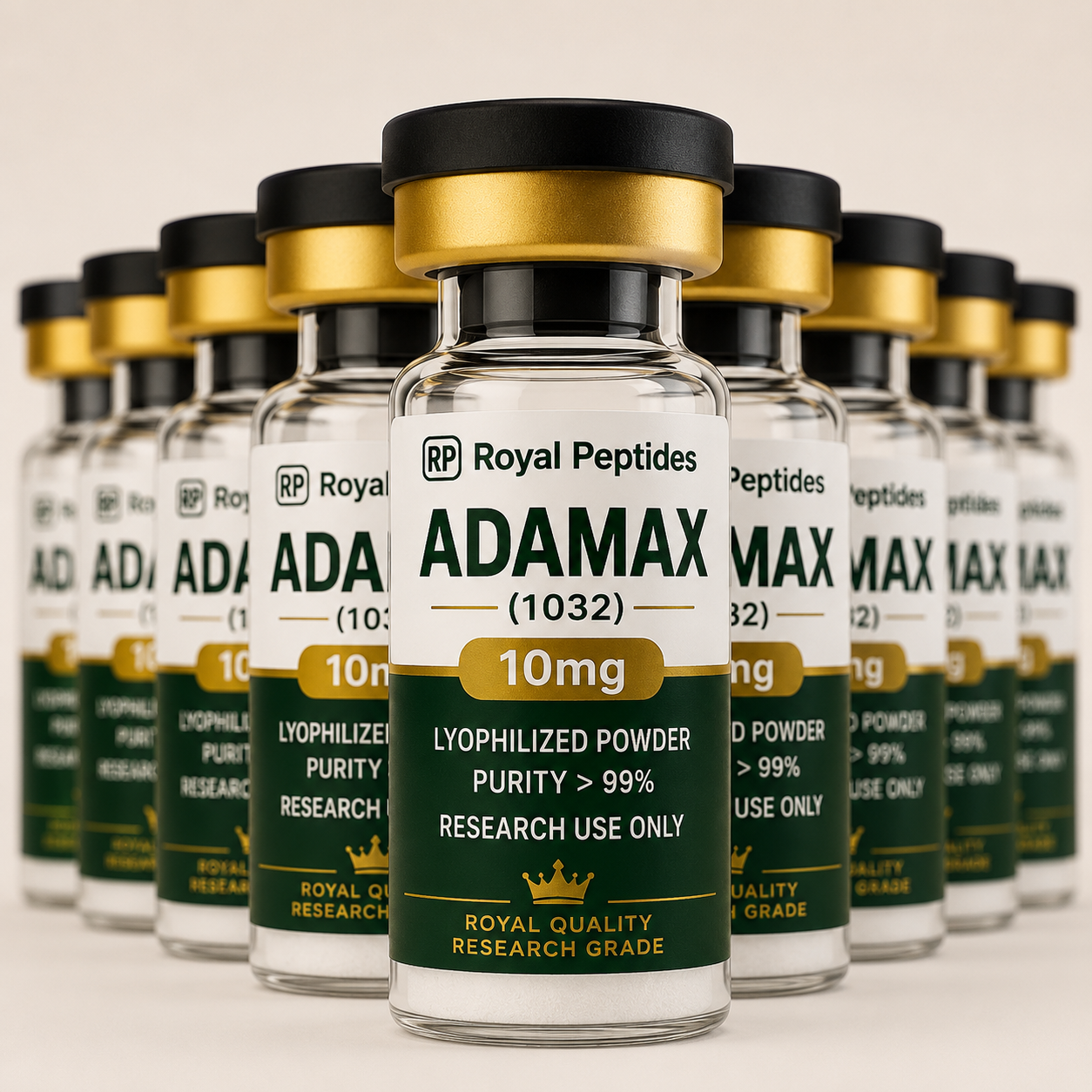
Adamax (1032) 10mg Kit (Pre-order)
ADAMAX (1032) 10mg Peptide – Premium Research Compound for Laboratory Investigation ADAMAX (1032) 10mg is a premium lyophilized research peptide manufactured exclusively for scientific and laboratory research. Produced under strict quality standards and intended for research use only, ADAMAX (1032) is supplied as a highly purified freeze-dried powder designed to provide excellent stability during storage and experimental handling. Whether your laboratory is investigating novel peptide signaling pathways, receptor interactions, or advanced biochemical mechanisms, ADAMAX (1032) offers researchers a premium-grade material suitable for controlled experimental environments. Research Use Only. Not for human or veterinary use. ADAMAX (1032) 10mg for Advanced Laboratory Research ADAMAX (1032) 10mg is a premium lyophilized research peptide developed for scientific investigation into neurobiology, peptide signaling, and cognitive research pathways. Designed as a next-generation analogue of Semax, ADAMAX incorporates structural modifications intended to improve molecular stability and enhance resistance to enzymatic degradation, making it an exciting compound for modern peptide research. At Royal Peptides, every vial of ADAMAX (1032) is manufactured under stringent quality standards and supplied as a highly purified lyophilized powder to support laboratory consistency and reproducibility. Each 10mg vial is intended exclusively for research purposes and is not approved for human or veterinary use. What is ADAMAX (1032)? ADAMAX (1032) is a synthetic peptide analogue based on the well-known neuropeptide Semax, a peptide originally derived from the ACTH (4-10) fragment. Semax has been extensively investigated for its role in neurotrophic signaling, neuronal resilience, learning, memory, and cognitive pathway research. ADAMAX was engineered to build upon this foundation through structural modifications designed to increase molecular stability and potentially improve central nervous system exposure in experimental models. Researchers are investigating whether these modifications may provide prolonged biological activity compared with traditional Semax while preserving many of its neurobiological characteristics. Although research remains in its early stages, ADAMAX has rapidly gained interest among peptide researchers studying neuroplasticity, synaptic communication, cellular resilience, and cognitive function. Proposed Mechanism of Action Current understanding of ADAMAX is largely based on the biological pathways previously investigated with Semax and the rationale behind its molecular design. Researchers continue to explore several mechanisms that may contribute to its experimental activity. Neurotrophic Factor Signaling One of the most significant areas of peptide neuroscience involves Brain-Derived Neurotrophic Factor (BDNF). BDNF plays a critical role in: Neuronal survival Synaptic plasticity Memory formation Learning processes Long-term potentiation Neural network remodeling Research involving Semax has demonstrated modulation of neurotrophic signaling pathways, and ADAMAX is currently being investigated for similar activity in laboratory models. Neuroplasticity Research Neuroplasticity refers to the brain’s remarkable ability to reorganize neuronal connections throughout life. Researchers are interested in ADAMAX because enhanced neuroplasticity may influence: Synaptic efficiency Learning mechanisms Memory consolidation Neural adaptation Cellular communication These investigations continue to expand as scientists seek to better understand peptide-mediated neuronal signaling. Dopaminergic and Monoamine Pathways Experimental research involving Semax has demonstrated interactions with neurotransmitter systems involved in: Dopamine regulation Serotonin signaling Motivation pathways Executive function Cognitive processing Because ADAMAX shares structural similarities with Semax, researchers continue evaluating whether comparable signaling pathways may be involved. Neuronal Protection Research Modern neuroscience increasingly focuses on compounds capable of supporting neuronal resilience during experimental stress models. Current laboratory investigations explore ADAMAX in relation to: Oxidative stress Cellular resilience Protein regulation Mitochondrial function Synaptic maintenance These studies remain experimental and continue to evolve. Blood-Brain Barrier Research One unique aspect of ADAMAX is the incorporation of an adamantane-derived structural modification. Adamantane chemistry has been widely utilized throughout medicinal chemistry because it may improve: Molecular stability Lipophilicity Membrane permeability Resistance to enzymatic degradation Researchers are investigating whether these properties may contribute to improved experimental delivery within central nervous system models. Areas of Scientific Research ADAMAX (1032) is currently being explored across several areas of peptide science, including: Neurobiology Cognitive neuroscience Learning and memory research Neuroplasticity Synaptic signaling Neurotrophic factor expression Cellular communication Protein signaling pathways Brain aging research Experimental neuroprotection As scientific understanding continues to develop, ADAMAX remains an emerging compound of significant interest within peptide research. ADAMAX vs Semax Semax has been studied for decades and remains one of the most recognized nootropic research peptides. ADAMAX was designed as a next-generation analogue intended to build upon the original molecule through enhanced molecular engineering. Researchers are particularly interested in potential improvements involving: Increased stability Extended biological activity Improved resistance to degradation Enhanced laboratory handling Advanced peptide engineering While Semax remains the most extensively studied compound, ADAMAX represents an exciting direction for future peptide research. Explore our premium Semax peptide here: https://royal-peptides.com/product/semax-10mg/ Manufacturing Standards Every ADAMAX (1032) vial from Royal Peptides undergoes strict quality control procedures. Our manufacturing process emphasizes: Premium raw materials High purity peptide synthesis Lyophilization for stability Sterile filling procedures Professional laboratory packaging Batch consistency Royal Peptides is committed to providing researchers with dependable, high-quality compounds for scientific investigation. Storage For optimal stability: Store refrigerated upon arrival. Freeze for long-term storage. Protect from excessive moisture. Avoid repeated freeze-thaw cycles after reconstitution. Reconstitute only according to established laboratory procedures. Why Researchers Choose Royal Peptides Royal Peptides has become a trusted supplier among research laboratories by focusing on quality, transparency, and customer support. Benefits include: ✓ Premium research-grade peptides ✓ Professional laboratory packaging ✓ Fast North American shipping ✓ Secure payment options ✓ Responsive customer service ✓ Extensive peptide catalogue ✓ Third-party testing available on selected products ✓ Trusted by researchers worldwide Related Research Peptides Researchers interested in ADAMAX frequently explore additional compounds within our neuroscience and metabolic research collections. Semax 10mg One of the most extensively researched neurotrophic peptides available. https://royal-peptides.com/product/semax-10mg/ Retatrutide A next-generation triple receptor agonist widely studied for metabolic research. https://royal-peptides.com/product/retatrutide-10mg/ Research Guide Learn more about peptide handling, storage, reconstitution, and laboratory best practices. https://royal-peptides.com/guide/ Scientific Literature Researchers seeking peer-reviewed publications can browse the National Library of Medicine database. https://pubmed.ncbi.nlm.nih.gov/ Frequently Asked Questions What is ADAMAX (1032)? ADAMAX (1032) is a synthetic Semax-derived research peptide supplied as a 10mg lyophilized powder for laboratory investigation. What makes ADAMAX different from Semax? ADAMAX incorporates structural modifications intended to improve molecular stability and resistance to enzymatic degradation compared with the original Semax molecule, while retaining a similar research focus on neurobiology and peptide signaling. What is ADAMAX researched for? Researchers investigate ADAMAX in experimental models related to neuroplasticity, learning and memory, neuronal signaling, cognitive neuroscience, neurotrophic pathways, and peptide pharmacology. Is ADAMAX intended for human use? No. ADAMAX (1032) is supplied exclusively for laboratory research and is not intended for human consumption, therapeutic use, or veterinary use. How should ADAMAX be stored? Store refrigerated for short-term use or frozen for long-term preservation. Lyophilized peptides should remain dry until reconstitution to maximize stability. Does Royal Peptides provide high-quality research peptides? Yes. Royal Peptides is committed to supplying premium research compounds manufactured under strict quality standards, with third-party testing available for many products. Research Use Disclaimer This product is: NOT intended to diagnose disease NOT intended to treat disease NOT intended for human consumption NOT intended for veterinary use NOT intended as a pharmaceutical product Purchasers are responsible for ensuring all research complies with applicable laws, institutional policies, and laboratory safety requirements.
AI Readiness
Good foundation, but some important product data is still missing.