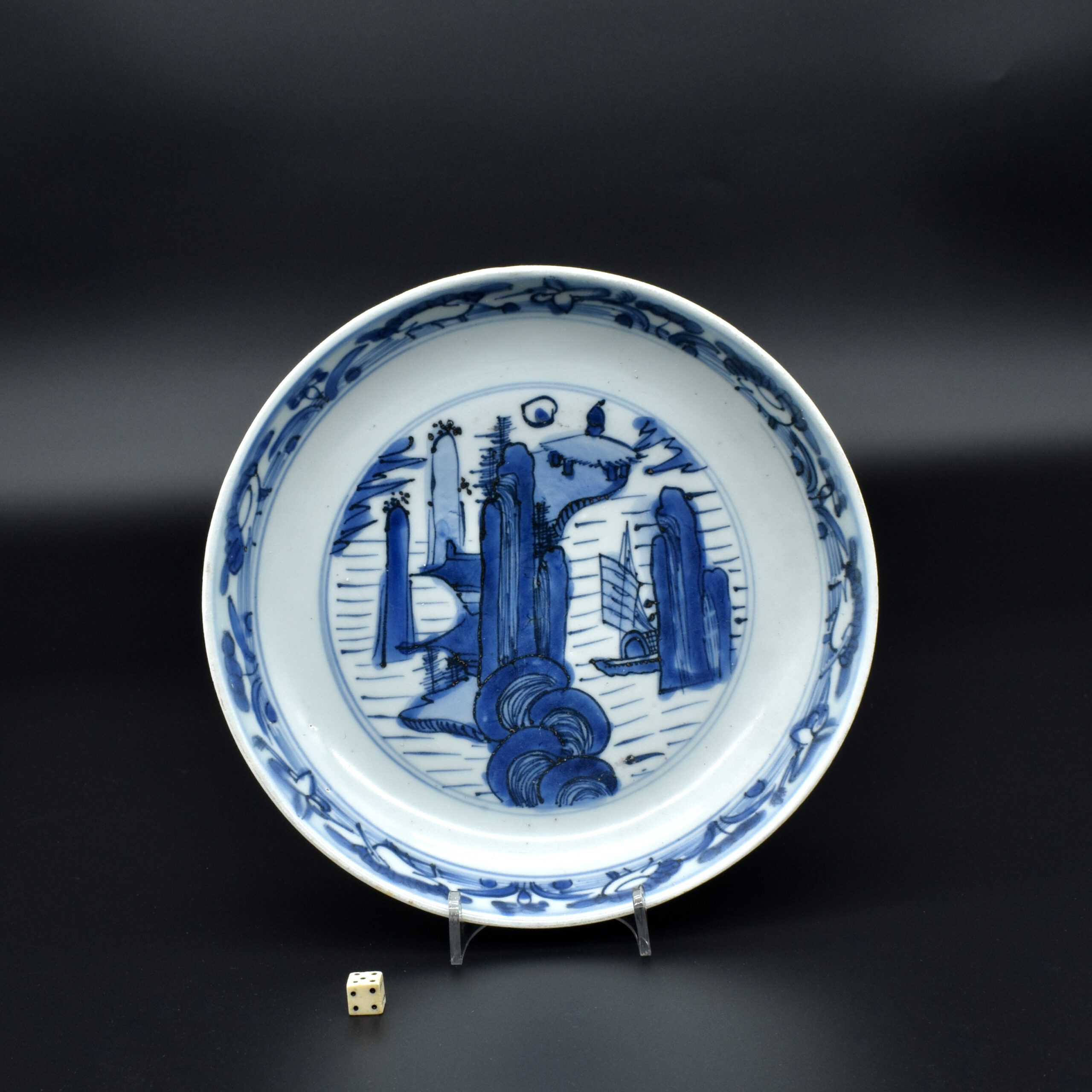
A Small 16th Century Ming Blue and White Porcelain Dish.
A Small 16th Century Ming Blue and White Porcelain Dish, China, Jingdezhen Kilns, Jiajing (1522-1566), Longqing (1567-1572) or Early Wanli (1573-1620). This well painted shallow dish from c.1560-1580 comes from a shipwreck, unfortunately I don’t know which wreck it comes from. The Fort San Sebastian Wreck, a 16th century Portuguese wreck discovered of the Island of Mozambique is of the same period, however I couldn’t find a comparable piece among the 30 lots of porcelain sold at Christie’s in Amsterdam (19th of May 20004). The present dish is well painted dish and is typical of Chinese Ming export porcelain from c.1560-1580. The blue is very strong and vibrant, the well depicts very large rocks in water, the central rock has a water fall with waves spilling out into the water below. A fishing vessel is partly obscured by a boat on the right. In the distance is a grass covered shelter. This landscapes with tall rocks surrounded by water aren’t a fantasy, this an actual landscape that can be found in China’s ‘Shilin Stone Forest’ in Yunnan Province, its limestone rocks were errored by rain, 270 million years ago this was a shallow tropical sea. The border consists of egrets or herons feeding in water or flying above it. The back has been left without decoration except for a very narrow band around the outer edge of the foot, it has a small shallow foot. Larger Ming porcelain pieces with similar designs can be found in the very important collection at the Topkapi Saray Museum Istanbul (see References). Ming blue and white porcelain dishes of this type were certainly in Iran in the 17th century, during the Safavid Persia / Safavid Empire. Iranian potters made Fritware imitations of these Ming dishes in the 17th century, two examples are at the Victoria & Albert Museum in London (see Information below). Large Chinese versions, much more thickly potted of and of a slightly later date, referred to as Swatow ware were produced at various kilns in Zhangzhou Prefecture, Fujian Province. They had similar landscapes with tall rocks surrounded by water often with Pagodas, however they look very different.
How AI sees this product
The more complete this product's details, the more confidently AI assistants can understand and recommend it.