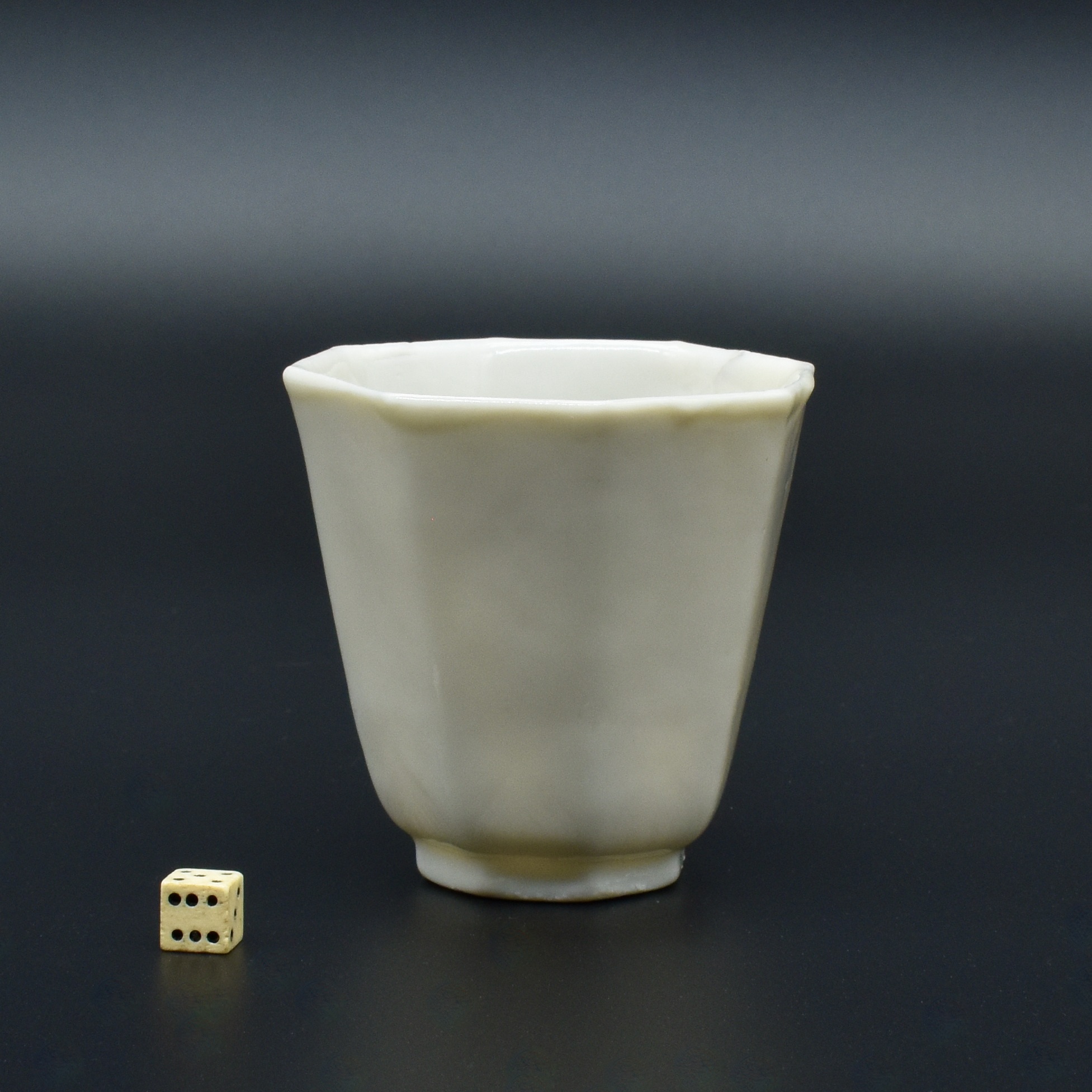
A Kangxi Octagonal Blanc de Chine Porcelain Beaker.
A Kangxi Octagonal Blanc de Chine Porcelain Beaker, Dehua kilns, Fujian Province c.1680 – 1720. The lower curved part of each panel has a lotus form lappet which has been moulded, the base has a raised seal-mark (see the additional photographs in the Photograph Gallery below). This simple form is rather more unusual than the other more thickly potted moulded examples, many of which bare a seal-mark for the workshop Zhongtun shi (Mr. Zhongtun). See below for a plain Blanc de Chine example and a beaker with enamel decorated added in London in around 1715 to 1720. Blanc de Chine Porcelain : The porcelain known in the West as Blanc de Chine was produced 300 miles south of the main Chinese kiln complex of Jingdezhen. The term refers to the fine grain white porcelain made at the kilns situated near Dehua in the coastal province of Fujian, these kilns also produced other types of porcelain. A rather freely painted blue and white ware, porcelain with brightly coloured `Swatow` type enamels as well as pieces with a brown iron-rich glaze. However it is the white Blanc de Chine wares that have made these kilns famous. The quality and colour achieved by the Dehua potters was partly due to the local porcelain stone, it was unusually pure and was used without kaolin being added. This, combined with a low iron content and other chemical factors within the body as well as the glaze, enabled the potters to produce superb ivory-white porcelain. See Below For More Photographs and Information SALE PENDING
AI Readiness
Good foundation, but some important product data is still missing.