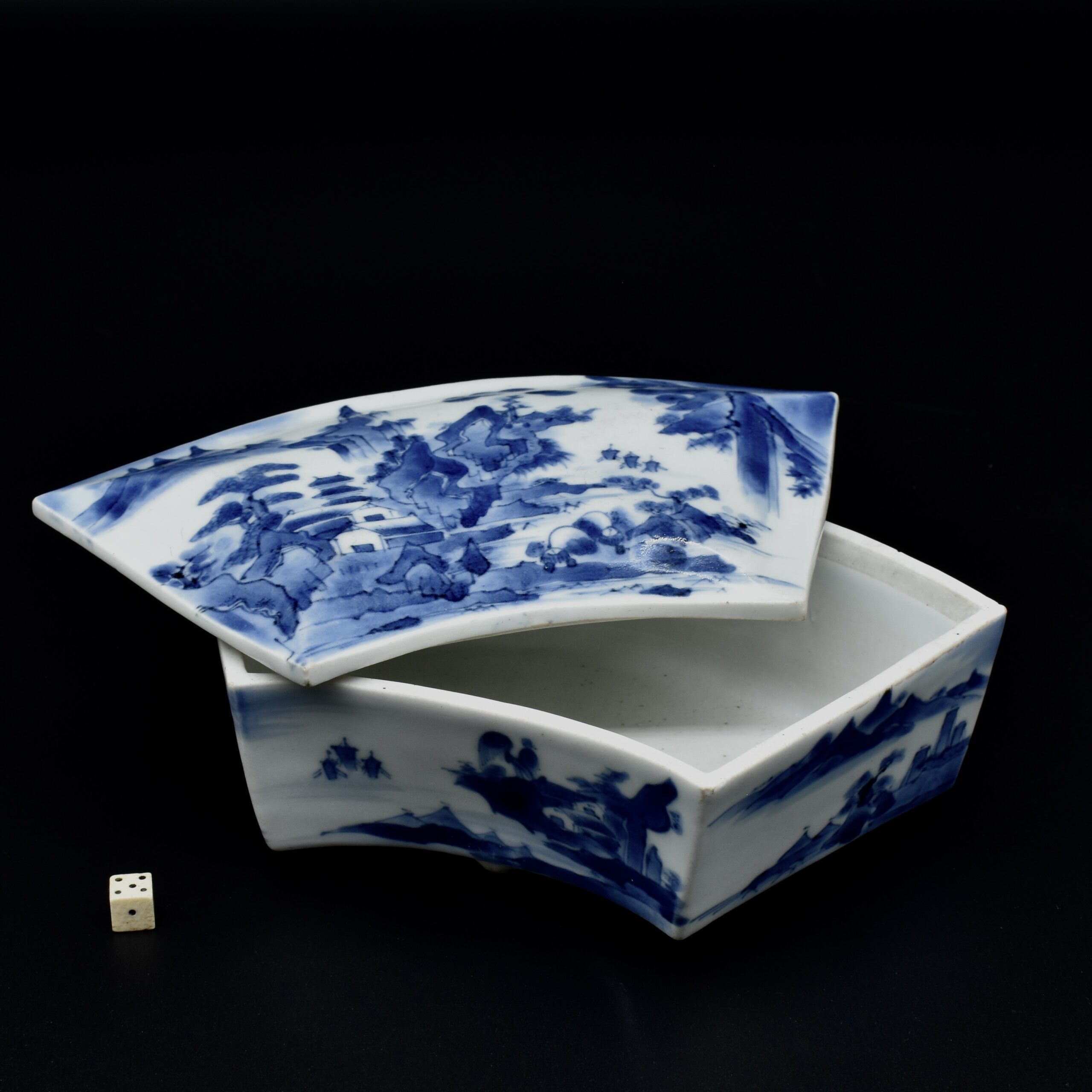
A Rare 17th Century Japanese Porcelain Fan Shaped Box and Cover, Kakiemon or Perhaps Arita.
A Rare 17th Century Japanese Porcelain Fan Shaped Box and Cover, Kakiemon or Arita c.1660-1680. Painted in rich tones of blue with graded shading, the scene is an extensive mountainous landscape with dramatic rocks, pine trees, a pagoda, other buildings and three sailing boats. The base of this porcelain box is similarly painted. The base is unglazed, and it has a neatly cut cross that was added prior to firing. It sits on three small double indented rounded feet which are unglazed at the top, glaze has been applied around the line where the feet stuck on with slip, in this case the slip is watered down porcelain clay. Presumably, this was done to help the feet adhere to the unglazed body of the base, it worked well as all three feet are there after around 350 years. It comes with its traditional Japanese ceramic storage box, referred to as Tomobako. In its infinite wisdom Google has translated the inscription on the box as “Deep and sweet but not fishing shape There are three cakes” The three cakes must be the bun shaped feet. This rare form, a fan shaped box on three unglazed bun-shaped pads is a novelty the Japanese would have appreciated. The variety of design, and form from this period is remarkable, however by around 1700 things became more standardised. That was partly due to a more difficult economic climate in Japan and perhaps it reflected the need to standardise export porcelain to the West, thus saving money. I think this piece would have been made for the domestic market, only a limited number of pieces were exported to Europe at this period. They include European forms that were commissioned by the Vereenigde Oostindische Compagnie (V.O.C.) the Dutch East India Company, such as jugs, tankards and pieces made specifically for individual members of the V.O.C. Burghley House in Lincolnshire has an important early collection of Japanese porcelain, some of which is porcelain made for the Japanese but it was exported, other pieces are clearly export ware. As far as I know there are, there are no fan shaped boxes of this type in early European collections – please let me know if you know of an example. The painting of this box seems to be Kakiemon, the subject matter, tones of cobalt blue and painting style are typical of Kakiemon porcelain. However, Arita used very similar painting styles. Its also possible that the painters from Arita and Kakiemon didn’t spend their whole working life at just one kiln. It is well known that painters in 18th century Europe travelled to where the work was. Some painters took their work home, they cheated ! Painters at the French Royal Porcelain Factory, Sèvres, stole white porcelain from the factory, smuggling it out and decorated it and fired it at home to earn extra money. The history of ceramics involves people, so things aren’t always as they seem. SALE PENDING See Below For More Photographs and Information.
How AI sees this product
The more complete this product's details, the more confidently AI assistants can understand and recommend it.