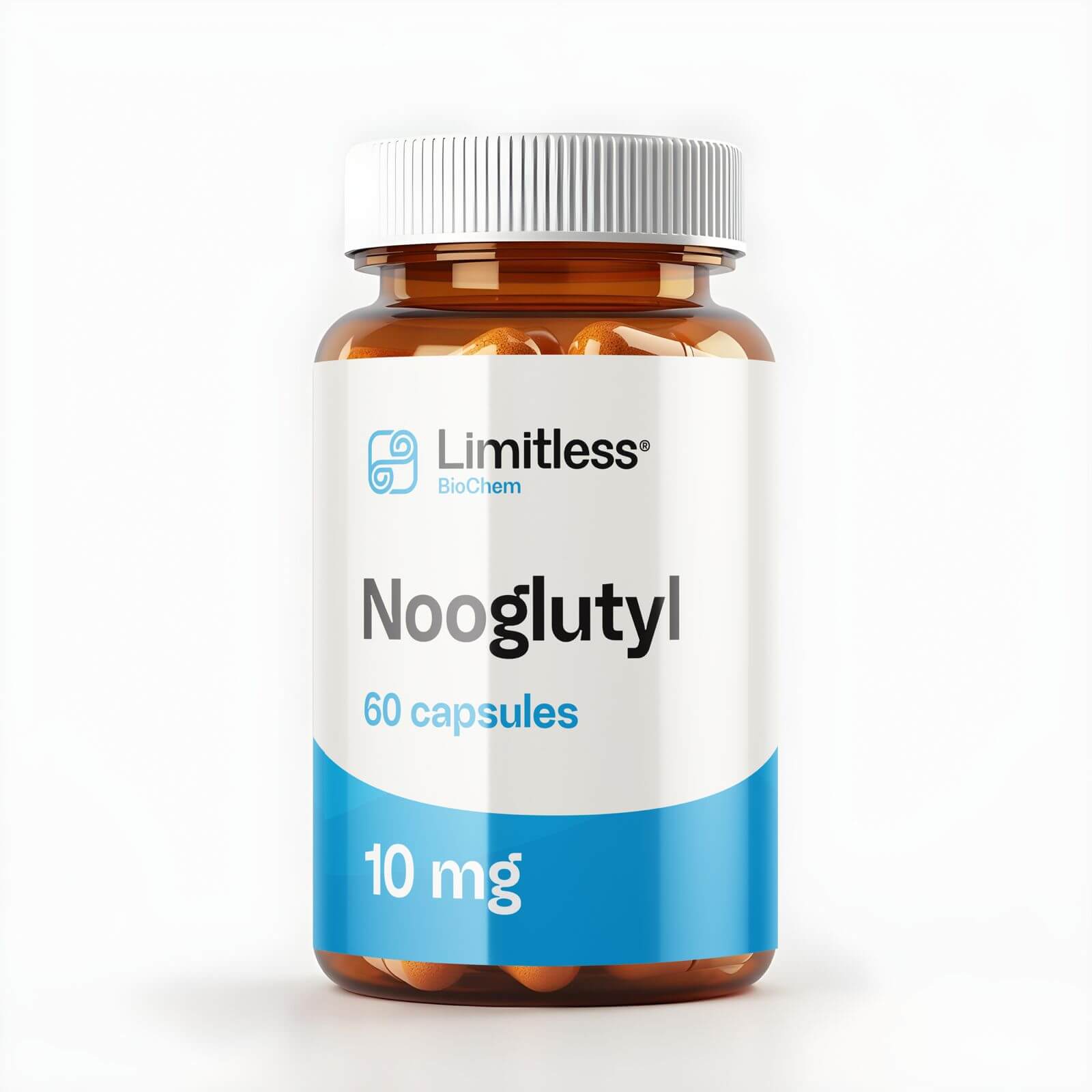
Nooglutyl 10 mg – 60 capsules
Nooglutyl 10 mg — 60 oral research capsules. Nooglutyl is a glutamatergic nootropic developed at the Research Institute of Pharmacology of the Russian Academy of Medical Sciences in the late 1980s and characterized in published Russian-language pharmacology as one of the most potent positive allosteric modulators of the AMPA-type glutamate receptor in the racetam-adjacent class. Mechanistically dissimilar to the classical pyrrolidinone racetams, Nooglutyl pairs AMPA-PAM activity with glutamate-release facilitation in a way that produces robust enhancement of memory acquisition and consolidation in rodent models at sub-milligram-per-kilogram oral doses — placing it among the most pharmacologically efficient nootropic tool compounds in the published literature. RESEARCH USE ONLY · Not for human or veterinary use. For laboratory and collector purposes only. Purity ≥ 98 % (HPLC) — third-party tested, CoA on file Form Research capsules Content 10 mg Nooglutyl per capsule Total 60 capsules per bottle (600 mg total) Packaging Sealed bottle with tamper-evident closure Storage Room temperature, dry, protected from light Molecular formula C₁₁H₁₂N₂O₆ Molecular weight ≈ 268.22 g·mol⁻¹ IUPAC / structure N-(5-hydroxynicotinoyl)-L-glutamic acid CAS number 112193-35-8 Synonyms Nooglutyl; nooglutil; glutamatergic nootropic Research Overview Nooglutyl is a glutamic-acid-conjugated heterocyclic small molecule developed at the Research Institute of Pharmacology of the Russian Academy of Medical Sciences in the late 1980s, with a substantial body of Russian-language preclinical pharmacology characterizing its memory-enhancing and neuroprotective profile [1]. Mechanistically, Nooglutyl exhibits a dual glutamatergic mechanism unusual in the nootropic literature: positive allosteric modulation of AMPA-type glutamate receptors combined with facilitation of pre-synaptic glutamate release [1,2]. In rodent models — passive-avoidance, conditioned-fear, Morris water maze, and amnesia-rescue paradigms — Nooglutyl produces robust dose-dependent enhancement of memory acquisition and consolidation at sub-milligram-per-kilogram oral doses, a potency profile substantially higher than the classical racetams [2]. The compound also displays anxiolytic, anti-amnestic and neuroprotective activity in scopolamine-induced and ischemic-injury models, with documented effects on hippocampal LTP magnitude [3]. Nooglutyl has remained an essentially Russian-research-only molecule since its original development, providing an important Eastern European entry into the AMPA-PAM cognitive-enhancement landscape that contemporary Western research is now revisiting through compounds like TAK-653 and IDRA-21. Primary Research Areas AMPA-receptor positive allosteric modulation — the principal Russian-developed AMPA-PAM in the published literature; complements newer Western ampakines (IDRA-21, TAK-653) as a research comparator [2,4]. Memory acquisition and consolidation — robust dose-dependent enhancement in passive-avoidance, conditioned-fear and spatial-memory paradigms at sub-mg/kg doses [1,3]. Pre-synaptic glutamate release — the second arm of the dual mechanism, distinguishing Nooglutyl from purely post-synaptic AMPA-PAMs [1]. Anti-amnestic and neuroprotective research — documented rescue of scopolamine-induced and ischemic-injury memory deficits in rodent models [3,5]. Hippocampal LTP and synaptic plasticity — facilitates LTP induction and maintenance in hippocampal slice and in-vivo electrophysiology [1,3]. Memory after a stroke — in rats whose brain artery was blocked, nooglutyl cut the damaged area from 22% to 8% of the affected half of the brain and restored the memory of what the animals had learned. Mexidol and PBN, tested in the same experiment, gave smaller effects [5]. Bleeding inside the brain — in rats with an experimental brain hematoma, a single injection given three to four hours later reduced the neurological deficit, restored coordination and memory, and prevented deaths. The dose was given hours after the bleed, not before it [6]. Memory with aging — in mice bred to age quickly, which at nine months already move less, are more anxious and forget what they learned, nooglutyl brought all three back toward normal. This is the reason the compound is looked at for age-related memory loss [7]. Brain energy after head trauma — after head trauma in rats the mitochondria of the brain stop producing energy properly; nooglutyl prevented that loss and did better than picamilon and pyritinol. Energy failure in the brain is one of the mechanisms behind the cognitive problems that follow a head injury [8]. References Voronina TA, Garibova TL, Khromova IV, et al. [A new substance with nootropic activity–N-5(hydroxynicotinoyl)-L-glutamic acid]. [in Russian] Farmakol Toksikol. 1990;53(4):13-6. PMID 1977613. Firstova IuIu, Vasil’eva EV, Kovalev GI. [Studying specific effects of nootropic drugs on glutamate receptors in the rat brain]. [in Russian] Eksp Klin Farmakol. 2011;74(1):6-10. PMID 21476267. Voronina TA, Garibova TL, Trofimov SS, et al. Comparative studies on the influence of ONK (N(5-hydroxynicotinoil) glutamic acid), piracetam and meclofenoxate on the learning- and memory-impairing effect of scopolamine, clonidine, and methergoline. Acta Physiol Pharmacol Bulg. 1991;17(4):8-16. PMID 1841522. Iasnetsov VV, Krylova IN. [The antiamnestic effect of nootropic substances in rats]. [in Russian] Eksp Klin Farmakol. 2013;76(11):3-6. PMID 24555225. Povarova OV, Garibova TL, Kalenikova EI, et al. [Effect of phenyl-tert-butylnitrone, mexidol and nooglutil on the ischemic lesion zone and memory in rats following middle cerebral artery occlusion]. [in Russian] Eksp Klin Farmakol. 2004;67(1):3-6. PMID 15079898. Garibova TL, Galaeva IP, Voronina TA, et al. [Effect of nooglutil on rats with intracerebral posttraumatic hematoma (hemorrhagic stroke)]. [in Russian] Eksp Klin Farmakol. 2003;66(3):13-6. PMID 12924225. Garibova TL, Voronina TA, Litvinova SA, et al. [Effect of nooglutyl on the behavior and memory of SAMP10 mice with genetically determined accelerated aging]. [in Russian] Eksp Klin Farmakol. 2007;70(4):3-6. PMID 18078032. Novikov VE, Kovaleva LA. [The effect of substances with nootropic activity on oxidative phosphorylation in brain mitochondria in acute craniocerebral trauma]. [in Russian] Eksp Klin Farmakol. 1997;60(1):59-61. PMID 9162289.
How AI sees this product
The more complete this product's details, the more confidently AI assistants can understand and recommend it.