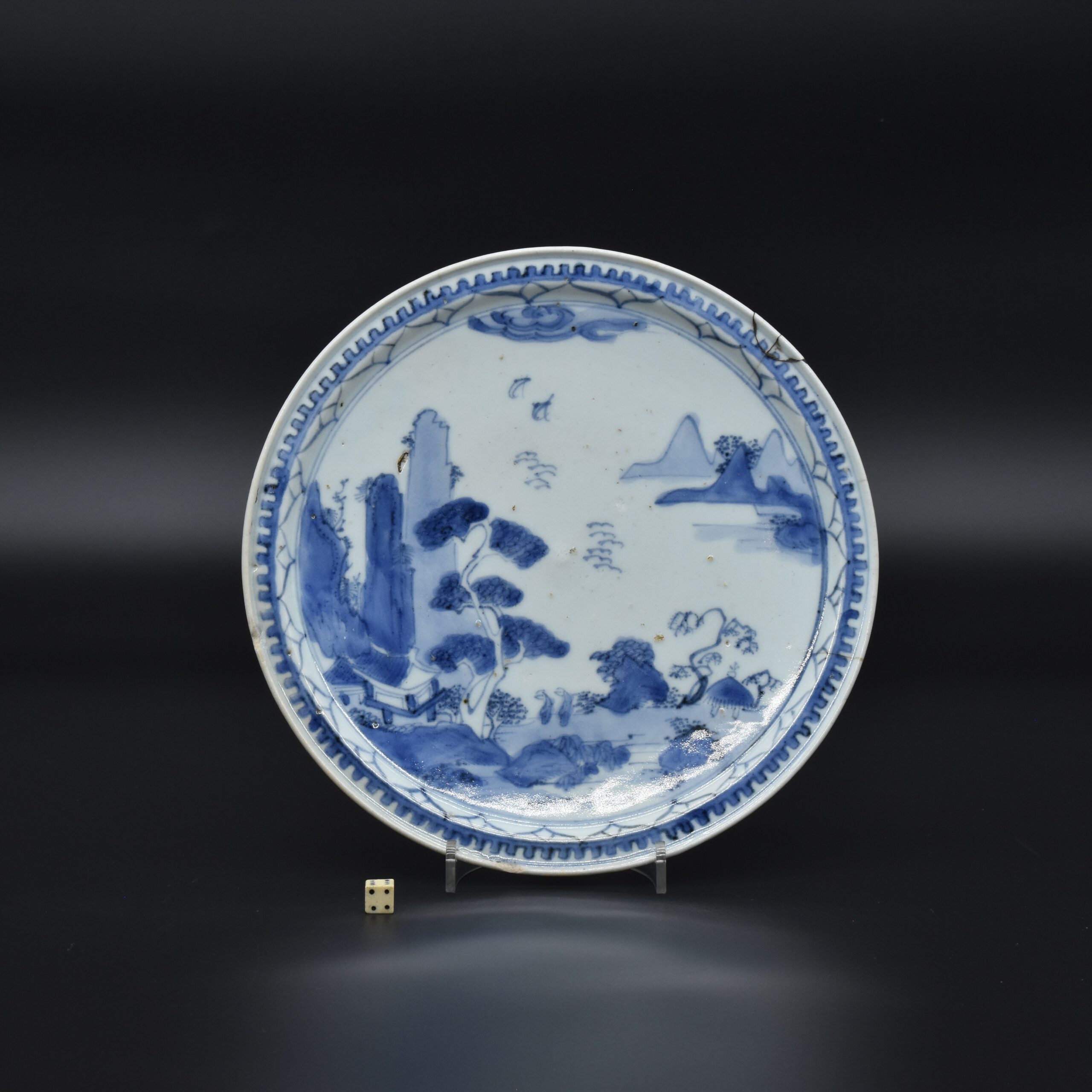
A Rare Documented Shoki-Imari Porcelain Dish From the Komizo Kilns, Arita, Japan c.1630 – 1637/40.
A Very Rare Documented Shoki-Imari Porcelain Dish from the Komizo Kilns (Komizo-gama) Arita, Hizen Province, northwestern Kyūshū, Japan c.1630 – 1637/1640. This dish is illustrated in an important book by the highly respected archaeologist Nobuyuki Murakai ‘The Origin of Imari Porcelain: Excavated Shards from Komizo Kiln‘ (written in Japanese, by Nobuyuki Murakai. Published in August 2020, Soshisha Art Publishing). Murakami is a leading researcher of Japanese ceramics and a key expert at the Arita Museum of History. He is credited with studying over 10,000 boxes of Arita porcelain shards, piecing together the exact history of early Imari (early Japanese porcelain). The Komizo kiln, located in western Arita, operated briefly in the early 1600s (circa 1610–1637/40). The Komizo kiln is widely regarded as the founding porcelain kiln in Japan. It was Korean potters, were captured and forced to go to Japan, that produced the first porcelain, laying the foundations for all porcelain production in the country. The book relies on factual archaeological evidence. Instead of focusing entirely on intact pieces, it shows the actual kiln damaged porcelain pieces and excavated shards discovered at the Komizo kiln site. Dr. Oliver Impey in his groundbreaking book about the early Japanese porcelain : The Early Kilns of Japan, Arita in the First Half of the Seventeenth Century (Oliver Impey, Clarendon University Press Oxford 1996. ISBN 0-19-826370-8) quotes Kōji Ohashi, as mentioning the implementation order of closure of the eleven workshops in 1637, among those closed were the Komizo kilns. Kōji Ohashi, is the Honorary Advisor and former Director of the Kyushu Ceramic Museum at Arita, Japan.” Dishes from this early period are uncommon in the West as the earliest Japanese porcelain, referred to as Shoki-Imari (c.1610- 1640) was not exported. This is the only piece of Japanese porcelain we have had that can firmly attributed to an individual Arita kiln. This flat heavy porcelain dish with a small cavetto and an everted rim has a thick rough foot rim with grit adhering. The Shoki-Imari dish is thickly potted, and the glaze is uneven with burst bubbles and some kiln grit, these are typical of Japanese porcelain during this early period. The landscape has been painted at speed with large variety of brush strokes, some of which are very fine, the blue varies from a very thin pale washes to deeper inky dark areas. This winter scene can be understood as the insignificance of humanity in awe of the grandeur of nature, the fragility of life and the uselessness of ego, striving to be humble. Two tiny figures are set in a landscape, their heads bowed down, a simple shelter to the right, and a larger building to the left wedged between a cliff edge and mountains. An indication of clouds is at the top of main image, below two sailing boat only rendered with a few strokes of the brush giving an indicating sails caught in the breeze, two flocks of birds fly over the water each made with a single brush stroke. The narrow cavetto is painted with a design using the tops of lotus petals, a crenelated border is on the flat edge below the upturned rim. See Below For More Photographs and Information RESERVED
AI Readiness
Good foundation, but some important product data is still missing.