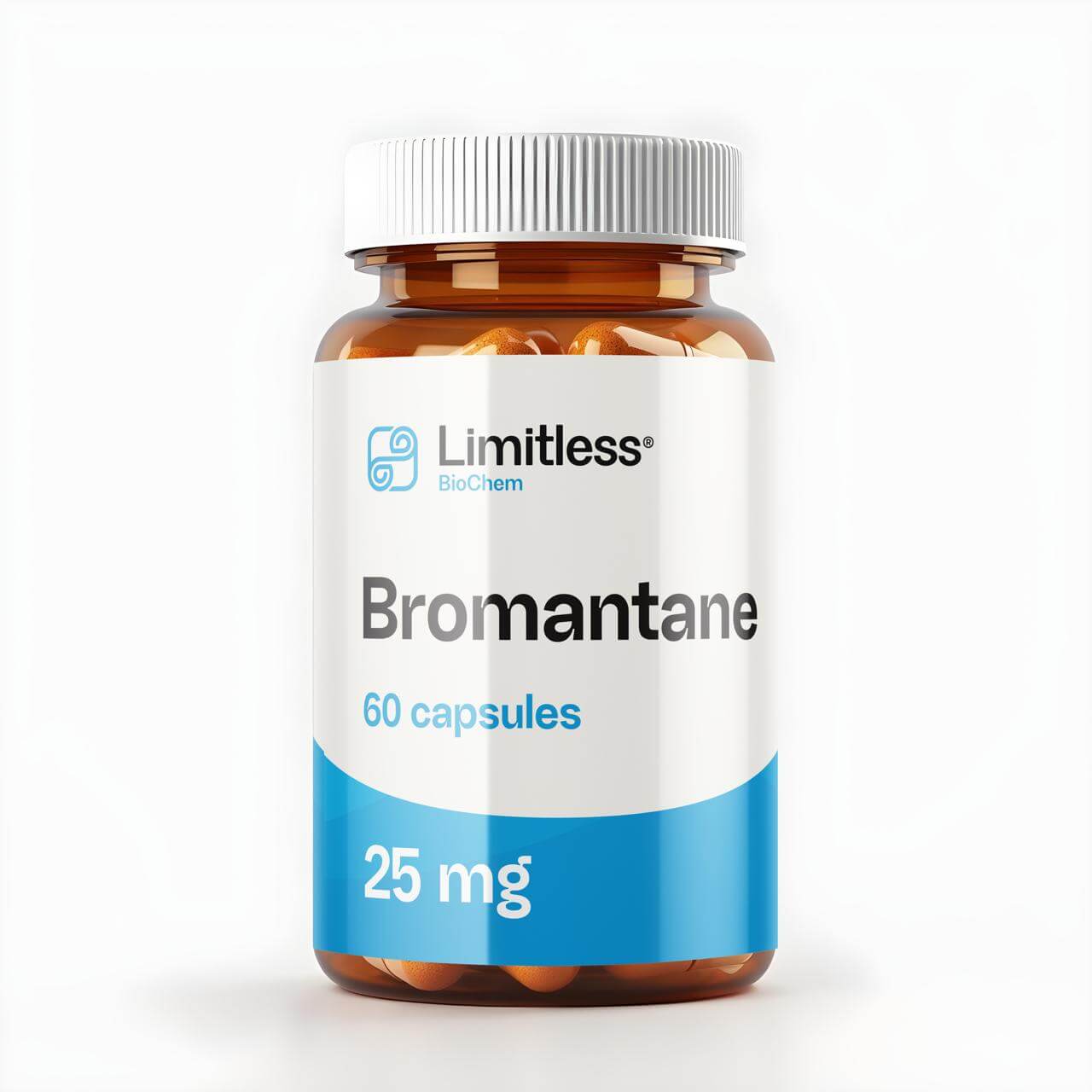
Bromantane 25 mg – 60 capsules
Bromantane 25 mg – 60 Capsules research-grade capsules in a sealed container. Bromantane (Ladasten; N-(4-bromophenyl)adamantan-2-amine) is an adamantane-derived compound investigated in dopaminergic transmission, neuroplasticity and stress/fatigue research models. Research Use Only: All products are intended exclusively for laboratory and scientific research. Not for human or veterinary use. Purity High purity; third-party tested (COA/HPLC) Form Capsules Content 25 mg Bromantane per capsule; 60 capsules per container (total 1,500 mg per container) Packaging Sealed container with 60 capsules and tamper-evident cap Storage Store in a cool, dry place at 15–25 °C; protect from light and moisture. Keep container tightly closed. Molecular formula C16H20BrN Molecular weight ≈ 306.25 g·mol⁻¹ IUPAC name N-(4-bromophenyl)adamantan-2-amine CAS number 87913-26-6 Research Overview Bromantane is used as a tool compound in laboratory systems to probe dopaminergic signaling, psychostimulant-like activity without classical monoamine release, and stress/fatigue response pathways. The capsule format provides a fixed 25 mg unit for studies requiring consistent, pre-measured quantities. Studies often evaluate DAT/TH regulation, neurotrophic and synaptic plasticity markers, as well as mitochondrial bioenergetics under controlled conditions. Primary Research Areas Dopaminergic signaling: DAT/tyrosine hydroxylase regulation and downstream transcriptional programs [3]. Neuroplasticity & synaptogenesis: Spine-density and synaptic-protein markers in neuronal assays [3]. Stress/fatigue response models: Behavioral and biochemical endpoints in controlled paradigms [1,2]. Mitochondrial bioenergetics: Cellular respiration and membrane-potential readouts. Anxiety as well as stimulation: in a Russian phase II trial in patients with psychogenic asthenic disorder the drug was both stimulant and calming, the stimulant side dominating after a single dose. In rats the calming effect appeared only in the strain bred to react badly to stress, so how anxious someone is may decide which effect they get [2,4]. Physical work capacity: bromantane is classed in the Russian literature as an actoprotector: a synthetic adaptogen said to raise the body’s tolerance of physical load without raising oxygen consumption or heat production. The claim rests on a review of the drug class rather than a controlled trial, and no placebo-controlled human endurance study turned up in PubMed [5]. Inflammation after an immune hit: in male mice given bacterial LPS, five doses of 30 or 50 mg/kg beforehand cut the rise in TNF-alpha and IL-6 and stopped the depression-like behaviour, more strongly than the antidepressant imipramine in the same experiment. It was mice, injected, and given before the insult rather than after it [6]. Very high doses reverse the effect: a systematic rat screen found 30 to 300 mg/kg stimulated behaviour and movement while 600 mg/kg and above suppressed both. More is not better here – the direction of effect flips – though these are single doses in rats at levels far above anything used in the human studies [8]. Smaller litters when given before mating: female rats dosed for 16 days before mating with untreated males had litters 34.9 per cent smaller at 30 mg/kg and 44.2 per cent smaller at 600 mg/kg, while the middle dose produced larger litters. The finding concerns fertility outcomes in rats, and the dose-response is not orderly [7]. Sleep and quality of life: in the 728-patient Russian multicentre study, 50 to 100 mg a day for 28 days improved sleep-wake regulation, autonomic symptoms and quality of life, and the gains were still there a month after the drug was stopped. Side effects occurred in 3 per cent, and it was an open study with no placebo group [1]. References Voznesenskaia TG, Fokina NM, Iakhno NN. [Treatment of asthenic disorders in patients with psychoautonomic syndrome: results of a multicenter study on efficacy and safety of ladasten]. Zh Nevrol Psikhiatr Im S S Korsakova. 2010;110(5 Pt 1):17-26. PMID 21322821. Iarkova MA, Voronin MV, Seredenin SB. [Studying the mechanisms of ladasten action]. Eksp Klin Farmakol. 2005;68(3):3-6. PMID 16047669. Mikhaylova M, Vakhitova JV, Yamidanov RS, et al. The effects of ladasten on dopaminergic neurotransmission and hippocampal synaptic plasticity in rats. Neuropharmacology. 2007;53(5):601-8. PMID 17854844. doi:10.1016/j.neuropharm.2007.07.001 Siuniakov SA, Grishin SA, Teleshova ES, et al. [Pilot clinical trial of ladasten]. Eksp Klin Farmakol. 2006;69(4):10-5. PMID 16995430. Oliynyk S, Oh S. The pharmacology of actoprotectors: practical application for improvement of mental and physical performance. Biomol Ther (Seoul). 2012;20(5):446-56. PMID 24009833. doi:10.4062/biomolther.2012.20.5.446 Tallerova AV, Kovalenko LP, Durnev AD, et al. Effect of ladasten on the content of cytokine markers of inflammation and behavior of mice with experimental depression-like syndrome. Bull Exp Biol Med. 2011;152(1):58-60. PMID 22803040. doi:10.1007/s10517-011-1453-2 Iezhitsa IN, Spasov AA, Bugaeva LI. Effects of bromantan on offspring maturation and development of reflexes. Neurotoxicol Teratol. 2001;23(2):213-22. PMID 11348840. doi:10.1016/s0892-0362(01)00119-2 Iezhitsa IN, Spasov AA, Bugaeva LI, et al. Toxic effect of single treatment with bromantane on neurological status of experimental animals. Bull Exp Biol Med. 2002;133(4):380-3. PMID 12124651. doi:10.1023/a:1016206306875
How AI sees this product
The more complete this product's details, the more confidently AI assistants can understand and recommend it.