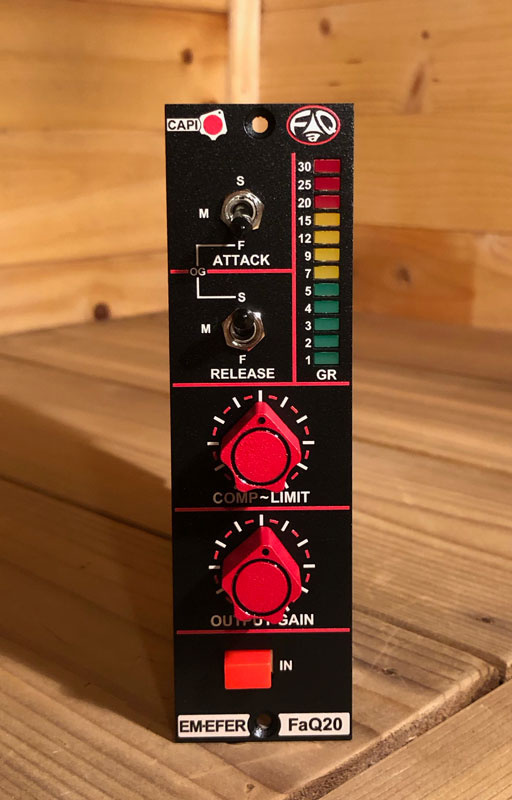
CAPI EM-EFER FaQ20 Compressor
Jeff at CAPI made something very special, once again! Below taken from CAPI’s Website First off, what or who was Melcor? Melcor was a pro audio equipment manufacturer in the mid to late 1960s. They predated API by a handful of years. In fact, rumor has it that product designers and engineers left Melcor to start API with Saul Walker circa 1969 or so. The same folks that designed the Melcor 1731 opamp would then go on to design the API 2520. Besides the opamp, the Melcor CL-20 compressor limiter would morph into the early API 525. The Melcor 2-band GME-20 EQ would transform into the very first API 550 and the Melcor AML27 preamplifier card would become the legendary API 312. Background: After the pleasure in hearing the unique sonic footprint of our FaQ31 and FaQ32 preamps, I set out to create a compressor/limiter in the same sonic family. I reached out to my friend Clarence Jey and paid him a visit in October of 2024. Clarence is the proud owner of the custom 1968 RCA Recording Console originally from RCA Studio A in New York City. Folklore has it the console(s) were designed by Chet Atkins and Les Paul with sister consoles being built for various similar RCA studios around the country. Each console had a bank of 6 compressor/limiters that you could route/bus 1 or more tracks to. These limiters were the Melcor CL-20. At this point, no one had “cloned” the CL-20. There was no known public schematic and original units were very few and far between. Clarence was generous enough to loan me a spare limiter that he had. I quickly got to work reverse engineering the module. It was very apparent the API 525 was a modified improved version the CL-20. In fact, there are pics floating around that show API serial number tags on actual CL-20 modules with a pair of extra pots or switches installed. The OG (original gangster) unit had an unbalanced input and unbalanced output. I took the liberty of adding an OPA134 as a balanced receiver amp. For balancing the output, I chose to use our FaQ-400-17 output transformer. Not being one to just Xerox copy or clone, my goal was to make a more flexible version that still had the general characteristics and tone of the CL-20. Once I familiarized myself with the circuit, I started experimenting with optional attack and release times. The OG module had a very fast attack with a very slow, program dependent release. My guy Joel and I chose a few different time-constants by ear. We then went to a few friend’s studios for listening and made a few more final adjustments finally settling on a some options that just work great. Last thing was the metering. The OG has a vertical analog meter that indeed looks cool AF but from a functionality standpoint, its almost useless. You can tell if you’re tickling the unit or smashing something but not much in between. I wanted metering that was as accurate as I could get it so I created a ground up circuit that does just that. Accurately represents the attack time, release time and dBs of compression to within +/- 0.25dB. This is done with the sidechain’s DC control voltage. IMHO, the CL-20 and 525 are both flawed in that the meter rectifier is completely separate from the sidechain rectifier that creates the FET’s DC control voltage. Changes in attack and release times are not reflected on those meters but they are indeed shown on the FaQ20’s 12 segment LED meter! The FaQ20 was specifically designed with our MEC1731 opamps in circuit. We have never tried other amps so cannot comment on how they might sound. In general, the FaQ20 has a distinctively phat, slow and old sound. Simply glorious. EXTRA Talk of the realgearonline.com They are both FET comp’s but could not be more different. The FETs are in very different locations in the circuit. The FC526 has a FET implemented like an 1176 (and many other FET comp’s). It’s basically a voltage divider in the audio path (like a typical volume pot or fader) that gets controlled by sidechain audio that gets converted and manipulated into a DC control voltage. Johnkenn would call this a “volume monkey”. The FaQ20 has a FET that sits between an opamp’s inverting input and ground. This is the gain control position where every one of our preamps has a “preamp gain” pot or switch with resistors that sit between an opamp’s inverting input and ground. The FET is also controlled by sidechain audio that gets rectified to DC in a pretty different manor than the FC526. ….So pick your flavor. Come with 3 MEC1731 opamps, email us if you like some other opamps. API (and compatible) Lunchbox and VPR500 racking systems. Fully built to perfection in Canada with a 1 year warranty. These can be also build to order.
How AI sees this product
The more complete this product's details, the more confidently AI assistants can understand and recommend it.