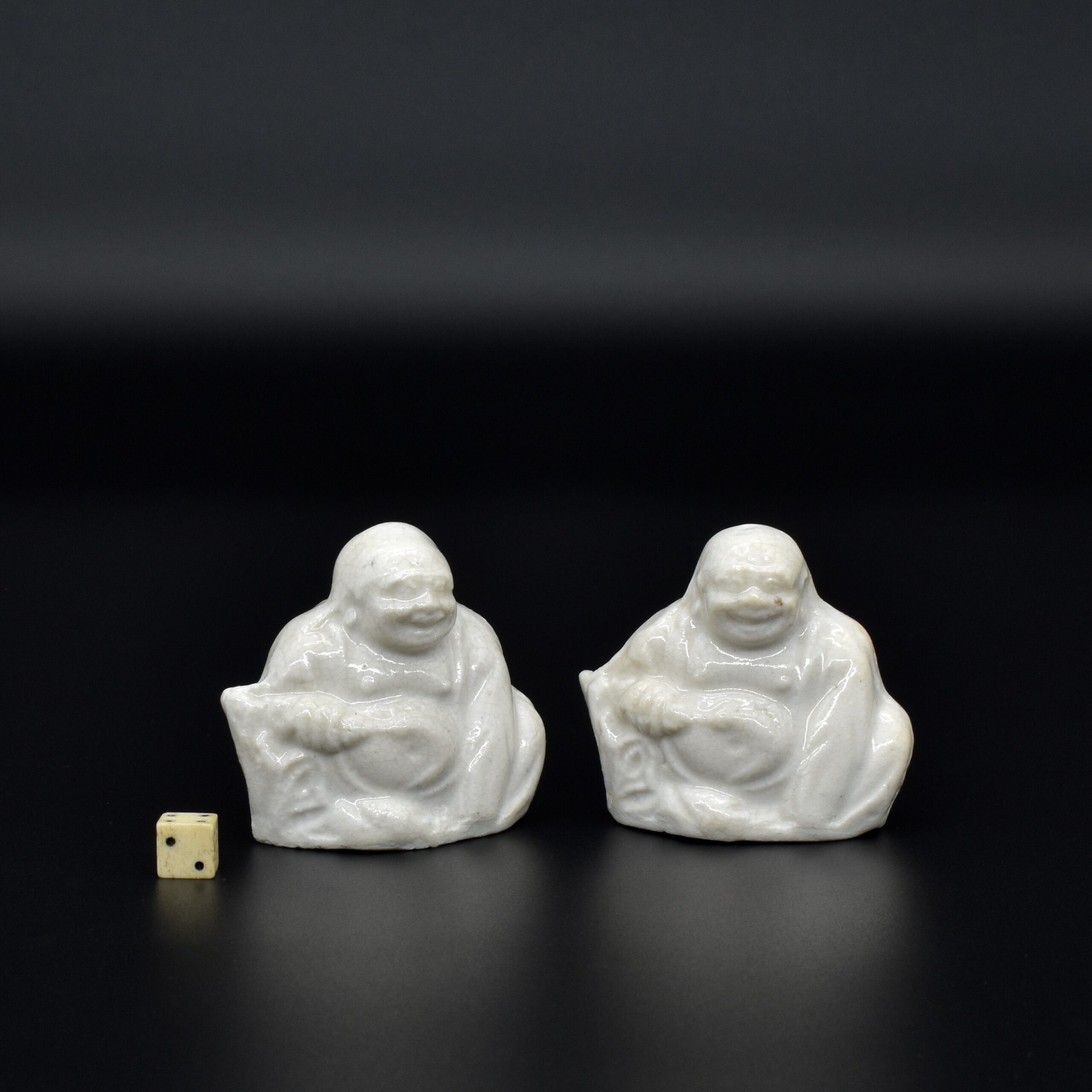
A Pair of Kangxi Blanc de Chine Porcelain Water Droppers in the Form of Budai.
A Pair of Kangxi Blanc de Chine Porcelain Water Droppers in the Form of Budai holding a fly whisk, Dehua Kilns, Fujian Province, China. c.1690-1720. Water droppers were what Chinese scholars used to make ink for writing and painting, the solid hard dried ink would be ground against an ink stone. These were made of a rough gritty stone or a porcelain equivalent. Water was dropped on to make the ink liquid. These are effectively Chinese scholars objects, however large amounts of seemingly Chinese items were sent to England and mainland Europe as exotic foreign curiosities. These are simply mould made with no handwork. They are lightly potted and appear to have been under fired as they have a crazed glaze. The records of the Dashwood, a British trading vessel, were sold in England in the September of 1703, this Supra-cargo, include 10,800 ‘square toys’. These were Blanc de Chine porcelain seals, I have bought and sold many of these over the years. Some are uncut, some have mould seals to the base and could have been used in China, there seals that were engraved, its likely these were not exported. However, the label, ‘square toys’, shows that in Britain they were seen as novelties to show friends and to be on display in cabinets. I’m not sure if the Chinese scholarly class would have approved. Certainly the original English owner of these water droppers would not have known their function or who Budai was. Budai (Hotei in Japanese) is a Chinese deity. His name means `Cloth Sack`, and comes from the bag that he often carries. According to Chinese tradition, Budai was an eccentric Chinese Zen monk who lived during the 10th Century. He is almost always shown smiling or laughing, hence his nickname in Chinese, the Laughing Buddha. In English speaking countries, he is popularly known also as the `Fat Buddha`. In China Porcelain figures such as the present example would have been used in a family shrine while offering prayers, but in the West they would be seen as exotic curiosities, sometimes referred to as Magot or Pagod. The term Magot was used from as early as the mid 17th century to describe the European heavy set or bizarre representations in clay, plaster, copper or porcelain of Chinese or Indian figures. The term is usually used to describe the European porcelain. Pagoda Figure comes from the term pagode or religious figures housed in pagoda shrines. (Kisluk-Grosheide, `The Reign of Magots and Pagods`, Metropolitan Museum Journal 73, 2002, pp. 177, 181, 182, 184). SOLD See Below For More Photographs and Information
AI Readiness
Good foundation, but some important product data is still missing.