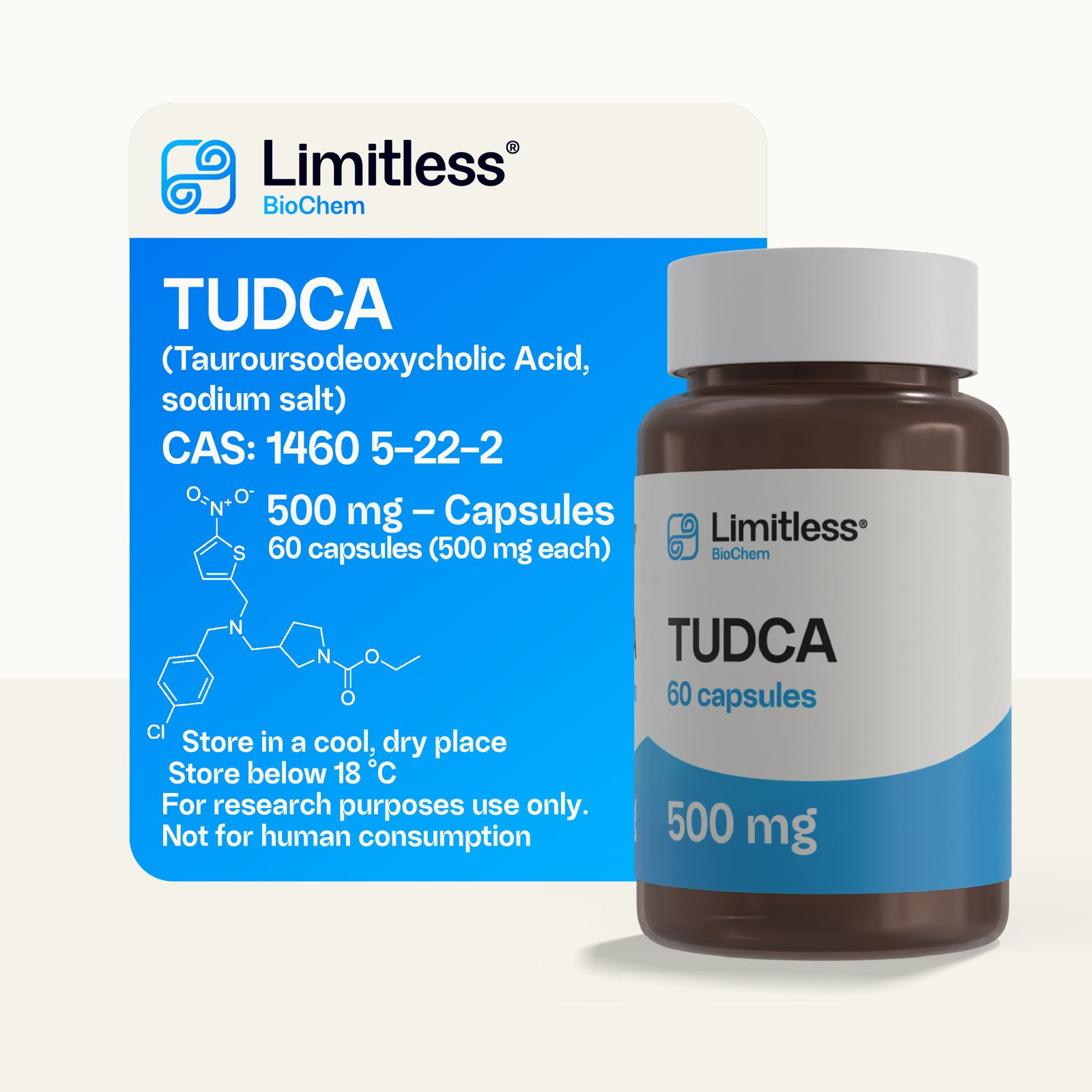
TUDCA 500mg – 60 capsules
TUDCA 500 mg — 60 research capsules. Tauroursodeoxycholic acid is one of the most pharmacologically validated bile-acid chaperones in modern hepatology and cell biology. Approved as a hepatoprotective drug in several jurisdictions and a long-standing first-line cholagogue in traditional Chinese medicine, TUDCA combines two of the rarest properties in molecular pharmacology: an exceptionally clean human safety record dating back decades, and a documented mechanism — endoplasmic-reticulum-stress chaperoning — that places it at the centre of contemporary research on metabolic disease, neurodegeneration and mitochondrial dysfunction. The 500 mg per-capsule potency matches the dose increment most frequently reported in published clinical pharmacology, allowing finer titration across study protocols. RESEARCH USE ONLY · Not for human or veterinary use. For laboratory and collector purposes only. Purity ≥ 99 % (HPLC) — third-party tested, CoA on file Form Research capsules Content 500 mg TUDCA per capsule Total 60 capsules per bottle (30 g total) Packaging Sealed bottle with tamper-evident closure Storage Room temperature, dry, protected from light Molecular formula C₂₆H₄₅NO₆S Molecular weight ≈ 499.70 g·mol⁻¹ IUPAC name 2-{[(3α,5β,7β)-3,7-dihydroxycholan-24-oyl]amino}ethanesulfonic acid CAS number 14605-22-2 Synonyms Tauroursodeoxycholic acid; tauroursodiol; TUDCA Research Overview TUDCA is the taurine-conjugated form of ursodeoxycholic acid (UDCA) — the same hepatoprotective molecule used clinically for primary biliary cholangitis. Mechanistically, TUDCA acts as a chemical chaperone that stabilizes mis-folded proteins in the endoplasmic reticulum, suppresses the unfolded-protein response (PERK/IRE1α/ATF6), and inhibits mitochondrial outer-membrane permeabilization and downstream apoptotic signaling [1,2]. Because ER stress and mitochondrial apoptosis are convergent pathways in obesity, type-2 diabetes, ALS, Huntington’s, Parkinson’s, retinal degeneration and ischemia-reperfusion injury, TUDCA has become a workhorse research tool across these disparate fields [1–3]. In a randomized human study in obese non-diabetic adults, four-week oral TUDCA improved hepatic and muscle insulin sensitivity by ~30 % [3]. Its safety profile across decades of clinical use — well-tolerated even at multi-gram daily doses — is unmatched among bile-acid pharmaceuticals. Primary Research Areas ER stress and unfolded-protein-response (UPR) modulation — the prototype small-molecule chaperone, used as a positive control to interrogate PERK/IRE1α/ATF6 signaling in countless cell-stress models [1]. Hepatic and metabolic research — improves hepatic insulin sensitivity in human RCTs and mitigates steatosis, lipotoxicity and gluconeogenic dysregulation in NAFLD/MASH preclinical models [3]. Mitochondrial cytoprotection and apoptosis — stabilizes mitochondrial membrane potential, prevents cytochrome-c release and inhibits Bax-mediated permeabilization in cardiac, hepatic and neuronal models [2]. Neurodegeneration models — evaluated in ALS, Huntington’s, Parkinson’s, stroke and retinal-degeneration paradigms; Phase II/III data exist for ALS [1,2]. Cholestatic and gallbladder research — the parent application area; well-characterized effects on biliary flow, cholesterol saturation and choleretic kinetics [1]. References Vang S, Longley K, Steer CJ, Low WC. The unexpected uses of urso- and tauroursodeoxycholic acid in the treatment of non-liver diseases. Glob Adv Health Med. 2014;3(3):58–69. Rodrigues CMP, Steer CJ. The therapeutic effects of ursodeoxycholic acid as an anti-apoptotic agent. Expert Opin Investig Drugs. 2001;10(7):1243–1253. Kars M, Yang L, Gregor MF, et al. Tauroursodeoxycholic acid may improve liver and muscle but not adipose tissue insulin sensitivity in obese men and women. Diabetes. 2010;59(8):1899–1905.
How AI sees this product
The more complete this product's details, the more confidently AI assistants can understand and recommend it.