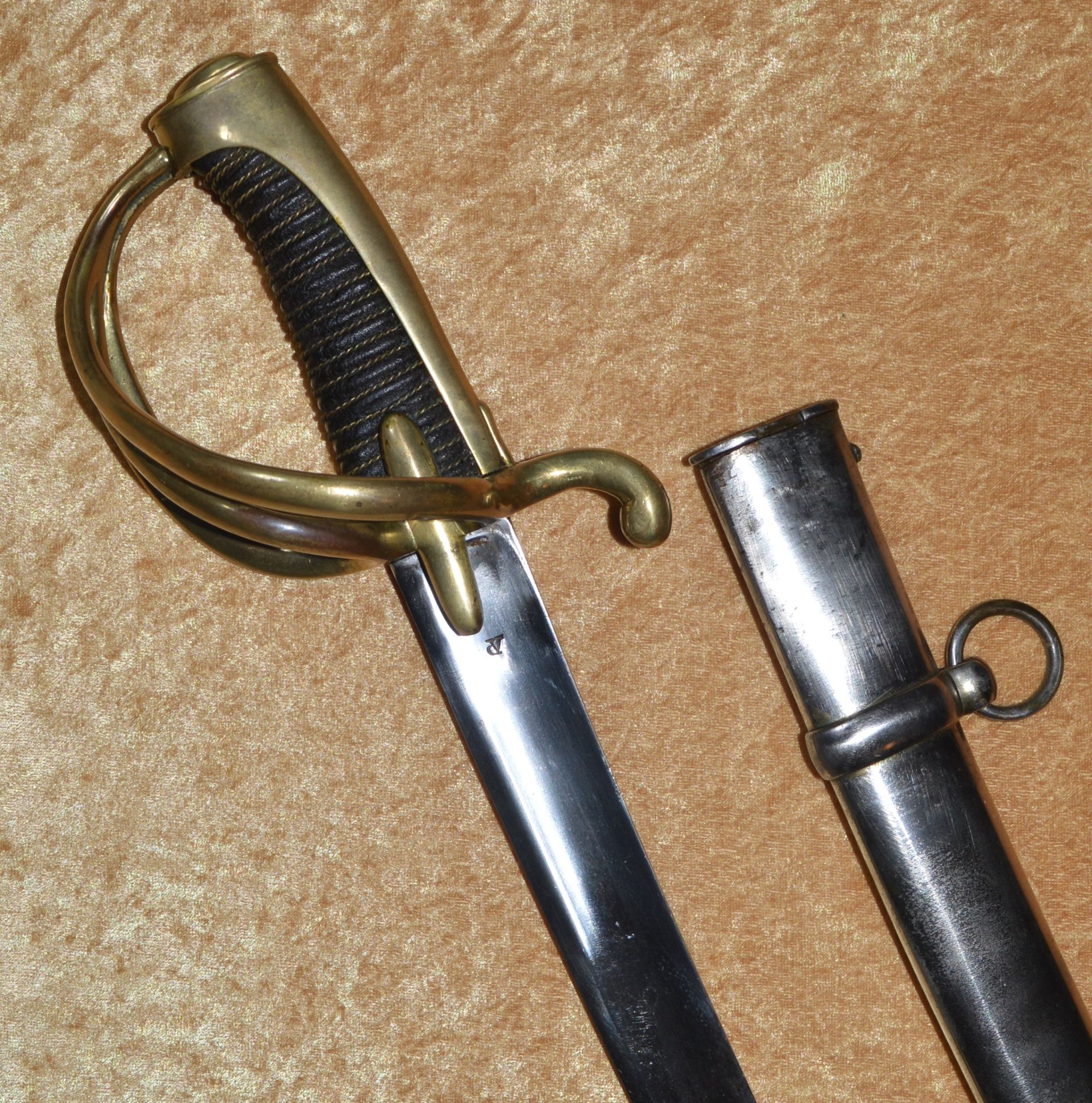
French Napoleonic AN XI Cavalry Trooper’s Saber
Carried by hussars, chasseurs à cheval, and other light cavalry units during the Napoleonic Wars, the AN XI, named according to the French Revolutionary Calendar, was introduced in 1802. It was a more consistent pattern that was more easily mass produced than earlier revolution era examples. Most were made at the Klingenthal Armory and so marked, but when they could not meet the demand, independent sword makers (mostly in Paris) were called upon to make up the difference. These swords are marked “AP”, for “Ateliers de Paris”, or some believe it is for “Atelier de precision”. This example features a 34 5/8″ (88 cm) curved single-edged blade with a single broad fuller running nearly the entire length; deeply stamped “AP” at the forte on one side. Brass hilt of typical style, with knuckle bow stamped with faint poinconne and the number “523″ and joined by two additional bars originating at the quillon block and connecting with the Phrygian helmet style pommel with its integral backstrap. Double lozenge-shaped langets; the grip wrapped with leather and twisted brass wire. Steel scabbard with twin carry rings, one band marked “899″, (or perhaps “668?”) and marked with five hash marks on the top of the throat, corresponding to 5 hash marks on the blade spine where it meets the guard (see photos). Very good plus condition, the metal cleaned bright in the European fashion, with scattered light pitting, the blade with several shallow edge nicks near the tip and minor age staining; scabbard drag shows some wear where it would drag along the ground when carried on foot, as typically found on field-used swords. Overall length 40 1/4″ (102,2 cm), not including scabbard.
AI Readiness
Good foundation, but some important product data is still missing.