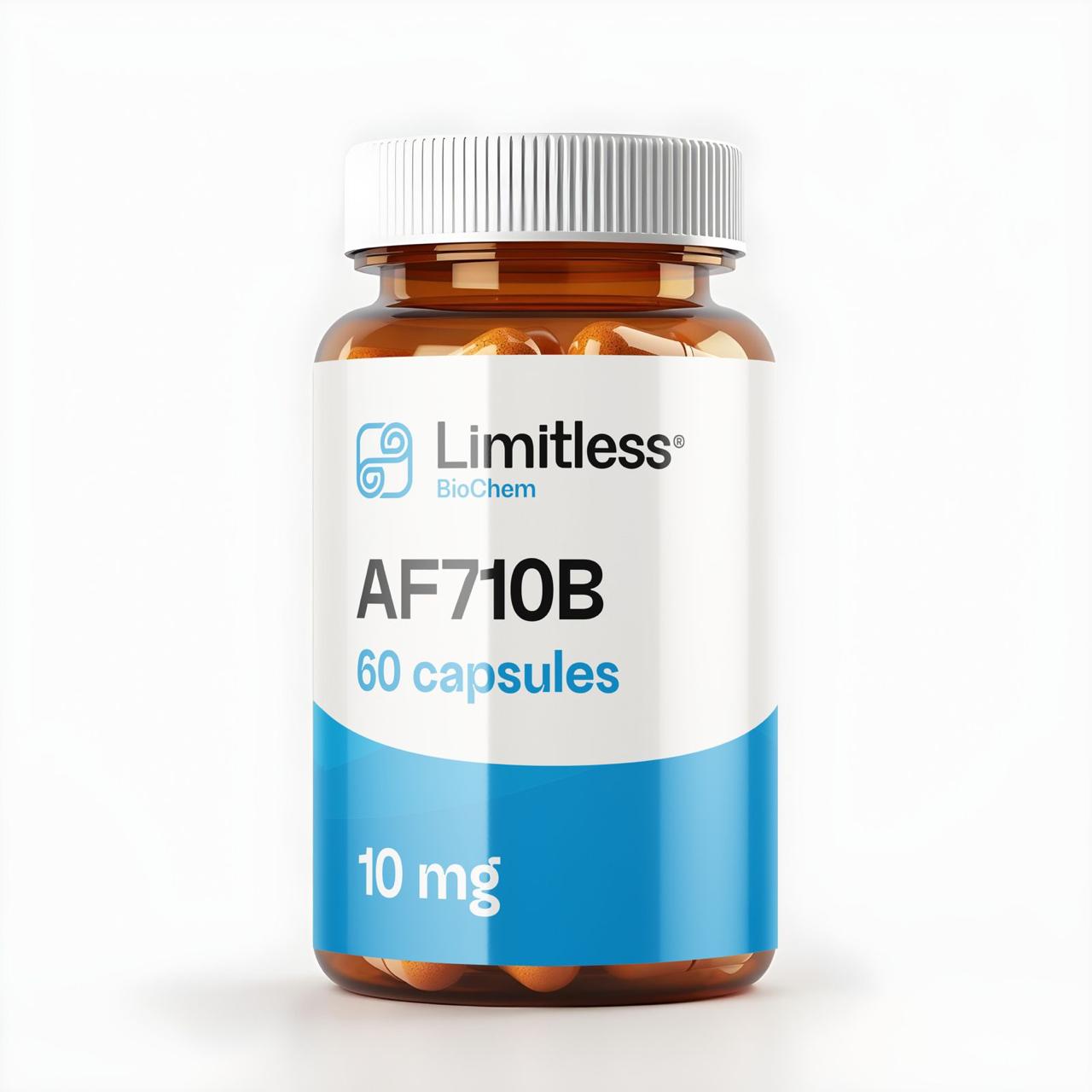
AF710B 10 mg – 60 capsules
AF710B 10 mg — 60 oral research capsules. AF710B (also referenced as ANAVEX 3-71) is a dual-target small molecule that acts as a positive allosteric modulator of the M1 muscarinic acetylcholine receptor and as an agonist at the sigma-1 receptor. Unlike direct muscarinic agonists, it potentiates M1 signalling only where endogenous acetylcholine is already present, which is the basis of the selectivity reported in the published preclinical literature. In animal models of amyloid pathology this dual profile has been characterised alongside markers of synaptic density and neuroinflammation [1,2]. RESEARCH USE ONLY · Not for human or veterinary use. For laboratory and collector purposes only. Purity ≥ 98 % (HPLC) — third-party tested, CoA on file Form Research capsules Content 10 mg AF710B per capsule Total 60 capsules per bottle (600 mg total) Packaging Sealed bottle with tamper-evident closure Storage Room temperature, dry, protected from light Molecular formula C₂₀H₂₇N₃OS Molecular weight ≈ 357.52 g·mol⁻¹ IUPAC / structure 1-(2,8-dimethyl-1-thia-3,8-diazaspiro[4.5]decan-3-yl)-3-(1H-indol-3-yl)propan-1-one CAS number 1235733-73-9 Synonyms AF-710B; ANAVEX 3-71; ANAVEX3-71; M1 PAM / sigma-1 agonist Research Overview AF710B is a spiro-indole small molecule developed as a dual M1 muscarinic / sigma-1 receptor ligand. The M1 receptor is a principal mediator of cholinergic signalling in the cortex and hippocampus, while the sigma-1 receptor is a chaperone protein at the mitochondria-associated endoplasmic reticulum membrane involved in cellular stress responses. Published preclinical work reports that the compound’s effects on amyloid pathology, synaptic markers and cognitive performance in transgenic rodent models depend on activation of both targets together, rather than either one alone [1]. Later work in a transgenic rat model of Alzheimer-like amyloid pathology examined early intervention and cognitive endpoints [2], and human single-ascending-dose research has characterised its pharmacokinetic profile [3]. No therapeutic or clinical claims are made or implied. Primary Research Areas Dual M1 / sigma-1 receptor pharmacology — the defining mechanism — allosteric potentiation at the M1 muscarinic receptor combined with sigma-1 agonism; published work indicates both are required for the observed downstream effects [1]. Amyloid pathology models — studied in transgenic rat and mouse models for effects on amyloid plaque accumulation and related markers of pathology [1,2,3]. Synaptic density and neuroinflammatory markers — preclinical reports describe changes in synaptic spine density and glial markers in amyloid-pathology rodent models [1,2,3,7]. Rodent cognitive-behavioural assays — applied in scopolamine-reversal and transgenic-model cognitive tasks to probe M1 and sigma-1 contributions to learning and memory [1,2,3]. Early-phase pharmacokinetic characterisation — population pharmacokinetics and food-effect analysis described in single-ascending-dose human research [4]. Heart rhythm in people — volunteers took doses of 5 to 200 mg with no meaningful change in heart rate or the PR, QRS and QT intervals. An effect on QTc bigger than 10 milliseconds could be ruled out. It was one dose in healthy young adults, so it says nothing about daily use or anyone on heart medication [5]. Tau as well as amyloid — female triple-transgenic Alzheimer mice given 10 micrograms per kilogram daily for two months had less tau pathology and lower activity of the enzymes behind it – BACE1, GSK3-beta and p25/CDK5 – alongside the falls in amyloid. This is mice, and no tau measurement has been reported in a person [1]. The benefit outlasted the last dose — transgenic rats treated by mouth and then taken off the drug kept their memory improvement and their reduced amyloid five weeks later. A second study ran seven months, then four weeks off, and the animals still avoided the cognitive decline their untreated littermates had. Both results are in rats, with nothing comparable in people [2,3]. More cell energy, more free radicals — tested on mouse brain mitochondria, the compound raised respiratory complex I activity and with it reactive oxygen species output in healthy tissue, while cutting the radical surge and complex I and IV failure caused by amyloid-beta. So it is mildly pro-oxidant in undamaged tissue, and this was isolated mitochondria, not a living animal [6]. The doses that worked were tiny — every animal result came from micrograms per kilogram, not milligrams: 1 to 30 by mouth in the rat memory work, and 10 a day in the long transgenic-rat studies. Scaled across, that is under a milligram for a 70 kilogram adult, while the human study ran from 5 mg to 200 mg [1,2,5]. BDNF matured properly again — in the seven-month prevention study the treated rats regained the ability to convert the BDNF precursor protein into its mature, active form, which the untreated animals had lost. One study, one rat strain, and it is a tissue measurement rather than anything a person would feel [3]. References Fisher A, Bezprozvanny I, Wu L, et al. AF710B, a Novel M1/σ1 Agonist with Therapeutic Efficacy in Animal Models of Alzheimer’s Disease. Neurodegener Dis. 2016;16(1-2):95-110. PMID 26606130. doi:10.1159/000440864 Hall H, Iulita MF, Gubert P, et al. AF710B, an M1/sigma-1 receptor agonist with long-lasting disease-modifying properties in a transgenic rat model of Alzheimer’s disease. Alzheimers Dement. 2018;14(6):811-823. PMID 29291374. doi:10.1016/j.jalz.2017.11.009 Orciani C, Do Carmo S, Foret MK, et al. Early treatment with an M1 and sigma-1 receptor agonist prevents cognitive decline in a transgenic rat model displaying Alzheimer-like amyloid pathology. Neurobiol Aging. 2023;132:220-232. PMID 37864952. doi:10.1016/j.neurobiolaging.2023.09.010 Fadiran EO, Hammond E, Tran J, et al. Population-Based Characterization of the Pharmacokinetics and Food Effect of ANAVEX3-71, a Novel Sigma-1 Receptor and Allosteric M1 Muscarinic Receptor Agonist in Development for Treatment of Frontotemporal Dementia, Schizophrenia, and Alzheimer Disease. Clin Pharmacol Drug Dev. 2024;13(1):21-31. PMID 38073274. doi:10.1002/cpdd.1323 Fadiran EO, Hammond E, Tran J, et al. Concentration-QTc Relationship from a Single Ascending Dose Study of ANAVEX3-71, a Novel Sigma-1 Receptor and Allosteric M1 Muscarinic Receptor Agonist in Development for the Treatment of Frontotemporal Dementia, Schizophrenia, and Alzheimer’s Disease. Clin Pharmacol Drug Dev. 2023;12(9):888-901. PMID 37515316. doi:10.1002/cpdd.1303 Goguadze N, Zhuravliova E, Morin D, et al. Sigma-1 Receptor Agonists Induce Oxidative Stress in Mitochondria and Enhance Complex I Activity in Physiological Condition but Protect Against Pathological Oxidative Stress. Neurotox Res. 2019;35(1):1-18. PMID 29127580. doi:10.1007/s12640-017-9838-2 Ryskamp D, Wu L, Wu J, et al. Pridopidine stabilizes mushroom spines in mouse models of Alzheimer’s disease by acting on the sigma-1 receptor. Neurobiol Dis. 2019;124:489-504. PMID 30594810. doi:10.1016/j.nbd.2018.12.022
How AI sees this product
The more complete this product's details, the more confidently AI assistants can understand and recommend it.