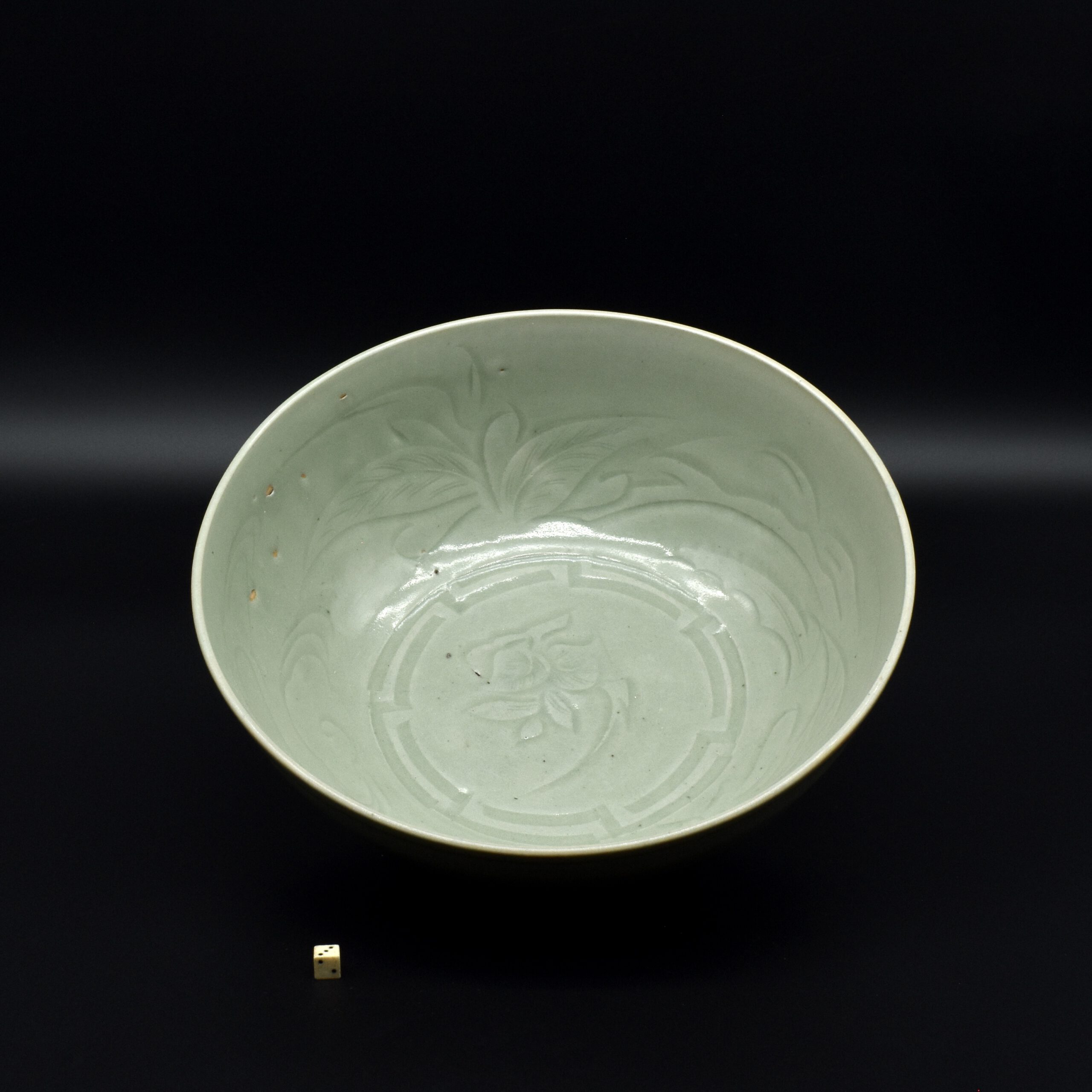
A Large Carved 17th Century Japanese Celadon Bowl.
A Large Carved 17th Century Japanese Celadon or Seiji Bowl, Probably Hasami Kiln, Fudōyama kilns or Maruo kilns, Japan c.1650 – 1680. Japanese celadon ware was made at several kilns, the most well known was the Hasami Kiln, it seems that in Japan they sometimes refer to their celadon ware as ‘Hasami ware’. The present bowl has a very distinctive carved pattern to the well, this design is often found on large pieces of Japanese celadon. A large celadon porcelain dish fragment with this border was recovered from the Fudōyama kiln site. See The Early Kilns of Japan, Arita in the First Half of the Seventeenth Century in ‘References’ below. It is probable that this distinctive border was made at all three of the aforementioned Japanese celadon kilns. A very small number of Japanese celadon ware was exported to Indonesia and the Dutch Republic, but most pieces were made for the domestic market. This large deep heavy Seiji (celadon) bowl is typical of ‘Hasami ware’, however the base replicates those found on Chinese Longquan celadon. A wide circular ring is clearly visible on the base it is a rusty red-brown colour due to a thin layer of high iron-oxide (around 3 to 5%) glaze has been added. As well as being an acknowledgement, or tribute to the potters of Longquan in China, it also serves a practical function. A a thin circular kiln support was used, it is visible as a thin white line within the iron-oxide glaze wash. The carved and incised decoration shows two leafy plants, perhaps banana, in a landscape. SALE PENDING See Below For More Photographs and Information
How AI sees this product
The more complete this product's details, the more confidently AI assistants can understand and recommend it.