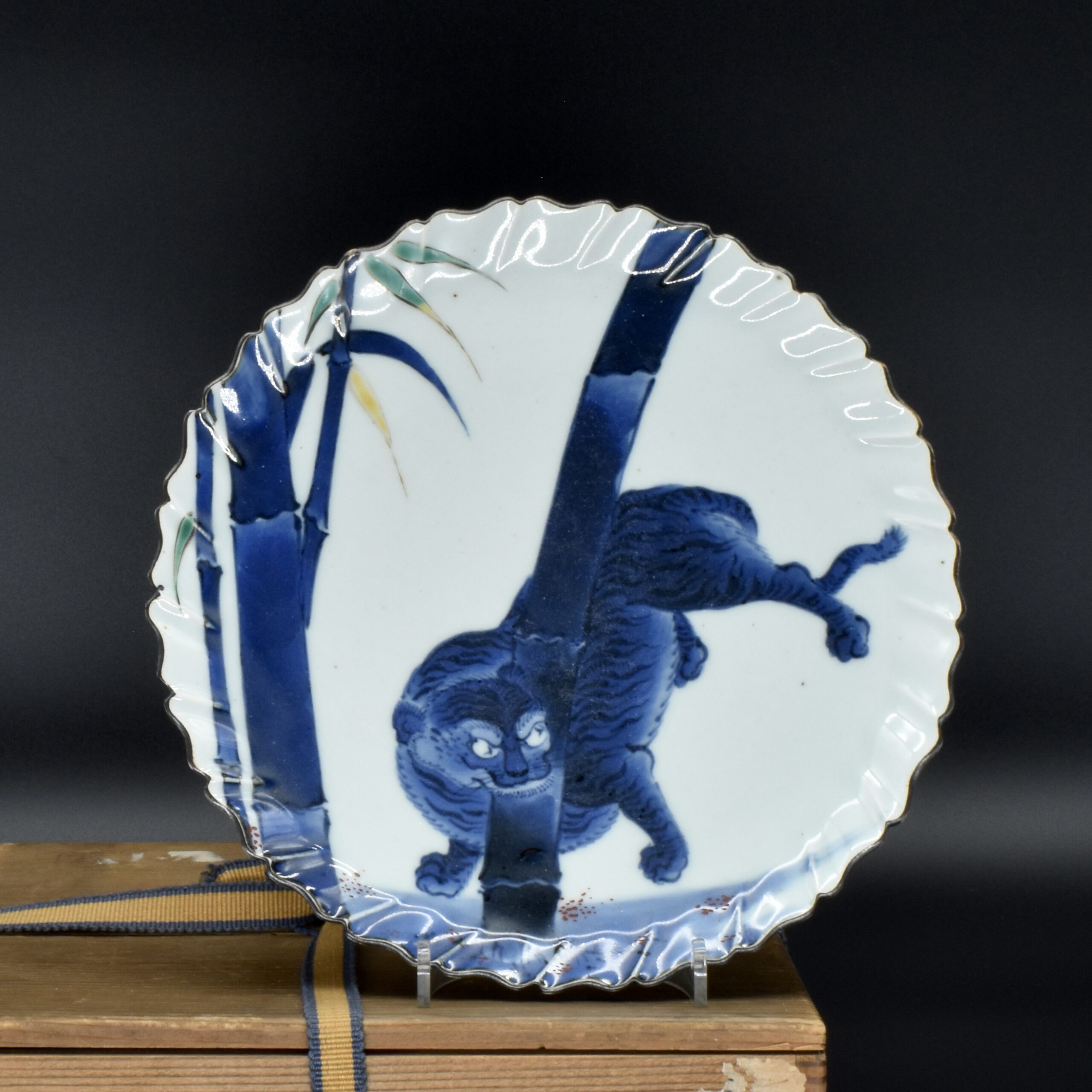
A Rare Mid-17th Century Japanese Porcelain Tiger Dish
A Rare 17th Century Japanese Porcelain Tiger Dish, Arita Kilns c.1660 – 1670. This mould made plate is thinly potted and has an iron brown rim. Tigers represent Yin, the female side of Yin and Yang. This striking design is of a large menasing female tiger, with her head wrapped around a substantial bamboo stem, with further bamboo to the left. The design is bold and strong, with the horizontal lines of the bamboo adding energy. This Arita dish is painted in exceptionally strong tones of cobalt blue, looking closely, you can see the details aren’t visible at first, due to tone of blue being similar for the details and the tonal washes. The well crafted, rather thinly potted dish was made with the help of a mould. The gently raised ribbed sides with foliate edge is a feature that was perhaps taken from a lacquer or metal form. The date of this dish is likely to be from the period of 1660 to 1670, according to moulded dishes in the Shibata collection (not this design), the earliest version of this shape is dated to c.1655. Two examples of dishes of this shape and design in the Toguri Museum have been dated to the second half of the 17th century, the example in the Gardiner Museum is dated to c.1650. I’ve not been able to find an example with enamel decoration. It’s likely the enamels are Japanese from 17th century, or perhaps early 18th century. The type of painting and enamels used are too restrained to be 18th century Dutch decoration, they would have added more decoration. The shape of the bamboo leaves is well observed, the yellowing of the leaf ends shows a familiarity with this plant, another reason to rule out European decoration. For an example of a Japanese Kakiemon style porcelain dish, of a design and shape that was produced with and without the overglaze colours, see below the ‘Picture Gallery’. The flat rim is dressed with an iron-oxide enamel, called 口紅 Fuchibeni in Japanese, meaning lipstick. It was used to frame ceramic designs but it also adds some strength to the fragile rim, as well as showing that the rim was not chipped. The word Fuchibeni, comes from kuchi meaning mouth and beni meaning red/safflower red. SOLD See Below For More Photographs and Information
AI Readiness
Good foundation, but some important product data is still missing.